NetSuite outsourced accounting can be a practical choice for businesses that need skilled finance staff, clear reports, and well-kept books without building a large in-house accounting team. As a business grows, daily finance work can become harder to manage, from bank checks and bill payments to payroll, tax records, and monthly reports.
NetSuite is an ERP system that brings key finance tasks into one platform. However, owning the software does not mean a business has the right staff or time to manage every task. NetSuite outsourced accounting gives businesses access to trained accounting staff who can manage agreed finance tasks within the system.
The main question is not whether a business should outsource all its accounts. It is whether the cost of an outside team is lower than the cost and risk of doing the same work in-house. The answer depends on business size, transaction volume, staff costs, reporting needs, and how effectively NetSuite accounting solutions can meet the company’s financial management requirements.
What You Will Learn From This Blog
- How NetSuite outsourced accounting works and which tasks an outside team can manage.
- Which finance issues can lead a business to consider outsourcing.
- How to assess the cost of an in-house team against an outsourced model.
- What to check before hiring a NetSuite accounting service provider.
- How to choose NetSuite accounting solutions that fit your business needs and budget.
- When outsourcing can offer better value than hiring more full-time staff.
What Is NetSuite Outsourced Accounting and How Does It Work?
NetSuite outsourced accounting is a service model in which an outside accounting team manages selected finance tasks within a business’s NetSuite account. NetSuite accounting solutions allow businesses to retain ownership of their system and financial data, while providers work under agreed roles, access rules, and review steps.
NetSuite as the Main Accounting System
NetSuite accounting solutions bring sales, bills, payments, expenses, journal entries, and financial reports into one system. This gives the finance team a shared view of business activity and reduces the need to maintain separate records for each task.
Setting Up the Scope of Work
The business and provider first agree on the tasks to be handled, such as bookkeeping, bank reconciliation, accounts payable, or monthly reports. Clear task lists also set out who approves payments, reviews entries, and handles unusual transactions.
Giving Role-Based System Access
The business grants each team member access based on their work. For example, a bookkeeper may record bills, while a manager approves payments. This keeps key duties separate and limits access to sensitive records.
Recording and Checking Transactions
The outsourced team enters or reviews daily transactions, checks supporting documents, and matches bank activity with the financial data in NetSuite. Any missing invoice, unclear payment, or unmatched entry is raised for review rather than being treated as correct.
Preparing Reports and Closing Accounts
At the end of each month, the team checks account balances, posts approved entries, and prepares reports such as the profit and loss statement and balance sheet. The business can then review its results and take action based on the figures.
optional anymore
on running the business
What Business Challenges Can NetSuite Outsourced Accounting Address?
As transaction volumes rise, finance work can take more time than a small team can spare. NetSuite outsourced accounting can address some of these issues by assigning routine work to staff with relevant system and accounting skills.
Delayed Monthly Financial Reports
When bills, sales, and bank entries remain unchecked, month-end reports may be late or incomplete. A defined close process gives each task a due date and a named person, so the business can review its results on time.
Rising In-House Staff Costs
Hiring an accountant involves more than a monthly salary. Recruitment, training, software access, leave cover, and staff benefits also add to the cost. Outsourcing can reduce the need to hire for every new finance task.
Errors in Manual Data Entry
Repeated data entry can lead to wrong amounts, duplicate bills, or entries posted to the wrong account. A trained team can use set review steps and account checks to find such errors before reports are issued.
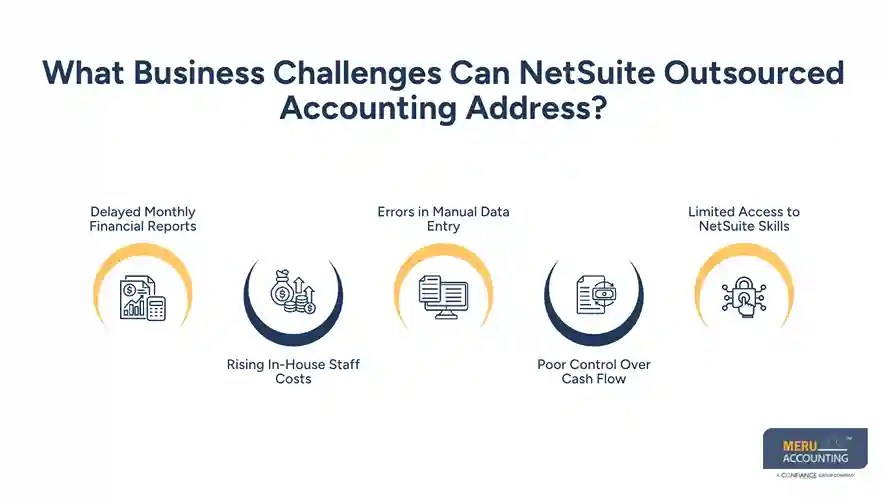
Poor Control Over Cash Flow
Late bill entry or weak tracking of customer dues can make cash needs hard to predict. Regular accounts payable and receivable reports give owners a clearer view of what is due, what is unpaid, and when cash may be needed.
Limited Access to NetSuite Skills
A business may own NetSuite but lack staff who know how to use its finance tools well. An outside team with relevant system experience can provide NetSuite accounting solutions for agreed finance tasks without the business hiring a full-time NetSuite specialist.
What Accounting Functions Can Businesses Outsource Through NetSuite?
The tasks covered by NetSuite outsourced accounting depend on the business’s needs, system setup, and service agreement. Some firms outsource only routine entries, while others assign a wider set of finance tasks to an outside team.
Bookkeeping and General Ledger
The team records sales, costs, bills, receipts, and approved journal entries in the right accounts. It can also review ledger balances and flag entries that need more detail or approval.
Accounts Payable
The provider uses NetSuite accounting solutions to record supplier bills, check invoice details, track due dates, and prepare payment lists. The business should retain approval rights for payments and set clear limits for each authorised user.
Accounts Receivable
The team records customer invoices, tracks open balances, and matches receipts against dues. Ageing reports can show which customers have overdue bills and where follow-up is needed.
Bank and Account Reconciliation
Bank, credit card, and other account balances are checked against the entries in NetSuite. Unmatched items are listed for review so that errors, missing entries, and old balances do not remain unnoticed.
Payroll and Expense Records
An outside team may record payroll entries, staff costs, and approved expense claims. Payroll tax rules differ by location, so the provider must know the rules that apply to the business and its staff.
Financial Reporting and Month-End Close
The team can prepare profit and loss statements, balance sheets, cash flow reports, and account schedules. Business owners should agree on the report format, review dates, and the person responsible for final approval.
How Much Can Businesses Save With NetSuite Outsourced Accounting?
The cost of NetSuite outsourced accounting varies with transaction volume, the number of entities, the tasks assigned, reporting needs, and the level of review required. There is no single savings rate that applies to every business.
Compare the Full Cost of In-House Staff
An in-house accountant’s cost includes salary, employer taxes, benefits, recruitment, training, leave cover, and software-related costs. A fair comparison must include these items rather than comparing the provider’s fee with salary alone.
Review the Outsourcing Fee
Ask the provider for a written fee based on the exact work to be done. Check whether the price covers monthly close, account reconciliation, report preparation, and the NetSuite accounting solutions required to manage additional tasks during busy periods.
Check the Cost of NetSuite Access
NetSuite subscription fees, user access, add-on modules, and system changes may remain separate from the accounting service fee. Confirm which costs are already part of your current setup and which may rise after outsourcing.
Measure Time Saved by the Internal Team
If managers spend hours checking bills or fixing entries, outsourcing may free time for sales, stock, customer service, and planning. Put a value on the hours saved and compare it with the provider’s fee.
Check the Cost of Errors and Late Reports
Wrong entries, missed bills, and late account reviews can lead to poor decisions or extra work. A sound review process can reduce these risks, but the business should still track error rates and report delays.
Review the Results After Three to Six Months
Compare the old and new costs after the service has run for a few months. Review report dates, open issues, error rates, staff time, and the total monthly fee before deciding whether the arrangement offers value.
How to Choose the Right NetSuite Outsourced Accounting Provider
Choosing a provider requires more than checking its fee or claim of NetSuite experience. The business should review its accounting skills, system knowledge, data controls, and ability to meet agreed deadlines.
Check NetSuite Experience
Ask which NetSuite accounting solutions the team has handled and what types of businesses it has served. Request examples of similar work, without asking the provider to share another client’s private data.
Review Accounting Skills
The team handling NetSuite outsourced accounting should know core accounting rules, account reconciliation, month-end close, and financial reporting. For tax or payroll work, check that the assigned staff have the right knowledge of the relevant local rules.
Ask About Data Security
Check how the provider controls user access, stores records, handles staff changes, and reports a data breach. Use separate user accounts, strict sign-in rules, and access levels based on each person’s role.
Set Clear Service Levels
The agreement should state the tasks covered, report dates, response times, review steps, and the person who handles queries. It should also explain how extra work, delays, and errors will be managed.
Check the Review and Approval Process
Ask who checks journal entries, reconciliations, and reports before they are sent to management. Payment approval, vendor changes, and bank detail updates should have clear checks and should not rest with one person.
Confirm Exit and Data Ownership Terms
The business should retain ownership of its financial data and have a clear way to regain access if the contract ends. Check how records, workpapers, open tasks, and user access will be handled during the handover.
Why Choose Meru Accounting for NetSuite Outsourced Accounting?
Meru Accounting provides accounting and bookkeeping services for businesses that need clear records and regular finance reports. Its service areas include accounts payable, accounts receivable, payroll, bank reconciliation, and financial reporting.
For businesses using NetSuite, the scope of work should be set around the system setup, transaction volume, and reporting needs. We place emphasis on clear task ownership, regular account checks, and review steps that keep finance work organised.
Our team can discuss the accounting tasks that a business wants to outsource and define the work, reporting cycle, and approval process before service delivery begins. Businesses should confirm the team’s current NetSuite experience, system access needs, and service scope before assigning work.
Key Takeaways
- NetSuite outsourced accounting gives businesses access to an outside team for selected finance tasks within NetSuite.
- The service can cover bookkeeping, accounts payable, accounts receivable, reconciliation, payroll entries, and financial reports.
- Outsourcing may cost less than hiring a full in-house team, but savings depend on the work scope and total costs.
- Businesses should keep control of payment approvals, system access, and key finance decisions.
- NetSuite accounting solutions work best when system setup, staff roles, and reporting needs are clear.
- A written service agreement should cover data access, review steps, fees, deadlines, and exit terms.
FAQs
NetSuite outsourced accounting allows businesses to hire an external accounting team to manage bookkeeping, bill payments, bank reconciliation, and financial reports within NetSuite.
A business should consider outsourcing when its finance workload grows, reports are delayed, in-house staff costs rise, or it lacks skilled NetSuite accounting staff.
The cost depends on transaction volume, number of users and entities, accounting tasks, reporting needs, and the provider’s monthly service fee.
Common services include bookkeeping, accounts payable, accounts receivable, payroll entries, bank reconciliation, general ledger management, and monthly financial reporting.
Choose a provider with proven NetSuite experience, qualified accounting staff, clear pricing, strong data security, defined service terms, and regular reporting.
optional anymore
on running the business