
Reconciliation in accounting helps verify that financial records are accurate, complete, and aligned with supporting documents. It is a core accounting control used to compare records, identify differences, and correct errors before they affect reporting. Understanding the types of reconciliation in accounting helps businesses apply the right control to each financial area.
Businesses use the accounting reconciliation process to confirm transactions, improve accuracy, and reduce the risk of fraud. Whether performed manually or through automation, reconciliation in bookkeeping supports stronger financial management.
The different types of reconciliation in accounting are important because even small differences between records can lead to reporting issues, compliance problems, or cash flow confusion. Regular reconciliation helps businesses maintain confidence in their financial information.
What You Will Learn From This Blog
By reading this blog, you will learn:
- What reconciliation in accounting means
- Different types of reconciliation in accounting
- How account reconciliation is performed
- Why reconciliation helps accuracy and fraud prevention
- How businesses use reconciliation to strengthen controls
This guide is easy to follow but useful for both new and experienced business owners.
What is Reconciliation in Accounting?
We decided to look at some of the pillars of the accounting profession while working with former accountants who now work at FloQast.
Accounting reconciliation is the most crucial step in ensuring that the figures in your financial records are correct. But here’s the thing: Reconciliation isn’t something you’ll learn in accounting school. The majority of people learn it on the job, if at all. It’s entirely feasible to have a successful accounting career without ever performing a single reconciliation. Learning the types of reconciliation in accounting helps explain why different accounts require different review procedures.
What is Reconciliation accounting and how Does It Work?
Account reconciliation is defined as “an accounting process that compares two sets of records to confirm that statistics are valid and in agreement,” according to Investopedia. Account reconciliation also ensures that the general ledger accounts are accurate, consistent, and complete.” These principles form the basis for the major types of reconciliation in accounting used by businesses.
Comparing two sets of records may not appear to be a particularly thrilling process. However, it is an essential part of the closure process for assuring the accuracy of a company’s financial accounts. Reconciliation is a significant aspect of professional bookkeeping for organizations that outsource their accounting.
Role of Reconciliation in Accounting
Error Detection
Reconciliation helps detect posting mistakes, duplicate entries, missed transactions, and other inconsistencies before they create reporting problems.
Fraud Prevention
Regular reconciliation can uncover unusual activity and unauthorized transactions that may otherwise go unnoticed.
Financial Accuracy
It helps make sure balances reported in the books match supporting records and actual account activity.
Internal Control Support
Reconciliation strengthens internal controls by creating a verification process separate from transaction recording.
Regulatory Compliance
Accurate reconciliations support tax compliance, audit readiness, and financial reporting requirements.
Cash Flow Verification
Reconciling accounts helps businesses confirm actual cash availability and manage liquidity better.
Audit Readiness
Strong reconciliation procedures make audits smoother by supporting balances with documented evidence.
Types of Reconciliation in Accounting
Bank account reconciliation
The most common type of reconciliation, this one needs businesses to reconcile their cash position by comparing the value of recorded bank transactions in their accounting software to those on their monthly bank statements. This is one of the most common types of reconciliation in accounting.
Reconciliation of vendors
Vendor reconciliations match the balance owing on supplier statements to the payable ledger’s transactions and overall balance. It is among the core types of reconciliation in accounting used for payables control.
Customer reconciliation
Businesses that offer credit terms to their clients do customer reconciliations.
Reconciliation between companies
Companies that are part of a larger group perform intercompany reconciliations. The parent firm can develop accurate consolidated accounting by doing intercompany reconciliations.
Reconciliation specific to a business
These are one-of-a-kind and pertain to the specifics of each company. Companies that sell goods, for example, must undertake a stock take to guarantee that the inventory value on the balance sheet appropriately reflects the worth of commodities stored.
General Ledger Reconciliation
General ledger reconciliation compares account balances in the ledger against supporting schedules or outside records to verify accuracy. Among all types of reconciliation in accounting, this often supports month end close accuracy.
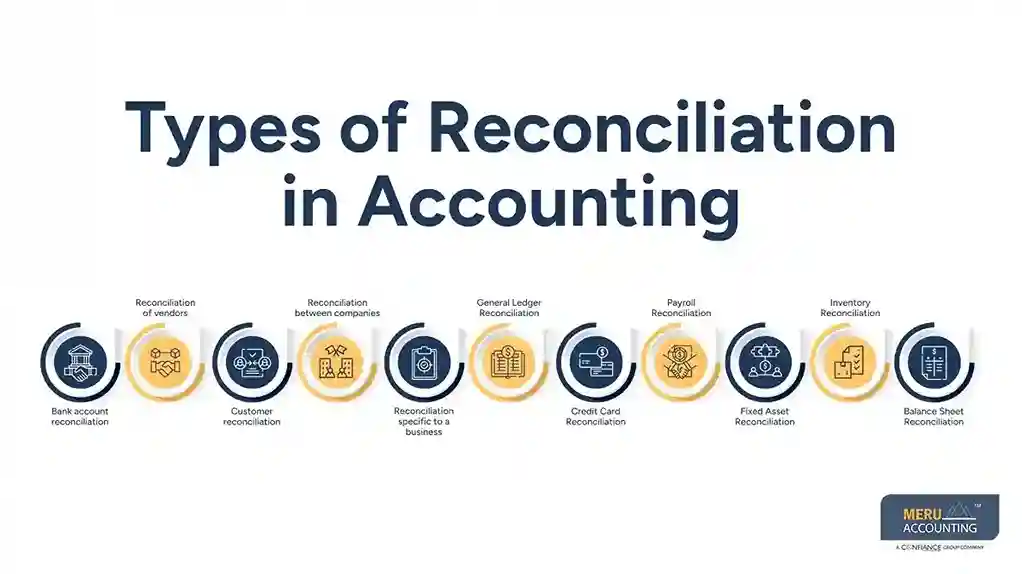
Credit Card Reconciliation
This reconciliation compares business credit card statements with recorded expenses to confirm all charges are accounted for.
Payroll Reconciliation
Payroll reconciliation verifies wages, taxes, deductions, and payroll liabilities against payroll reports and accounting records.
Fixed Asset Reconciliation
Businesses use this to verify asset values, depreciation, and fixed asset records.
Inventory Reconciliation
Inventory reconciliation confirms recorded inventory matches physical counts and valuation records.
Balance Sheet Reconciliation
This process validates balance sheet accounts such as receivables, payables, accruals, and liabilities. This is one of the more advanced types of reconciliation in accounting.
How it is done?
Let’s take a step back and consider the who, what, and when of account reconciliations before we get started. The process may vary depending on the types of reconciliation in accounting being performed. The value of products in storage is appropriately represented on the balance sheet.
Who: The best person is someone who is familiar with the types of transactions that pass through an account but isn’t the one who keeps track of them. Aside from the internal control element of segregating the recording and reconciling duties, a fresh pair of eyes is the greatest approach to spot errors.
What: Any balance sheet account with a significant balance should be reconciled regularly. This applies across multiple types of reconciliation in accounting.Autoren and similar tools make reconciliation so simple that every account may be reconciled in a matter of minutes — and some of it can be done automatically.
When: Reconciliation may be required monthly, weekly, or even daily, depending on transaction volume. Monthly reconciliations should be completed as quickly as practicable after the completion of the accounting period.
Check that the opening balances agree
Record the difference of the closing balances
Mark off all-new activity from the external document
Review the closing balance and, if necessary, produces a reconciliation report
Why Reconciliation Accounting Is Different From Basic Bookkeeping
Bookkeeping records financial transactions as they happen. Reconciliation goes a step further by verifying those records against independent sources.
While bookkeeping focuses on recording activity, reconciliation focuses on validation. This control function helps businesses catch issues that ordinary transaction recording may miss.
As businesses grow, formal reconciliation procedures become increasingly important for reliable reporting and stronger financial controls.
Why Businesses Need Regular Account Reconciliation
Regular account reconciliation helps businesses:
- Prevent reporting errors
- Improve audit preparedness
- Support tax accuracy
- Reduce fraud risks
- Improve cash management
- Strengthen decision making
Businesses that reconcile regularly often have cleaner books, better reporting, and stronger financial controls.
Choosing the Right Reconciliation Method for Your Business
Choosing among types of reconciliation in accounting depends on:
- Transaction volume
- Industry requirements
- Frequency of account activity
- Manual versus automated processes
- Internal control needs
Some businesses may only need monthly reconciliations, while others may require weekly or even daily processes. Using the right method improves efficiency and reduces risk.
Meru Accounting’s Reconciliation Services
Managing reconciliations can be time consuming. Meru Accounting makes it simple. Our team helps businesses maintain accurate records, reduce errors, and improve control. We support multiple types of reconciliation in accounting for growing businesses.
We offer:
- Bank Reconciliations: Verify bank balances, deposits, withdrawals, and cash activity accurately.
- Vendor and Customer Reconciliations: Match receivables and payables to supporting records.
- Balance Sheet Reconciliations: Review account balances and supporting schedules.
- Month End Reconciliation Support: Help businesses close books accurately and on time.
- Automated Reconciliation Support: Use technology to improve speed and consistency.
- Error Investigation and Cleanup: Identify discrepancies and resolve historical issues.
With Meru Accounting, businesses can focus on growth while experts handle the reconciliation process.
What’s the need for reconciliation?
Accounting reconciliation is a critical activity for both firms and individuals since it allows them to check for fraudulent behavior and avoid financial statement inaccuracies. As part of standard accounting operations, reconciliation is usually performed at regular periods, such as monthly or quarterly.
The accounting procedure of reconciliation ensures that the actual amount spent matches the amount shown leaving an account at the end of a fiscal period.
Individuals and businesses do reconciliation regularly to look for mistakes or fraudulent behavior.
Industry Insight
Accounting guidance from the Financial Accounting Standards Board and internal control principles supported by the American Institute of Certified Public Accountants reinforce the importance of reconciliations as part of sound financial management.
Key Takeaways
- Reconciliation confirms financial accuracy.
- Multiple reconciliation types serve different purposes.
- Regular reconciliation reduces fraud risks.
- Automation can simplify the reconciliation process.
- Professional support improves control and reporting.
- Using reconciliation helps businesses operate more reliably and profitably.