
Law accounting plays a major role in helping law firms stay financially organized, compliant, and profitable. As firms face growing client demands, strict trust accounting rules, complex billing structures, and rising operating costs, managing accounting internally can become more challenging.
Strong law bookkeeping and accounting support accurate records, compliance, cash flow management, and better financial control. For many firms, outsourcing has become a practical solution. Professional law firm and legal accounting support can improve accuracy, reduce compliance risks, strengthen billing and trust account management, and lower overhead costs.
This blog explains why outsourcing law bookkeeping and accounting is becoming a smart move for law firms looking to improve efficiency and support long-term growth.
What You Will Learn From This Blog
- How law accounting supports daily law firm operations
- Why are more firms outsourcing accounting functions
- Common financial challenges outsourcing can help solve
- How outsourced support improves compliance and trust in accounting
- Ways law bookkeeping and accounting support billing, payroll, and cash flow
- Cost advantages of outsourcing compared to internal teams
- How outsourcing can support growth and long-term planning
What Is Law Accounting And How Does It Support Law Firm Operations
Financial Recordkeeping For Legal Practices
Law accounting covers the recording and management of revenues, expenses, client funds, payroll, and reporting. It helps firms maintain organized financial data needed for both operations and compliance.
Strong financial records also support informed business decisions. Firms can review performance trends and better manage resources.
Trust Account Management
One major part of law bookkeeping and accounting involves trust accounts and client retainers. These funds often require separate tracking, reconciliations, and careful reporting.
Proper handling reduces risks related to errors and compliance concerns. It also protects client funds and firm’s reputation.
Billing And Revenue Management
Law firms often work with hourly billing, retainers, contingency arrangements, or mixed billing models. Law bookkeeping and accounting support accurate invoicing and revenue tracking.
Well-managed billing processes help reduce delays and improve collections.
Expense Monitoring And Cost Control
Tracking operating expenses is essential for profitability. Law bookkeeping and accounting help firms monitor staff costs, software costs, overhead, and case-related expenses.
This gives firms better control over budgets and spending.
Financial Reporting And Planning
Law firm and legal accounting support reports such as profit and loss statements, cash flow reports, and partner reports.
These reports help firm owners make informed decisions about growth and resource planning.
Why More Firms Are Turning To Outsourced Law Accounting Services
Internal Workloads Continue To Increase
As firms grow, financial tasks often become more demanding. Billing, compliance reviews, payroll, and reconciliations may stretch internal teams.
Outsourced law accounting helps manage this workload efficiently.
Access To Experienced Professionals
Outsourcing gives firms access to specialists familiar with law firm and legal accounting practices.
This experience often improves financial accuracy and process quality.
Technology And Process Support
Many outsourced providers work with legal and accounting software that improves reporting and efficiency.
This support can strengthen internal processes without heavy technology investments.
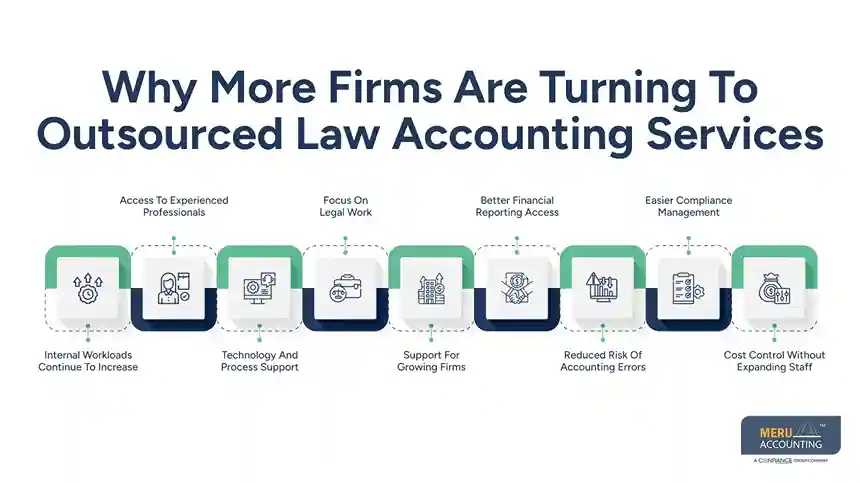
Focus On Legal Work
Attorneys and internal staff often spend valuable time on administrative tasks.
Outsourcing law bookkeeping and accounting allows firms to focus more on client work and case management.
Support For Growing Firms
As firms expand, financial complexity often increases. Outsourced support can scale as needs grow.
This flexibility is one reason many firms choose outsourcing.
Better Financial Reporting Access
Many firms need timely reports to monitor profitability, expenses, and performance. Outsourced law bookkeeping and accounting often improve reporting consistency and access to useful financial data.
Reduced Risk Of Accounting Errors
Managing accounting internally can increase the chance of missed entries or reconciliation issues. Professional support helps reduce errors and improve financial accuracy.
Easier Compliance Management
Keeping up with trust accounting rules and financial regulations can be time-consuming. Outsourced support helps firms maintain stronger compliance processes.
Cost Control Without Expanding Staff
Building an in-house accounting team can increase payroll and overhead costs. Outsourcing gives firms access to support without the expense of growing internal teams.
Key Challenges Solved Through Professional Law Accounting Support
Managing Complex Compliance Rules
Law firms operate under financial rules that can be difficult to manage internally.
Professional law accounting support helps firms stay organized and reduce compliance risk.
Correcting Reconciliation Issues
Errors in trust accounts or general ledger reconciliations can create serious concerns.
Outsourced specialists help improve reconciliations and reporting accuracy.
Improving Billing Delays
Delayed invoices and collection issues can affect revenue flow.
Law firm and legal accounting support can improve billing processes and follow-up controls.
Handling Limited Internal Resources
Smaller firms may not have dedicated accounting departments.
Outsourcing gives access to support without building large internal teams.
Strengthening Financial Visibility
Some firms struggle to access timely financial data.
Professional law bookkeeping and accounting support often improves reporting visibility and decision support.
How Outsourcing Improves Compliance In Law Firm And Legal Accounting
Trust Accounting Compliance Support
Trust accounting rules require careful handling and documentation.
Outsourced law accounting helps support proper tracking and reconciliations.
Audit Readiness
Firms may face audits, reviews, or regulatory checks.
Strong accounting processes can help support smoother audit preparation.
Better Documentation Controls
Well-managed records improve compliance support and reduce missing information.
This often strengthens financial oversight.
Reduced Risk Of Errors
Accounting mistakes can lead to costly problems.
Experienced law firm and legal accounting professionals help reduce risk through structured processes.
Ongoing Compliance Monitoring
Rules and reporting requirements may change over time.
Outsourced support often helps firms stay current with evolving requirements.
Cost Benefits Of Outsourcing Law Accounting For Growing Firms
Lower Staffing Costs
Hiring internal accounting staff can involve salaries, benefits, and training expenses. Outsourcing can help manage costs more efficiently.
Reduced Software And Infrastructure Expense
Internal accounting teams may require software licenses and system costs. Outsourced law accounting may reduce some of these expenses.
Flexible Service Costs
Firms often pay only for services needed. This flexibility can help manage budgets during different growth stages.
Fewer Costly Errors
Financial errors can create penalties or revenue loss. Professional support may help reduce those risks.
Better Resource Allocation
Funds saved through outsourcing can often support business development or operations. This can support long-term growth.
How Law Accounting Helps Manage Trust Accounts And Client Funds
Separate Tracking Of Client Funds
Trust balances need clear separation from operating funds. Law accounting helps support proper handling.
Regular Reconciliations
Frequent reconciliations help identify issues early. This supports compliance and financial accuracy.
Accurate Retainer Tracking
Many firms manage multiple retainers and client deposits. Strong law bookkeeping and accounting processes support proper tracking.
Support For Reporting Requirements
Some jurisdictions require trust-related reporting. Law firm and legal accounting support help firms stay organized.
Protection Of Client Confidence
Proper fund management supports trust and professional reputation. That remains critical for legal practices.
Why Outsourcing Law Accounting Supports Billing, Payroll, And Cash Flow Management
Stronger Billing Processes
Accurate billing supports timely revenue collection. Outsourced law accounting often improves invoicing workflows.
Payroll Management Support
Payroll can involve salaries, partner draws, taxes, and benefits tracking. Professional support helps improve payroll consistency.
Cash Flow Monitoring
Cash flow is important for managing a firm’s operations. Law bookkeeping and accounting supports visibility into incoming and outgoing funds.
Collections Support
Delayed collections can affect working capital. Law firms and legal accounting services can support receivable monitoring.
Better Financial Coordination
Billing, payroll, and cash flow often connect closely. Coordinated accounting support can improve overall financial management.
How Outsourced Law Accounting Supports Growth And Profitability
Better Financial Decision Support
Growth often requires stronger financial insight. Law accounting helps firms review performance and plan with more confidence.
Support For Expansion
Opening offices or adding practice areas can increase financial demands. Outsourced support can scale with expansion.
Profitability Monitoring
Tracking margins by matter or practice area can support stronger decisions. This is an important part of law firm and legal accounting.
Improved Budgeting Support
Budget planning helps firms manage growth responsibly. Outsourced law bookkeeping and accounting often supports stronger budgeting processes.
More Focus On Client Service
Reducing internal administrative burden can help firms focus on serving clients. That often supports growth over time.
Why Law Accounting Outsourcing Can Be A Smart Long-Term Strategy
Scalable Financial Support
As firms change, accounting needs often change too. Outsourced support can adjust without major internal restructuring.
Process Consistency
Structured accounting processes support long-term stability. Consistency often improves financial management.
Reduced Operational Pressure
Internal teams often carry heavy administrative workloads. Law accounting outsourcing can help reduce that burden.
Access To Ongoing Expertise
Regulations and accounting practices change. Professional support can help firms stay prepared.
Support For Future Planning
Long-term success often depends on financial discipline. Law firm and legal accounting outsourcing can support that foundation.
Why Choose Meru Accounting For Law Accounting Support
Industry-Focused Accounting Support
Meru Accounting provides law accounting support designed around the needs of legal practices. Our team understands trust accounting, billing controls, compliance support, and law firm reporting requirements.
Experienced Outsourced Professionals
We support firms with experienced professionals who understand law firm and legal accounting processes. This helps improve financial accuracy and reporting quality.
Flexible Service Models
Our services can support firms needing day-to-day bookkeeping, trust accounting support, reporting assistance, or broader outsourced accounting functions.
This flexibility allows firms to choose support based on their size, workload, and growth stage.
Technology And Process Support
Meru Accounting works with modern accounting tools and process-driven workflows to support efficiency and visibility.
This helps improve reporting access, strengthen controls, and support smoother accounting operations.
Growth-Oriented Financial Support
We help law firms strengthen accounting processes that support compliance, profitability, and long-term growth.
Our support is designed to help firms improve financial management while preparing for future expansion.
Our Expert Perspective
Many law firms first consider outsourcing because of workload pressure. In practice, firms often discover that the larger benefit is stronger financial control. Better reporting, improved trust accounting support, and more reliable billing processes often create value beyond cost savings.
A common pattern seen across growing firms is that outsourced law accounting shifts accounting from a reactive task into a structured business support function. That often makes a meaningful difference over time.
Key Takeaways
- Law accounting supports compliance, billing, trust accounting, and financial planning
- Outsourcing helps firms manage growing accounting complexity
- Professional support can reduce risks tied to errors and compliance issues
- Law firm and legal accounting services often improve billing and cash flow control
- Outsourcing can lower costs compared to expanding internal teams
- Strong law bookkeeping and accounting supports growth and long-term profitability
- For many firms, outsourcing can be a practical long-term strategy
FAQs
Law accounting covers financial tasks for law firms such as bookkeeping, billing, trust account management, payroll, and compliance reporting.
Many firms outsource to improve accuracy, manage compliance, reduce internal workload, and control costs.
Yes. Professional law accounting support often includes trust account tracking, reconciliations, and compliance support.
For many firms, outsourcing can be more cost-effective than maintaining a larger internal accounting team.
It helps improve financial reporting, manage cash flow, support compliance, and provide better information for business decisions.