
Growing transport firms face rising pressure to manage cost, billing accuracy, fuel tracking, vendor payments, and cash flow stability. At this stage, logistics accounting services play a key role in keeping financial records clear and structured.
As operations expand across routes, fleets, and clients, financial complexity increases quickly, making accurate reporting more difficult to manage internally without support from transportation accounting services.
Many transport operators now rely on logistics accounting services to bring consistency in financial tracking, reduce errors in cost allocation, and maintain timely reporting. This shift is not only about reducing workload but also about improving the financial clarity needed for long-term planning.
In this blog, you will learn why transport companies are shifting financial work to external teams, how accounting systems change with scale, and how structured financial handling supports business growth.
What You Will Learn From This Blog
- Why do transport companies face financial management challenges as they grow
- How logistics accounting services improve cost tracking and reporting accuracy
- Reasons internal accounting teams struggle with scaling operations
- How outsourcing reduces financial workload and reporting delays
- Impact of financial clarity on expansion decisions
- Common issues solved by structured accounting systems
- How firms like Meru Accounting support transport businesses
- Practical benefits of outsourcing financial tasks for logistics firms
Understanding Logistics Accounting Services
Logistics accounting services focus on managing the financial flow within transport operations, including income, expenses, fuel costs, driver payments, and freight charges. When these elements are tracked consistently, transport companies gain a clearer view of profitability at the route and shipment level, which directly improves decision-making.
Cost allocation plays a critical role here. Expenses such as fuel, maintenance, tolls, and labor are distributed across specific trips or clients, making it easier to see where margins are tightening and where operational costs are rising unexpectedly.
Revenue reconciliation and fleet expense monitoring further strengthen financial accuracy. Since transport businesses often operate with delayed payments, invoices, receipts, and bank entries must align precisely to prevent revenue mismatches. At the same time, recurring fleet expenses like servicing and repairs require continuous tracking to avoid unnoticed cost leakage.
Compliance and reporting are the final layer. Structured financial records support tax filing, audits, and financial reviews, ensuring transport companies maintain both regulatory compliance and internal financial discipline.
Why Transportation Companies Need Strong Financial Management
Rising Operational Costs
Fuel price fluctuations and unpredictable maintenance expenses directly impact margins, making logistics accounting services essential for maintaining financial control and stability.
As costs shift frequently, budgeting becomes less stable, and financial control requires tighter monitoring systems.
Multi-Route Complexity
Expansion across multiple routes adds layers of financial movement that are difficult to track manually. Each route generates its own cost structure, and without structured transportation accounting services, comparing profitability across routes becomes unreliable.
Delayed Payment Cycles
Transport companies often operate on extended credit terms with clients. When receivables are not tracked in real time, cash flow gaps begin to form, affecting day-to-day operational stability.
High Risk of Manual Errors
Manual bookkeeping increases the chances of mismatched entries and incorrect allocations. Even small errors in fuel or freight recording can distort overall profit calculations and lead to flawed business decisions.
Profitability Tracking Issues
Without structured financial visibility, it becomes difficult to identify which routes or clients are actually generating profit. This often results in pricing decisions based on assumptions rather than accurate margin data.
Why Internal Accounting Teams Struggle in Scaling Transportation Companies
Limited Workforce Capacity
As transaction volume increases, internal teams often struggle to keep up with the pace of entries and reconciliations. This leads to reporting delays and incomplete financial records during peak operational periods.
Lack of Specialized Knowledge
Transportation accounting requires industry-specific understanding of cost behavior across fuel, fleet, and logistics operations. Without this expertise, financial categorization errors become more frequent and harder to correct later.
Software Integration Gaps
Many transport companies rely on separate systems for fleet management, billing, and accounting. When these tools don’t integrate smoothly, data mismatches occur, leading many companies to adopt logistics accounting services for unified financial reporting.
High Work Pressure During Peak Seasons
During high-demand periods, operational priorities take precedence over accounting updates. As a result, financial data often lags behind real-time business activity.
Difficulty in Maintaining Real-Time Data
When systems are not updated continuously, financial reports reflect outdated information. This weakens forecasting accuracy and reduces confidence in decision-making.
How Outsourcing Logistics Accounting Services Transforms Financial Efficiency
Real-Time Financial Visibility
Instead of waiting for month-end reports, outsourced transportation accounting services provide continuous updates on revenue and expenses. This allows management to respond quickly to financial shifts as they happen.
Structured Cost Control
Every expense is categorized and monitored systematically through logistics accounting services, which reduces unnoticed cost leakage. Over time, this leads to a more controlled and predictable cost structure across operations.
Faster Reporting Cycles
Reporting timelines become significantly shorter when dedicated teams handle financial processing. Management receives timely insights that support quicker and more informed decisions.
Reduced Administrative Burden
When data entry and reconciliation are handled externally, internal teams can focus more on logistics operations rather than financial documentation tasks. This improves overall operational productivity.
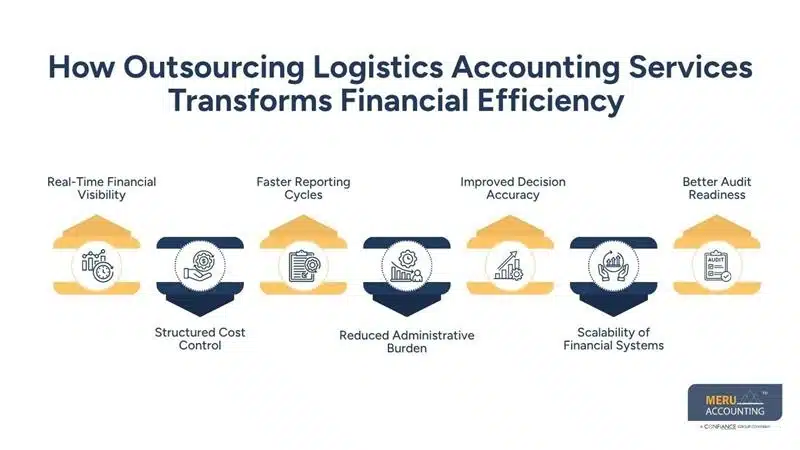
Improved Decision Accuracy
With cleaner and more structured data, pricing strategies and route planning become more data-driven. This reduces guesswork and strengthens long-term planning outcomes.
Scalability of Financial Systems
Outsourced accounting systems can easily scale with fleet expansion and increasing transaction volume. This ensures financial operations remain stable even during rapid business growth.
Better Audit Readiness
Well-maintained records through logistics accounting services make audits smoother and less time-consuming. Structured documentation reduces compliance risks and improves financial transparency.
Cost Savings and ROI of Outsourcing Accounting Functions
Lower Staffing Expenses
Hiring full internal teams increases fixed costs. Outsourcing reduces salary and training expenses. Workforce costs remain flexible based on business needs instead of fixed monthly commitments.
Reduced Technology Costs
Service providers already use advanced tools, removing the need for expensive software investment. Upgrades, licenses, and system maintenance costs are handled externally.
Better Resource Allocation
Companies can allocate internal resources to core transport operations. Operational focus shifts toward fleet movement, delivery timelines, and client service.
Fewer Financial Errors
Reduced errors through logistics accounting services lead to fewer penalties and correction costs. Accurate records reduce the risk of tax issues and invoice mismatches.
Higher Return On Operational Spending
Structured transportation accounting services increase financial clarity, improving ROI on transport operations. Better reporting leads to stronger cost control and improved profit visibility.
Common Challenges Solved By Outsourced Transportation Accounting Services
Invoice Management Issues
Many transport firms struggle with delayed or incorrect invoicing. Transportation accounting services ensure accuracy in billing cycles. Proper invoice tracking also reduces disputes with clients and improves payment timelines effectively.
Fuel Cost Mismanagement
Fuel tracking errors can impact profit margins significantly, making logistics accounting services critical for accurate cost monitoring. Proper accounting reduces such gaps. Regular monitoring of fuel usage helps identify unnecessary spending patterns across operations clearly.
Vendor Payment Delays
External accounting teams maintain structured payment schedules for vendors. Timely payments also help maintain stronger supplier relationships and avoid service interruptions during critical transport operations periods.
Compliance and Tax Errors
Transportation accounting services reduce compliance risks by maintaining clean records. Accurate documentation supports smooth tax filing and reduces audit-related issues for transport companies.
Lack of Financial Reporting Consistency
Standardized reporting formats improve financial transparency across departments. Consistent reports make it easier for management to compare performance across different time periods accurately.
How Outsourced Accounting Supports Business Expansion and Scalability
Support For Fleet Expansion
As fleets grow, accounting workload increases. Outsourcing ensures financial systems scale easily. This prevents delays in recording and monitoring expanding fleet operations effectively.
Multi-Location Financial Handling
Transport companies operating across regions benefit from centralized accounting systems. Standardized reporting ensures consistency across all branches and locations.
Better Cash Flow Planning
Structured logistics accounting services improve forecasting and liquidity management. Better planning helps avoid cash shortages during peak operational demand periods.
Investment Decision Support
Clear financial reports guide decisions on new routes and vehicles. Accurate insights reduce risks when expanding into new transport markets.
Improved Operational Stability
Consistent accounting systems reduce uncertainty during expansion phases. Stable records support smoother coordination between finance and operations teams.
How Meru Accounting Supports Transportation Companies
Meru Accounting works with transport and logistics firms to manage financial systems through structured reporting and industry-focused accounting support. Financial clarity helps businesses maintain better control over daily operations while handling growth in a stable way.
We set up industry-specific accounting systems based on transport workflows, including fleet, fuel, and route cost tracking. Our team also provides software integration support with tools like Odoo, Xero, and QuickBooks, which helps reduce manual work and improve data consistency across all operations.
We also ensure accurate financial reporting through regular statements that reflect real-time business performance. Along with this, our logistics accounting services include a cost monitoring framework that tracks expenses in detail, and our scalable accounting model ensures support grows smoothly as transportation companies expand.
Our Expert Perspective
In practical transport operations, financial clarity often plays a key role in determining how effectively a company manages expansion. Many businesses initially rely on internal systems but later transition to structured logistics accounting services as transaction volumes increase and operations become more complex.
From our experience, the most common gap in transport accounting is not data collection, but the correct interpretation of cost patterns across routes and fleets. When financial records are properly organized and analyzed, it becomes easier to support more stable pricing decisions and improve cash flow planning, making financial management less reactive and more strategic.
Key Takeaways
- Transport growth increases financial complexity
- Logistics accounting services improve cost tracking and reporting accuracy
- Internal teams often face capacity and skill limitations
- Outsourcing reduces financial workload and reporting delays
- Structured accounting improves cash flow visibility
- Better financial systems support expansion decisions
- External expertise reduces errors and compliance risks
FAQs
Transport companies deal with high transaction volume. Outsourcing logistics accounting services reduces workload and improves accuracy.
The main benefit of transportation accounting services is better financial control over fuel, fleet, and route expenses.
They track receivables and payables closely, helping businesses manage cash timing better.
Yes, even small firms benefit because they reduce errors and improve financial planning.
Yes, outsourcing removes hiring and training costs while improving reporting quality.