
Multi-entity businesses often struggle with data gaps, timing differences, and mismatched financial records across subsidiaries. In such cases, a management accounts service becomes a key support system to bring order and clarity. Structured management accounting services help align reports, reduce errors, and give leaders a clear view of performance across all units.
This blog explains how structured financial reporting supports financial clarity, improves reporting quality, and helps solve inconsistencies across entities. It also highlights the role of performance tracking services in monitoring results across multiple business units.
What You Will Learn From This Blog
- Why multi-entity reporting often becomes inconsistent
- How a management accounts service improves data accuracy
- Common challenges in consolidated reporting systems
- Role of KPI reporting services in tracking business performance
- Ways to fix reporting gaps across entities
- Practical methods to improve financial visibility
Understanding Reporting Inconsistencies In Multi-Entity Structures
Multi-entity businesses often struggle with reporting inconsistencies because each entity may use different accounting systems or software. This leads to mismatched data formats, broken links in financial records, and gaps during consolidation.
A management accounts service helps bring all financial data into a single structured format, making it easier to review and compare performance across entities.
Another major issue is the difference in financial closing timelines. Some entities may close their books earlier, while others report later, which creates delays and confusion in group-level reporting.
Along with this, inconsistent charts of accounts further complicate consolidation, as each entity may classify transactions differently. Management accounting service standardizes these reporting structures so that all entities follow a uniform system.
Global operations also face challenges from currency fluctuations and varying tax rules across regions, which can distort financial clarity if not managed properly.
On top of that, manual data entry increases the risk of human error, affecting the accuracy of final reports. A well-structured management accounts service reduces these risks by improving consistency, accuracy, and overall financial control.
Why Management Accounts Service Is Essential For Financial Clarity
Unified Financial View Across Entities
A management accounts service brings all entity data into one structured report. This helps leaders understand overall business health across all business units clearly.
Improved Decision-Making Accuracy
When data is clean and aligned, decisions become more reliable. A structured financial reporting system reduces guesswork and supports faster financial decisions.
Better Cash Flow Understanding
Multi-entity groups often face unclear cash flow positions. A structured reporting approach improves visibility across all units for better cash planning.
Strong Financial Control Systems
Control improves when reporting is standardized. A management accounts service helps track expenses and income consistently across all entities.
Reduced Month-End Pressure
Teams spend less time fixing errors at month-end when systems are structured properly. A management accounts service ensures faster and smoother closing cycles.
How Businesses Resolve Reporting Discrepancies Using Management Accounts Service
Identifying Root Causes Of Errors
The management accounts service identifies the root causes behind reporting inconsistencies quickly. Early detection prevents repeated financial reporting mistakes across entities.
Correcting Data Mapping Issues
Wrong data mappings are corrected at source level immediately. Proper mapping ensures accurate flow of financial information across systems.
Standardizing Reporting Templates
All entities follow one standardized reporting format consistently. This improves clarity and makes consolidation easier for management teams.
Strengthening Internal Controls
Strong internal controls reduce recurring reporting discrepancies across entities. Control systems ensure better compliance and financial discipline at every level.
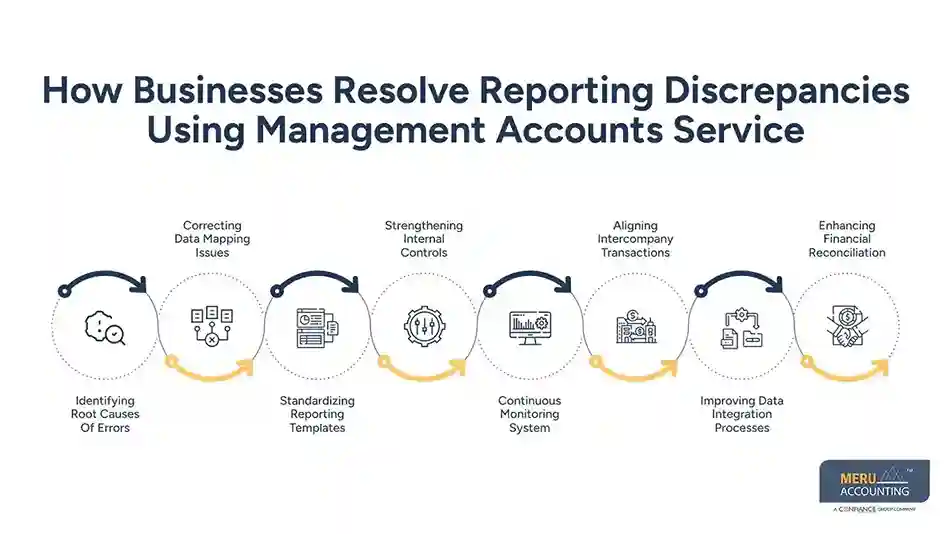
Continuous Monitoring System
Regular monitoring ensures long-term accuracy in financial reporting processes. Continuous checks help maintain consistency across monthly reporting cycles.
Aligning Intercompany Transactions
Intercompany transactions are reviewed and matched accurately for consolidation. This reduces duplication and ensures clean group-level financial statements.
Improving Data Integration Processes
Data integration across systems improves consistency and reporting accuracy. Integrated systems reduce manual errors and speed up reporting workflows.
Enhancing Financial Reconciliation
Reconciliation processes detect and fix discrepancies before final reporting. Accurate reconciliation improves trust in consolidated financial results.
Common Challenges In Consolidated Financial Reporting Across Entities
- Different entities store financial data in separate systems, making consolidation slow, complex, and less accurate. This often creates gaps in group-level reporting and delays financial decision-making.
- Without uniform reporting structures, financial data becomes inconsistent across entities. A management accounts service helps align all reports using standard templates for better clarity and comparison.
- Finance teams working in different locations may not share updates on time. This leads to missing information and incomplete financial consolidation.
- When corrections are made late, they impact the accuracy of consolidated reports. A structured reporting system ensures timely updates and reduces reporting errors.
- Without proper consolidation, leadership cannot see the full financial picture of the business. This affects planning, control, and performance tracking across entities.
Role Of KPI Reporting Services In Performance Tracking
Measuring Business Efficiency
KPI reporting services track efficiency across departments and entities. Clear insights highlight how each business unit performs against defined targets.
Tracking Revenue Growth Patterns
Revenue performance across different entities becomes easier to analyze, helping identify which locations or units are driving stronger growth and where improvement is needed.
Monitoring Cost Control
Expense movements across operations become more visible, making it easier to identify areas where costs are increasing or reducing. This supports more structured financial control.
Identifying Underperforming Units
Weak-performing branches or departments can be detected early through performance data, allowing faster corrective actions and reducing potential financial risks.
Supporting Strategic Planning
When combined with a management accounts service, performance insights improve long-term planning. This alignment supports more informed and balanced business decisions.
Improving Operational Transparency
Performance data becomes visible across all levels of the organization, improving accountability and ensuring a clearer understanding of operational outcomes.
Enhancing Forecast Accuracy
KPI reporting services analyze past and current performance trends to improve forecasting quality. Future planning becomes more reliable and data-driven.
How Management Accounts Service Improves Data Accuracy And Consistency
- A management accounts service ensures all entities follow the same reporting structure, which improves consistency in financial data across the group.
- Automated reconciliation support reduces manual work and improves accuracy by minimizing human errors in financial matching and adjustments.
- Regular financial reviews help identify errors early, allowing corrections before they affect consolidated reporting.
- Clean and structured reports improve audit readiness, making audit processes faster and more organized.
- A structured reporting service connects data from multiple systems into one format, improving overall data accuracy and consistency.
Key Components Of Effective Multi-Entity Management Reporting
Standard Chart Of Accounts
Uniform account structure ensures clean consolidation. Consistent classification across entities improves financial comparison and reporting accuracy.
Centralized Reporting Dashboard
A single dashboard provides a complete financial overview. Leadership gains real-time visibility into all entities without switching systems.
Consistent Accounting Policies
All entities must follow the same accounting rules. Financial statements remain comparable and reliable across the entire group structure.
Real-Time Data Updates
Timely updates improve accuracy of reports. Faster data flow supports quicker financial decisions and reduces reporting delays.
Strong KPI Mapping System
KPI reporting services help link financial data with performance indicators. Business performance tracking becomes clearer and more structured across entities.
Streamlining Financial Consolidation Through Structured Reporting Systems
Data Mapping Across Entities
Each entity’s data is mapped to a central format. This ensures consistent consolidation and reduces reporting confusion.
Elimination Of Duplicate Entries
A management accounts service removes repeated records. Clean datasets improve accuracy in group financial reporting.
Faster Monthly Closing Process
Standard systems reduce closing time significantly. Faster closures improve timely decision-making across business units.
Reduced Manual Adjustments
Automation reduces human errors in consolidation. This increases reliability of financial statements across entities.
Clear Group-Level Reports
Leaders get a complete view without confusion. Structured reports improve visibility of overall business performance.
Benefits Of Integrating KPI Reporting Services With Management Accounts
- Combining KPI reporting services with a management accounts service improves tracking quality and provides more reliable performance measurement across entities.
- Financial results connect better with business performance indicators, creating a stronger link between operations and financial outcomes.
- Data from both systems supports better forecasting and improves the accuracy of future financial planning and projections.
- Management gets clearer insights into all entities, helping understand performance trends and overall business health more effectively.
- Early detection of risks becomes easier, allowing faster corrective actions and better financial control across the organization.
Why Choose Meru Accounting?
Meru Accounting provides a structured management accounts service designed for businesses operating multiple entities across different regions. The main focus is on building clear and consistent reporting systems that reduce discrepancies and improve overall financial visibility across the group structure.
Our team works on aligning financial data across all entities and integrating kpi reporting services to support accurate performance tracking. This approach helps businesses reduce manual errors, improve reporting consistency, and speed up monthly financial reporting cycles.
With experience across global accounting tools and complex multi-entity structures, Meru Accounting ensures that every management accounts service engagement improves data accuracy, reduces reporting delays, and supports stronger financial decision-making at the leadership level.
Our Experts' Perspective On Multi-Entity Reporting And KPI Integration
In practical business environments, multi-entity reporting challenges appear more frequently than expected. Our experts consistently observe that organizations using a structured management accounts service experience fewer reporting errors and faster financial closing cycles across all entities.
Another important insight from our experts shows that integrating KPI reporting into financial reporting improves overall control over business performance. When a structured financial reporting system is combined with KPI tracking, businesses achieve more stable reporting systems and clearer visibility across growing multi-entity structures.
Key Takeaways
- Multi-entity reporting needs structured financial systems
- A management accounts service improves accuracy and consistency
- Reporting inconsistencies often come from system differences
- KPI reporting services help track performance clearly
- Standardization reduces month-end delays
- Integrated reporting improves decision-making quality
FAQs
It is a structured financial reporting system that provides regular reports for better decision-making across business entities.
They use different systems, formats, and timelines, which creates inconsistencies in financial data.
They track performance indicators like revenue, cost, and efficiency across different units.
Yes, it standardizes data and reduces manual work, which lowers the chance of errors.
Yes, even small groups benefit from structured reporting and better financial clarity.