A nonprofit can meet its fundraising goals and still struggle to fund its next project. The reason isn’t always a lack of donations. Sometimes, the money raised is already committed to a specific cause, program, or grant. This is where nonprofit fund accounting becomes important. It helps organizations see which funds are available, which have donor restrictions, and how much they can put toward new needs.
The real value of fund accounting goes beyond keeping books in order. It helps nonprofit leaders make better budget choices, plan programs with confidence, and show donors that their contributions are being used as promised. Understanding how restricted and unrestricted funds work is a key part of keeping an organization’s finances on track.
What You Will Learn From This Blog
- What nonprofit fund accounting is and why it matters.
- How restricted and unrestricted funds differ.
- How to track donations, grants, and fund expenses.
- Common fund tracking issues and ways to avoid them.
- Best practices for clear and accurate fund records.
- Which financial reports nonprofit leaders should review.
- How nonprofit accounting solutions can support better fund control.
What Is Nonprofit Fund Accounting and Why Does It Matter?
Nonprofit fund accounting is a way to track income, costs, and balances based on the purpose for which funds may be used. It helps an organization show which money is free to use and which money has limits set by donors or grantmakers.
For example, a charity may receive a $50,000 gift to support its food program. It may also receive a $20,000 gift for general costs. The first gift must be used for the food program, while the second may help pay for rent, staff, or other daily needs.
Fund accounting keeps these amounts clear in the books. It does not always mean that each fund needs its own bank account. In many cases, funds can share a bank account while the accounting records track each balance on its own.
How Fund Accounting Differs From Business Accounting
A for-profit business tracks income, costs, assets, and debts to measure profit and business health. A nonprofit tracks these items too, but it must also show whether its funds have limits on how they can be spent.
This extra level of tracking helps nonprofits show that they have used gifts as promised. It also helps them report the funds that remain for future work.
Why It Matters
Good fund records help a nonprofit:
- Honor donor terms and grant rules.
- Keep program funds apart from general funds.
- Track costs by program and funding source.
- Prepare clear reports for the board and donors.
- Plan future work based on funds that are truly available.
optional anymore
on running the business
Restricted vs. Unrestricted Funds: Understanding the Key Differences
Nonprofits must know which funds have donor limits and which can be used for general needs. This is one of the main tasks of nonprofit fund accounting.
What Are Restricted Funds?
Restricted funds are gifts that a donor or grant maker has set aside for a clear purpose or time period. The nonprofit must use the funds as agreed.
For example, a donor may give $15,000 to buy school supplies for children. The nonprofit cannot use that gift to pay for office rent or staff costs unless those costs are allowed under the donor’s terms.
Common examples include:
- Gifts for a set program or service.
- Grants for a named project.
- Funds for new buildings or major repairs.
- Gifts that must be held for use in a later year.
What Are Unrestricted Funds?
Unrestricted funds are gifts that come with no donor limits on how the nonprofit may use them. Leaders can use these funds for needs that support the mission and daily work of the group.
For example, a donor may give $5,000 to support the nonprofit’s work as a whole. The group may use this money for staff pay, rent, supplies, or other valid costs.
Unrestricted funds are vital because they help cover costs that may not be paid by grants or set-purpose gifts.
Temporarily and Permanently Restricted Funds
Under current U.S. nonprofit accounting rules, donor-restricted net assets are shown in two main classes: with donor restrictions and without donor restrictions.
The old terms “temporarily restricted” and “permanently restricted” are no longer used as the main financial statement classes under U.S. GAAP.
A time or purpose limit may still apply to a gift. For example, a donor may ask that funds be used for a program in the next fiscal year. A gift may also be held in a long-term endowment, where the principal must stay intact and only approved income may be spent.
When a purpose or time limit is met, the amount is released from donor restriction and shown as net assets without donor restrictions.
How Nonprofit Fund Accounting Helps Manage Restricted and Unrestricted Funds
A clear fund accounting process helps nonprofits track each gift from the day it comes in until it is spent or released from a donor limit.
1. Tracks Donations Based on Donor Terms
Each gift should be recorded with its source, amount, date, and any donor terms. This helps the finance team know how the money may be used.
For example, if a donor gives $10,000 for a health program, the team should record the gift with that purpose. This makes it easier to track the gift and report on its use.
2. Keep Expenses Linked to the Right Funds
Every cost should be charged to the fund or program that received the benefit. If a nonprofit uses a grant to pay for staff who work on a set project, it should keep records of the hours spent on that work.
Shared costs, such as rent or utilities, need a fair and clear way to split the cost. The method should fit the cost and be used in a steady way.
3. Helps Track Grants and Spending Limits
Many grants come with rules on how and when funds can be spent. Some may set a budget for staff, travel, supplies, or other costs.
Fund records help teams compare actual costs with the grant budget. This can flag overspending or funds that may need to be used before the grant ends.
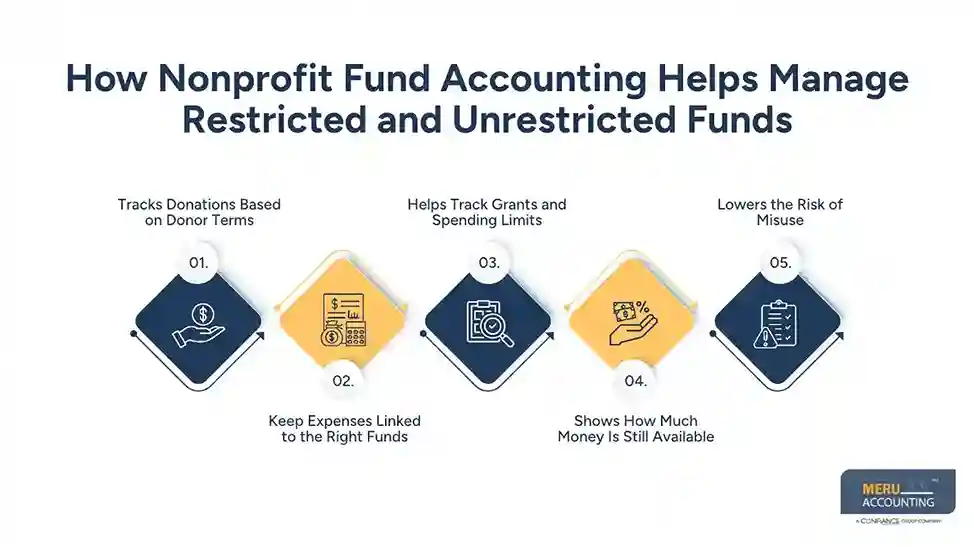
4. Shows How Much Money Is Still Available
A nonprofit may have a high bank balance but still lack funds for daily costs. This can happen when much of its cash is tied to grants or donor limits.
Fund accounting helps leaders see which funds are open for general use and which must stay set aside. This gives them a more honest view of cash needs.
5. Lowers the Risk of Misuse
Clear records and regular reviews can help stop staff from charging costs to the wrong fund. They also make it easier to find errors and fix them before reports are sent to donors or grant makers.
How to Record and Track Restricted and Unrestricted Funds
A clear process makes fund tracking easier and helps keep records ready for review.
1. Record Each Gift With Its Terms
Keep a copy of the gift letter, grant deal, or donor note. Record the date, amount, source, and any time or purpose limits in the books.
2. Set Up Clear Fund Codes
Use fund codes, classes, projects, or tags to track each source of money. The names should be easy for staff to read and use.
For example, a nonprofit may use separate codes for food aid, youth care, building work, and general use.
3. Record Income and Costs With Care
When money comes in, link it to the right fund. When a cost is paid, record the fund that should bear that cost. Keep bills, receipts, time sheets, and other proof with each entry.
4. Review Fund Balances Each Month
Compare the books with bank records and grant budgets. Check that costs match the purpose of each fund and that no gift has been used for a cost that is not allowed.
5. Record the Release of Donor Limits
When a donor’s purpose or time limit has been met, record the release in the books. This helps show the amount that is now free from donor limits.
Common Challenges in Managing Nonprofit Funds
Even well-run groups can face issues when they manage many gifts and grants.
- Mixing fund balances: Staff may fail to track which gifts have limits. This can lead to funds being used for the wrong purpose.
- Poor donor records: Missing gift letters or grant terms can make it hard to know how money may be spent.
- Wrong cost allocation: Shared costs may be charged to the wrong fund if there is no clear method.
- Late grant reports: Poor records can slow down reports and make it hard to meet grant due dates.
- Cash flow gaps: A nonprofit may have cash in the bank but lack enough funds for daily costs because much of the cash is restricted.
These issues can affect donor trust, board decisions, and grant work. A set review process and clear roles can help reduce the risk.
Best Practices for Accurate Nonprofit Fund Accounting
Good nonprofit fund accounting depends on clear rules, trained staff, and regular checks. These steps can help keep records in order.
- Set clear fund rules: Define how each fund is set up, used, and closed.
- Keep donor terms on file: Store gift letters and grant deals where the finance team can find them.
- Use a steady cost split method: Set a fair basis for shared costs, such as staff time or floor space.
- Review reports each month: Check fund balances, costs, and grant budgets for errors.
- Set clear approval steps: Use more than one person to review key payments and fund changes.
- Train staff: Make sure staff know which costs can be charged to each fund.
- Keep an audit trail: Save bills, receipts, donor notes, and records of key changes.
These steps make it easier to answer donor questions, prepare for audits, and plan future work.
Financial Reports Every Nonprofit Should Monitor
Reports help leaders see how funds are used and whether the group is on track. Nonprofit fund accounting should support clear reports that match the needs of the board, donors, and grant makers.
1. Statement of Financial Position
This report shows the nonprofit’s assets, debts, and net assets at a set date. It also splits net assets into those with and without donor restrictions.
2. Statement of Activities
This report shows income, costs, and changes in net assets over a set period. It helps leaders see how gifts, grants, and costs affect the group’s funds.
3. Statement of Functional Expenses
This report shows costs by both nature and function. It may split costs into program services, management and general, and fundraising.
4. Statement of Cash Flows
This report shows cash that came in and went out during the period. It helps leaders plan for bills, payroll, and future needs.
5. Grant and Fund Reports
These reports show income, costs, and balances for each grant or fund. They help teams check whether funds are being used as planned and prepare reports for grant makers.
Nonprofit Fund Accounting Services by Meru Accounting
A grant may cover program costs but exclude general administration. A donor may set aside money for a future project, while the organization still needs funds to meet its current expenses. Managing these different requirements calls for more than basic bookkeeping. It requires accurate fund records, sound expense allocation, and a clear view of how each funding source can be used.
At Meru Accounting, we help nonprofits manage these accounting needs through services such as:
- Restricted and Unrestricted Fund Tracking: Record donations, grants, and other income based on their purpose and donor terms.
- Grant Accounting and Expense Tracking: Monitor grant budgets, eligible costs, spending, and remaining balances.
- Fund-Based Expense Allocation: Assign direct and shared costs to the right programs and funding sources using clear allocation methods.
- Bank and Account Reconciliation: Match accounting records with bank activity and resolve errors that may affect fund balances.
- Nonprofit Financial Reporting: Prepare statements and fund-level reports that help boards and management review income, expenses, and available resources.
- Bookkeeping Cleanup and Catch-Up: Correct past entries, review fund classifications, and bring incomplete financial records up to date.
- Audit Preparation Support: Organize supporting documents, transaction records, and account schedules for audit review.
Our nonprofit accounting solutions focus on the details that matter in fund management. We help maintain a clear link between the money an organization receives, the expenses it records, and the purpose each fund is meant to serve. This gives nonprofit leaders more reliable financial information for budget planning, grant oversight, and board decisions.
Our Expert Insight
A common point of confusion in nonprofit accounting is knowing when a donor restriction has been met. Receiving a grant or making a payment does not, by itself, mean the restriction has been fulfilled. The terms of the gift matter. For example, if a donor provides funds to buy medical equipment, the nonprofit must follow the stated purpose before treating those funds as released from restriction.
We recommend reviewing donor agreements before recording releases and keeping clear support for each one. This is especially important when a gift has more than one condition or when funds are meant to support a project over several years. A well-documented release helps keep financial statements accurate and gives auditors a clear basis for review.
Key Takeaways
- Nonprofit fund accounting helps track money based on donor and grant terms.
- Restricted funds must be used for the stated purpose or time period.
- Unrestricted funds can support general needs and daily costs.
- Each gift should have clear records and the right fund code.
- Shared costs need a fair and steady method of allocation.
- Monthly reviews help spot errors and track grant spending.
- Clear reports help boards, donors, and grant makers see how funds are used.
- Nonprofit accounting solutions can help teams keep records clear and reports on time.
FAQs
It helps nonprofits track income and expenses by fund, monitor donor restrictions, and show how money is used to support their mission.
Restricted funds must be used for a donor-approved purpose or time period. Unrestricted funds can be used for general operations and other organizational needs.
Yes, if the donor or grant terms allow those costs. For example, a grant may cover salaries for staff working on a funded program.
It depends on the grant agreement. Funds may be carried forward, used during an approved extension, or returned to the grant maker.
Most U.S. nonprofits use accrual accounting and follow GAAP. They report net assets as either with donor restrictions or without donor restrictions.
optional anymore
on running the business