
An offshore team for accountants is reshaping how accounting firms handle growth, workload, and service delivery. Instead of depending only on in-house staff, firms now build remote teams in different regions to manage bookkeeping, reporting, payroll, and compliance tasks in a structured way. This approach helps firms handle more clients without increasing office size or fixed costs.
An offshore team for accountants allows firms to distribute work across time zones, improve turnaround time, and maintain steady output even during peak seasons.
Many firms also combine this model with offshore staffing for accounting firm structures to balance cost and capacity while keeping quality control in place.
This blog explains how this model works, its benefits, challenges, and how firms can use it to scale operations in a stable and practical way.
What You Will Learn From This Blog
- How offshore accounting teams support firm growth
- Why firms are moving toward remote staffing models
- Key benefits and risks involved in offshore accounting setup
- Difference between offshore and in-house accounting teams
- Practical steps to build a stable offshore accounting system
- Real use cases and working models used by firms today
Why Accounting Firms Are Shifting Toward Offshore Staffing For Accounting Firm Models
Rising Cost Pressure In Local Hiring
Many firms face high salary costs, office rent, and training expenses. Hiring locally increases fixed cost per employee. This reduces flexibility during slow seasons.
Difficulty In Scaling Quickly
In-house teams take time to hire and train. Offshore models allow faster onboarding of skilled accountants. This helps firms handle sudden client growth.
Growing Demand For Skilled Accounting Support
With increasing compliance needs, firms require more staff for bookkeeping, payroll, and reporting, which is where an offshore team for accountants becomes highly effective. Offshore teams help fill this gap without long hiring cycles.
Shift Toward Cloud Accounting Tools
Tools like QuickBooks, Xero, and NetSuite allow remote access to financial data. This makes offshore collaboration easier and more secure.
Focus On Core Client Services
Firms prefer keeping advisory, tax planning, and client relations in-house, while an offshore team for accountants handles routine accounting tasks.
This helps senior staff spend more time on strategy and client communication instead of repetitive data work.
Key Benefits Of Using An Offshore Team For Accountants In Modern Firms
Cost Efficiency And Resource Control
An offshore team for accountants helps reduce salary burden and infrastructure costs. Firms pay only for required work hours or services.
Better Work Distribution Across Time Zones
With an offshore staffing for accounting firm model, work continues even after local office hours, enabling near 24/7 productivity. This improves reporting speed and reduces delays in month-end closing.
Access To Skilled Global Talent
An offshore team for accountants provides access to globally trained professionals familiar with IFRS and GAAP standards.
An offshore team for accountants also reduces dependency on long internal training cycles by bringing in pre-skilled professionals.
Improved Focus On Advisory Services
Routine bookkeeping is handled offshore, allowing senior staff to focus on financial strategy and client advisory. This shift helps firms spend more time on high-value client discussions and decision-making support.
Scalable Resource Model
Firms using offshore staffing for accounting firm models can easily scale teams up or down based on workload without long-term commitments. This flexibility helps manage seasonal spikes like tax filing and year-end reporting more smoothly.
Reduced Operational Pressure
Offshore teams handle repetitive accounting work, reducing stress on in-house teams during peak reporting periods. This leads to better accuracy and fewer errors caused by workload overload.
How Offshore Staffing For Accounting Firm Improves Scalability
Flexible Team Expansion
With offshore staffing for accounting firm, firms can quickly add accountants during tax season or audit periods.
This helps firms manage sudden workload spikes without long hiring delays or permanent cost commitments.
Project-Based Resource Allocation
Teams can be assigned based on client projects instead of fixed roles, improving efficiency.
This allows better control over time spent on each client and reduces idle capacity within the firm.
Standardized Work Processes
Offshore teams often follow structured workflows, reducing errors and improving consistency.
It also makes it easier to maintain uniform reporting quality across multiple clients and locations.
Faster Turnaround Time
Work distribution across time zones allows continuous processing of financial data.
This helps firms complete reports and reconciliations faster, improving client satisfaction.
Reduced Dependency On Local Hiring Market
This is a key advantage of an offshore team for accountants, as firms are not impacted by local hiring constraints.
This ensures stable hiring capacity even when local accountant demand increases suddenly.
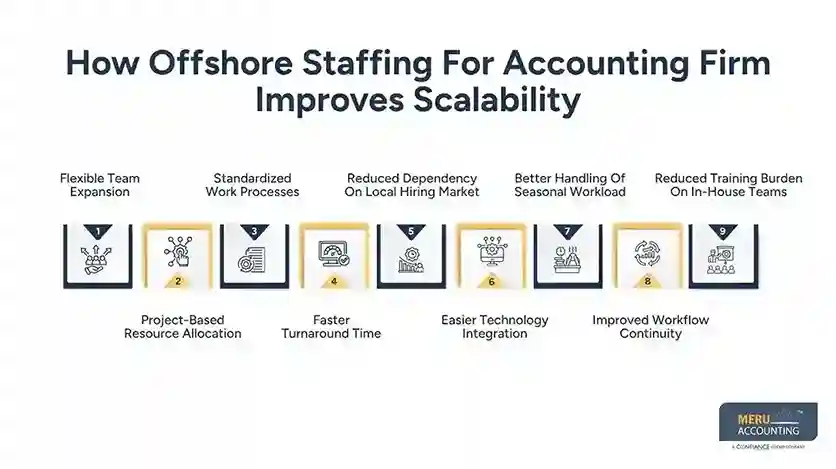
Easier Technology Integration
Offshore teams are usually trained in multiple accounting platforms, making system migration smoother.
This reduces transition time when firms switch between tools like QuickBooks, Xero, or NetSuite.
Better Handling Of Seasonal Workload
Offshore staffing for accounting firm helps manage peak seasons like tax filing and audits with ease.
Firms can temporarily scale teams without long-term hiring commitments.
Improved Workflow Continuity
Work continues across different time zones, reducing downtime in accounting processes.
This ensures that tasks move forward even outside regular business hours.
Reduced Training Burden On In-House Teams
Offshore professionals often come pre-trained in accounting systems and standards.
This reduces the time and effort needed from in-house staff for onboarding.
Challenges In Offshore Staffing For Accounting Firm And How To Overcome Them
Communication Gaps
Different time zones may cause delays in communication. Regular reporting schedules and shared dashboards help reduce this issue.
Data Security Concerns
Financial data sensitivity requires strong access controls, encryption, and compliance protocols.
Quality Control Issues
Without proper review systems, errors may occur. Firms should implement multi-level review processes.
Cultural And Work Style Differences
Different working habits may affect output consistency. Standard operating procedures help align expectations.
Dependency On Technology
System downtime can impact productivity. Backup systems and cloud redundancy are necessary.
Offshore Vs In-House Accounting Teams: A Scalability Comparison
Key Area | In-House Accounting Teams | Offshore Accounting Teams |
Cost Structure Difference | In-house teams involve salaries, benefits, office space, and training costs, which create high fixed expenses. | Offshore teams reduce fixed costs and convert them into flexible, usage-based expenses that adjust with workload. |
Speed Of Scaling | Hiring is slow due to recruitment cycles, interviews, and onboarding processes. | Teams can be expanded quickly based on demand, especially during peak seasons like audits or tax filing. |
Flexibility In Operations | Workforce size is fixed, making it harder to adjust during low or high workload periods. | Staffing can be increased or reduced easily depending on client volume and project needs. |
Control And Supervision | Direct supervision is easier due to physical presence in the office. | Work is managed through structured reporting systems, cloud tools, and defined workflows. |
Productivity Across Time Zones | Limited to office hours, which may slow down turnaround time. | Work continues across different time zones, improving continuous output and faster completion. |
Long-Term Growth Impact | Growth is slower due to higher cost pressure and hiring limitations. | Firms can scale faster and take on more clients due to higher operational capacity. |
Best Practices For Building A Successful Offshore Team For Accountants
Define Clear Work Processes
When building an offshore team for accountants, setting standard procedures for bookkeeping, reporting, and communication helps avoid confusion. This ensures every team member follows the same method, which reduces errors in financial work.
Use Cloud-Based Accounting Tools
Platforms like Xero, QuickBooks, and NetSuite improve transparency and collaboration. They also allow real-time access to data, which helps teams work without location barriers.
Establish Strong Reporting Systems
Daily or weekly reports help track performance and maintain accountability. This makes it easier for managers to identify delays and correct issues early.
Invest In Training And Onboarding
Proper training ensures offshore staff understand firm standards and client requirements. It also reduces dependency on senior staff for basic task clarification.
Set Up Data Security Protocols
Access control, encryption, and audit logs are necessary for financial safety. These measures help protect sensitive client information from unauthorized access.
Maintain Regular Communication
Scheduled meetings help align goals and resolve issues quickly. It also improves coordination between in-house and offshore teams for smoother operations.
How Meru Accounting Supports Offshore Accounting Operations
Meru Accounting provides structured offshore team for accountants solutions designed for growing firms that want to scale without increasing internal workload pressure.
With experience across industries such as real estate, IT, hospitality, and e-commerce, we build dedicated offshore teams that handle bookkeeping, payroll, reconciliation, and financial reporting.
The firm also supports migration from tools like QuickBooks, Xero, and NetSuite, ensuring a smooth transition and data accuracy. Businesses working with Meru Accounting benefit from trained professionals, standardized workflows, and reliable reporting systems that support long-term scaling.
This offshore team for accountants model helps firms reduce operational pressure while maintaining consistent financial quality and compliance standards.
Our Expert Perspective
From our perspective, accounting firms perform better when an offshore team for accountants handles routine accounting tasks, separating them from advisory and client-focused work.
A well-managed offshore team for accountants helps handle repetitive tasks with consistency, but long-term success depends on strong systems, workflows, and communication structures. When offshore staffing for accounting firm models are supported with clear processes and proper review, firms achieve better control, improved efficiency, and more stable growth.
Key Takeaways
- An offshore team for accountants helps firms scale without high fixed costs and operational pressure.
- Work distribution across time zones improves efficiency
- Offshore staffing for accounting firm models support faster hiring, easy scaling, and flexible workforce management during peak workloads.
- Strong systems are needed for communication and data security
- Offshore and in-house teams can work together for balanced operations
- Proper structure and training are key to long-term success
FAQs
It is a remote group of accounting professionals who handle bookkeeping, payroll, and reporting tasks for firms from different locations.
It allows firms to handle more clients without increasing office size or hiring local staff at high cost.
Yes, if proper security measures like encryption and access control are used, data remains safe.
They can manage bookkeeping, bank reconciliation, payroll processing, financial reporting, and tax support tasks.
Yes, most offshore teams are trained in tools like QuickBooks, Xero, and NetSuite for smooth integration.