
Hotels deal with a large number of sales and costs every day. Room bookings, food sales, guest services, events, and other income streams create a steady flow of financial data. To keep track of all this activity, hotel owners and managers need reports they can trust. One of the most useful reports is the hotel income statement.
A hotel income statement gives a clear view of income, costs, and profit for a set time period. It helps hotel leaders see how the business is doing and where changes may be needed. Good financial data also helps with planning, cost control, and growth goals.
Still, many hotels find it hard to keep reports fully correct. High sales volume, many service areas, and manual work can lead to mistakes. Even small errors can affect profit reports and future plans. That is why many hotels now use outsourced hospitality accounting services. These services help keep records correct, reduce errors, and give hotel leaders better financial data.
In this blog, we will explain the role of a hotel income statement, answer the question what is hotel accounting, and show how outsourced accounting services help improve financial accuracy.
What You Will Learn From This Blog
- What a hotel income statement is
- The answer to the question, what is hotel accounting
- The main parts of a hotel income statement
- The benefits of outsourcing hotel accounting
- How outsourced accounting services improve financial accuracy
What Is a Hotel Income Statement?
A hotel income statement is a report that shows a hotel’s income, costs, and profit during a set time period. It helps hotel owners and managers review how well the hotel is doing from a financial view.
This report lists all money earned by the hotel and all costs paid to run the business. By checking the hotel income statement on a regular basis, hotel leaders can spot trends, manage costs, and improve profit.
Hotels often have many income sources. These may include:
- Room bookings
- Food and drink sales
- Event and banquet income
- Spa services
- Parking fees
- Other guest services
Each income source adds to the total shown on the hotel income statement.
The report also tracks costs such as:
- Staff pay
- Utility bills
- Ad and sales costs
- Building upkeep
- Office costs
- Daily operating costs
When total costs are taken from total income, the hotel can see its profit level.
A well-made hotel income statement gives hotel leaders a clear view of business results and helps support sound choices.
What Is Hotel Accounting and Why Is It Important?
Many hotel owners ask, what is hotel accounting and why is it not the same as standard business accounting.
So, what is hotel accounting exactly? It is the process of tracking, managing, and reporting all financial activity linked to hotel operations. This includes income tracking, bill payment, payroll, budgets, tax work, and financial reports.
Hotel accounting is unique because hotels have many income and cost centers. Money comes in from more than one area, and costs often need to be tied to the right department.
Hotel accounting tasks often include:
- Income tracking
- Bill payment management
- Payroll services
- Budget planning
- Financial reports
- Tax support
- Bank matching
- Cash flow tracking
Knowing what is hotel accounting is important because strong accounting helps hotels:
- Track business results
- Raise profit
- Manage costs
- Meet tax rules
- Support growth plans
- Build sound budgets
Without good accounting systems, hotels may face reporting errors, weak cash flow, and poor business insight.
Key Components of a Hotel Income Statement
A hotel income statement has several key parts that help show how the hotel is doing.
Revenue
Revenue is all income earned by the hotel during the reporting period.
Common revenue sources include:
- Room sales
- Food and drink sales
- Event income
- Spa income
- Store sales
- Guest service fees
Revenue data helps hotel leaders see which areas bring in the most money.
Cost of Sales
This section covers direct costs tied to sales.
Examples include:
- Food costs
- Drink costs
- Store item costs
Tracking these costs helps protect profit.
Operating Expenses
These are the day-to-day costs of running the hotel.
Examples include:
- Staff pay
- Employee benefits
- Utilities
- Repairs
- Sales and ad costs
- Insurance
- Office costs
Good cost control helps improve profit.
Gross Operating Profit
Gross Operating Profit, or GOP, shows how well the hotel runs before some fixed costs are removed.
A strong GOP often points to good daily operations.
Net Operating Income
Net Operating Income shows profit after operating costs are taken from total income.
This number gives a clear look at overall business results.
Financial Ratios and Key Measures
Many hotel leaders use data from the hotel income statement to track key measures such as:
- Revenue per available room
- Average daily rate
- Occupancy rate
- Profit margin
These measures help guide future plans and business goals.
Benefits of Outsourcing Hotel Accounting
As hotel work grows more complex, many hotel owners choose to outsource accounting tasks.
Outsourced hospitality accounting services offer many benefits that help improve both speed and accuracy.
Access to Hotel Accounting Experts
Hospitality accounting experts know the needs of hotels. Their skills help improve report quality and support rule compliance.
Less Work for Hotel Staff
Hotel teams can focus on guest care while accounting experts handle financial work.
Lower Costs
Hiring and training a full in-house team can be costly. Outsourcing often gives hotels access to skilled staff at a lower cost.
Better Financial Reports
Professional accounting teams use tested methods that help improve report quality and consistency.
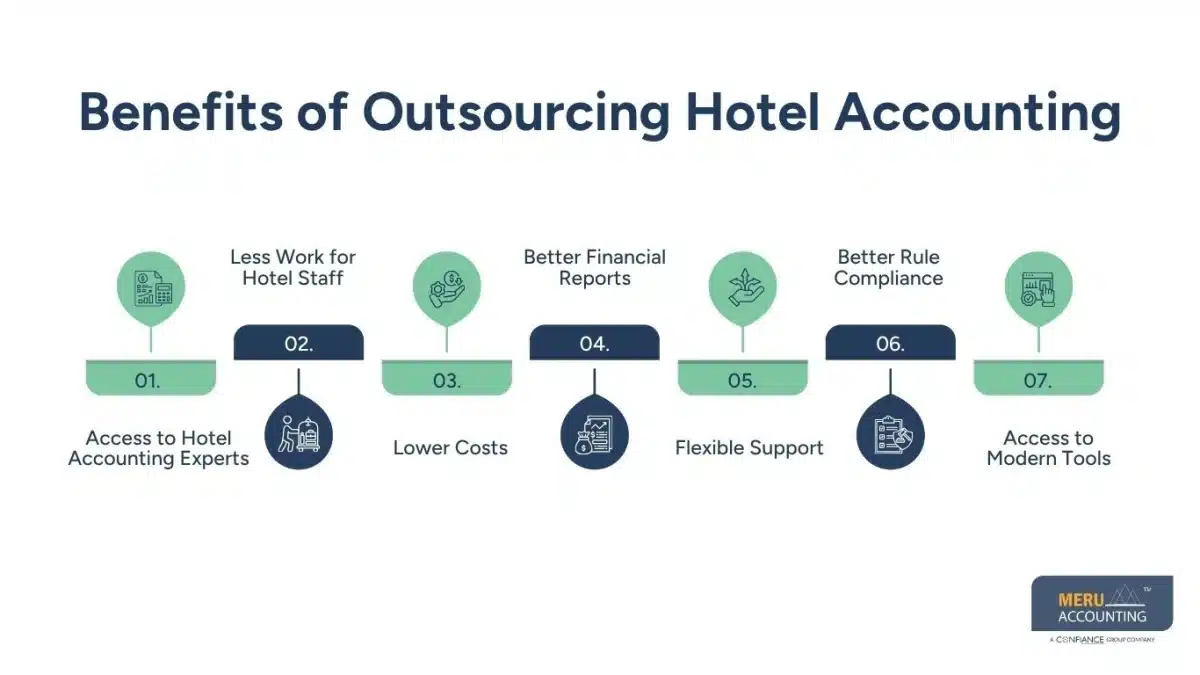
Flexible Support
As a hotel grows, outsourced services can grow as well. This helps meet new needs without adding more staff.
Better Rule Compliance
Accounting teams stay up to date on tax laws and reporting rules. This helps lower the risk of mistakes and fines.
Access to Modern Tools
Many outsourced firms use cloud tools that give hotel leaders quick access to financial data and reports.
How Outsourced Hospitality Accounting Services Improve Financial Accuracy
Financial accuracy is a key part of hotel success. Even a small error can affect reports, tax filings, budgets, and business plans.
Outsourced hospitality accounting services help improve accuracy in many ways.
Standard Work Processes
Professional accounting firms use clear and repeatable work steps.
These systems help reduce mistakes and improve data quality.
Correct Income Tracking
Hotels process a large number of sales each month.
Outsourced teams help make sure all income is tracked and placed in the right category.
This helps improve the accuracy of the hotel income statement and gives hotel leaders better data.
Timely Account Matching
Bank accounts, card sales, and other records must be checked on a regular basis.
Accounting teams match records often and fix issues before they grow into larger problems.
Strong Review Systems
Review systems help lower the risk of mistakes and fraud.
Outsourced firms often use checks, approvals, and review steps that help keep records correct.
Better Cost Tracking
Cost coding mistakes can affect report quality.
Accounting experts help place costs in the right area so reports stay accurate.
This helps improve the quality of the hotel income statement.
Faster Month-End Reports
Late reports can slow down business decisions.
Outsourced accounting teams help close books faster and provide reports on time.
Better Financial Review
Correct reports make it easier to review trends and compare results.
Hotel leaders can make better choices when they have reliable data.
Use of Connected Systems
Modern accounting tools can connect with hotel systems, payroll tools, and payment systems.
This reduces manual work and helps improve accuracy.
Better Audit Support
Well-kept records help make audits smoother.
Outsourced accounting teams keep records organized and ready for review when needed.
How Meru Accounting’s Hotel Accounting Services
At Meru Accounting, we know the financial needs of hotels and other hospitality firms. Our hotel accounting services help improve report accuracy, strengthen controls, and support growth.
Our team helps hotels with:
- Bookkeeping
- Accounts payable
- Accounts receivable
- Payroll services
- Financial reports
- Budget planning
- Bank matching
- Tax support
- Cash flow review
We use proven work methods and modern tools to provide clear and timely financial data of hotels.
Our team understands what is hotel accounting and how hotel finances differ from those of other businesses.
By working with Meru Accounting, hotel owners gain support from trained accounting staff who help keep each hotel income statement correct and useful for decision-making.
Key Takeaways
- A hotel income statement shows a hotel’s income, costs, and profit during a set time frame.
- Knowing what is hotel accounting helps hotel owners manage money, costs, and reporting work more well.
- Key parts of a hotel income statement include sales, cost of sales, operating costs, and net income.
- Outsourced hospitality accounting services help improve report accuracy and cut down on financial errors.
- Expert accounting support helps hotels save time, manage costs, and make better business choices.
FAQs
A hotel income statement is a financial report that shows a hotel’s income, costs, and profit during a set period.
What is hotel accounting? It is the process of tracking, managing, and reporting all financial activity tied to hotel operations.
A hotel income statement helps hotel owners track profit, manage costs, review performance, and make informed business choices.
They improve accuracy through expert review, routine checks, strong controls, timely reports, and modern accounting tools.
Yes. Small hotels can reduce costs, improve report quality, save time, and gain access to skilled accounting support through outsourced services.