Payroll looks simple until the numbers stop matching. An employee gets paid, taxes are withheld, benefits are deducted, and the payment is sent. Behind that one transaction are wage costs, tax liabilities, deductions, bank payments, and accounting entries that must agree. This is where a payroll accountant plays an important role.
The work connects payroll data with the accounting records so that wages, taxes, deductions, and liabilities are recorded correctly.
For a growing firm, payroll can become harder to manage as staff numbers rise, pay rules change, benefits are added, or workers are spread across states. A small business payroll accountant can handle the accounting side while the owner and internal team focus on other business tasks.
What You Will Learn From This Blog
- What a payroll accountant does beyond calculating employee pay.
- The main duties involved in payroll accounting.
- How payroll data moves from employee records into the books.
- What payroll accounting services can include.
- What can affect the cost of payroll accounting.
- When an in-house role or a small business payroll accountant may make more sense.
- What to check before choosing a payroll accounting service.
What is a Payroll Accountant?
A payroll accountant works on the book side of staff pay. The role can cover pay data, pay tax, tax withholdings, perks, journal entries, account checks, reports, and fixes.
For example, if payroll shows $60,000 in pay but the main book shows $58,500, the gap needs to be checked. It may be due to a missed entry, a time gap, or a wrong post.
Payroll accounting does not end when staff gets paid. The pay data must also go to the right books and match the source data.
What Does a Payroll Accountant Do?
Calculate Employee Wages and Salaries
Payroll work can cover salary, hourly pay, overtime, bonuses, sales pay, leave, and other approved changes. The source data should be checked before gross pay is set.
Record Payroll Expenses and Liabilities
Employee pay is an expense, but payroll can also create tax and benefit debts. These sums must be kept in the right records so the firm can see what it has paid and what it still owes.
Reconcile Payroll With Accounting Records
Payroll data should match the general ledger and related pay data. If the sums do not match, the gap should be found and fixed before the books are closed.
Manage Payroll Taxes and Deductions
Payroll can include U.S. federal and state taxes, Social Security, Medicare, 401(k) plans, health plans, and other pay cuts. U.S. firms must meet the tax rules that apply to their firm and staff.
Prepare Payroll Reports and Financial Records
Payroll reports can show gross pay, net pay, taxes, pay cuts, benefits, and firm costs. These sums can then be used for month-end and year-end book work.
Review Payroll Discrepancies and Corrections
A wrong pay rate, missed overtime, or extra pay cut can change more than one record. The cause of the error should be found, and the fix should be made in the right payroll and book records.
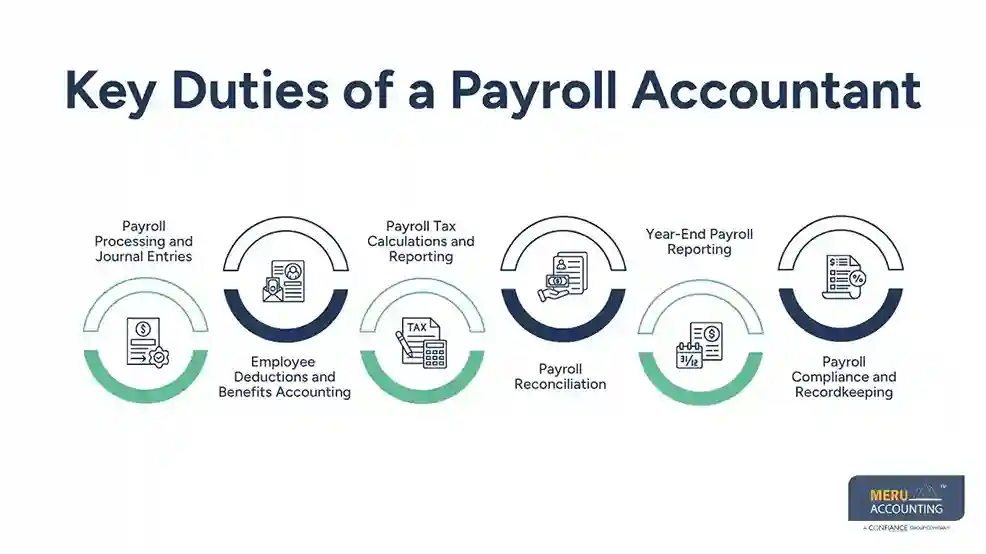
Key Duties of a Payroll Accountant
Payroll Processing and Journal Entries
Payroll work sets the pay data, while journal entries move that data into the books. Wage costs, tax costs, benefits, and dues must be put in the right accounts.
Employee Deductions and Benefits Accounting
Benefits and deductions may have their own accounts and due dates. The books should show what was cut from each paycheck and what the firm still owes to a plan or vendor.
Payroll Tax Calculations and Reporting
Tax work goes beyond a check of the final pay sum. Due dates, tax rules, staff data, and past changes can all affect the tax that must be filed or paid.
Payroll Reconciliation
Payroll reconciliation checks pay data against the ledger, bank data, tax sums, and pay cut accounts. It can flag lost entries, double posts, or dues that are still open.
Year-End Payroll Reporting
Year-end work checks pay sums, tax data, pay cuts, perks, and staff data. IRS rules say firms must keep work tax records for at least four years.
Payroll Compliance and Recordkeeping
Payroll records should show how each sum was set, held back, paid, and filed. Clear files also make it easy to check an old pay entry when a query comes up.
How Payroll Accounting Works
Collect Payroll and Employee Data
The process starts with hours, pay rates, leave, bonuses, new hires, employee exits, and deduction changes. These details should be reviewed before the payroll calculation begins.
Calculate Gross and Net Pay
Gross pay is calculated before deductions. Taxes, benefits, retirement amounts, and other approved deductions are then taken out to determine the employee’s net pay.
Record Payroll Journal Entries
Once payroll is approved, the related wage expenses and liabilities are recorded in the accounting system. Each amount should be posted to its correct account.
Account For Payroll Taxes and Deductions
Some amounts taken from pay are employee deductions, while others are employer costs. Amounts that have not yet been paid remain liabilities until they are settled.
Reconcile Payroll Accounts
Payroll totals, bank payments, tax balances, and ledger entries should agree. If they do not, the payroll accountant needs to identify whether the difference comes from timing, an error, or a missing entry.
Review and Close the Payroll Period
Before closing the period, unusual amounts, old liabilities, missing entries, and corrections should be reviewed. Once the open items are cleared, payroll can move into the normal accounting close.
optional anymore
on running the business
What are Payroll Accounting Services?
Payroll accounting services can cover day-to-day payroll work, checks, tax logs, reports, and year-end tasks. The scope can vary based on the size of the payroll and the staff a firm has in-house.
Payroll Processing
Payroll processing can mean a review of staff data, pay, tax cuts, and pay logs. It may be easy for staff on a set wage, but it can take more work when there is extra pay, sales pay, or more than one pay group.
Payroll Tax Accounting
Payroll tax accounting can mean a record of tax dues, tax pay, and key tax data. Firms should check which tax work and tax forms are part of the service.
Payroll Reconciliation
Payroll reconciliation checks if pay data, book data, and pay funds all match. It can spot double posts, tax dues not yet paid, or sums sent to the wrong account.
Payroll Journal Entries
Journal entries turn payroll data into book data. They can list wages, tax costs, staff plans, pay cuts, and other payroll costs.
Payroll Reporting
Payroll reports can show wage costs, tax dues, staff plans, pay cuts, and other key pay data. The best reports give firms data they can use to make sound choices.
Year-End Payroll Support
Year-end work can cover payroll checks, staff data checks, book fixes, and record checks. Up-to-date payroll data can make year-end work clearer and easier.
How Much Does a Payroll Accountant Cost?
There is no set cost for payroll accounting. A firm with 12 staff paid once a month has a much lower workload than a firm with 250 staff paid each week in many states.
Payroll Accountant Salary and Hourly Rates
An in-house payroll accountant costs more than just pay. The firm may also pay for tax, leave, staff perks, training, tools, gear, and other staff costs.
Cost of Outsourced Payroll Accounting Services
Outside firms may charge per staff member, pay run, month, or set of tasks. A low base fee may not mean a low end cost if tax work, fixes, reports, or year-end work cost more.
Factors That Affect Payroll Accounting Costs
Staff count, pay rate, states, staff perks, tax work, tools, report needs, fixes, and year-end work can all change the total cost.
In-House Payroll Accountant Vs. Outsourced Services
An in-house role gives the firm more day-to-day control and keeps payroll work in the core team. Outsourcing may fit a firm that has too little payroll work to need a full-time pro.
Small Business Payroll Accountant Pricing
A small business payroll accountant may charge by the hour, month, staff count, or set fee. Firms should check the tasks in the fee, not just pick the plan with the low ad price.
What Should be Included in the Cost
Ask if the fee includes payroll work, tax work, account checks, journal entries, reports, fixes, and year-end aid. A clear scope can help stop doubt over extra fees.
How to Choose a Payroll Accountant or Payroll Accounting Service
Payroll and Accounting Experience
Look for skill in both payroll work and accounting. Payroll tool use is key, but the provider should also know journal entries, dues, bank checks, and book data.
Tax and Compliance Knowledge
Ask what U.S. tax rules the provider can handle at the federal, state, and local level. For U.S. payroll, they should use the latest IRS rules, rates, and forms.
Software Expertise
Check if the provider knows the payroll and book tools used by the firm. What counts is not how many tools they know, but whether they can keep data right in each tool.
Data Security and Access Controls
Payroll has key staff data. Ask who can view payroll data, how that access is set, and how staff data is kept and sent.
Reporting and Reconciliation Processes
Ask what they check after each pay run and at month-end. A small business payroll accountant should be able to show how pay data is checked with the ledger, bank data, and unpaid dues.
Pricing and Service Scope
Ask for clear rates and a full list of tasks in the fee. This makes it easy to weigh an in-house hire vs. an out-of-house service.
Why Choose Meru Accounting for Payroll Accounting Services?
Meru Accounting provides payroll accounting services for businesses that need payroll figures recorded, checked, and connected with their accounting records.
Payroll and Accounting Work
Meru Accounting provides services that connect payroll records with accounting entries and account checks. This gives the finance team a clearer record of payroll expenses and liabilities.
Payroll Tax and Deduction Records
We provide services for recording payroll tax and deduction data within the accounting process. The tax rules that apply to the business should always be reviewed when handling these amounts.
Payroll Reconciliation
Meru Accounting provides services for checking payroll reports against accounting records and payment data. Differences can then be reviewed before they carry into another accounting period.
Payroll Reports
At Meru Accounting, we provide services for payroll reports covering key wage, tax, deduction, and payroll cost figures. Reports can be based on the information the finance team needs to review.
Small Business Payroll Accounting
A small business payroll accountant can be useful when a company has a small finance team but still needs regular payroll and accounting checks. Meru Accounting provides services based on the required payroll accounting scope.
Accounting Software and Records
At Meru Accounting, we work with accounting tools such as QuickBooks, Xero, Zoho Books, NetSuite, and Odoo. The right software depends on the company’s size, payroll process, reporting needs, and accounting workflow.
Our Expert Perspective
Payroll should not end when the employee receives the payment. The accounting work that follows is just as important.
A useful review asks simple questions: Does the payroll total match the wage expense? Do tax liabilities agree with payroll reports? Does the bank payment match the approved payroll? Are old balances still sitting in the books?
These checks can show where a payroll process needs attention. A payroll accountant should be able to trace the figures from the payroll data to the accounting entry and explain any difference.
For smaller firms, a small business payroll accountant can be a practical option when the company needs regular payroll accounting work but does not need a full-time specialist.
Key Takeaways
- A payroll accountant handles the book side of staff pay.
- Key tasks include payroll entries, pay cuts, tax work, bank checks, reports, and file upkeep.
- Payroll data should match the general ledger and pay records.
- A small business payroll accountant can fit firms with few in-house payroll staff.
- Costs vary by staff count, pay cycle, tax work, tools, states, and report needs.
- Firms should check the full scope of work, not just the fee per month.
- Payroll files should be kept and stored as set by the rules that apply.
FAQs
A payroll accountant records wages, taxes, deductions, benefits, and payroll liabilities while checking payroll data against the accounting records.
Payroll accounting services can include payroll processing, tax accounting, journal entries, payroll reconciliation, payroll reports, and year-end payroll work.
The cost depends on employee count, pay frequency, tax work, reporting needs, software, and whether the work is handled in-house or outsourced.
A small business may need payroll accounting when employee pay, tax records, deductions, and payroll reconciliations become difficult to manage internally.
A payroll accounting service should clearly state whether it includes payroll processing, tax and deduction records, journal entries, reconciliation, reports, corrections, and year-end work.
optional anymore
on running the business