
A strong plan starts with knowing how your cash moves. Preparing a cash flow forecast is a key first step in gaining full control over your business finances. It shows what you expect to earn and spend. This helps you stay ready for future needs. In this blog, we will guide you on building a clear and helpful cash forecast report.
Planning your cash flow helps you avoid surprises. It tells you when cash will come in and when it will go out. With this, you plan for bills, staff, and growth. It gives you control over your money, even when business gets tough.
What You Will Learn From This Blog
This blog is designed to give a practical understanding of cash flow prediction and how it supports better financial control in business operations.
- A clear understanding of what a cash flow forecast is and how it works in real business scenarios
- Insight into how a cash forecast report is structured and its key components
- Better clarity on how forecasting improves financial planning and decision-making
- Step-by-step methods for preparing an accurate cash flow forecast
- How outsourced cash flow forecast services support business growth and expansion
- Common forecasting mistakes and ways to avoid them for improved accuracy
- Useful tools and techniques that simplify cash flow tracking and reporting
What is a Cash Flow Forecast?
A cash flow forecast shows your expected cash inflows and outflows over a specific period. It helps you understand whether your business will have enough cash to manage daily operations, pay bills, and handle future costs. This planning tool is important for every business, whether small or large, because it gives a clear view of financial position before problems arise.
Why It Matters
- Prevents cash gaps by tracking inflow and outflow.
- Helps plan for slow sales or lean months.
- Keeps you ready for taxes or high one-time costs.
- Shows how long your cash can support your business.
What is a Cash Forecast Report?
It is the written form of your cash flow forecast. It lays out income and spending over weeks or months in a clear structure. It helps you see gaps, spot trends, and understand how money moves in and out of your business over time. A cash forecast report also gives a simple view of financial position, so planning becomes more practical and less uncertain.
What Comes Into the Report?
Start Cash
Cash on hand at the start of the month for better planning clarity. Opening balance sets the base for the full cash flow forecast report and defines the starting liquidity position clearly.
Cash In
Expected sales, loans, or other income from different sources. Incoming customer payments, receivables, and other inflows are also included in projected figures for accuracy.
Cash Out
Bills, wages, rent, supplier payments, and other costs for the period. Regular operating costs, along with one-time expenses, are recorded to understand total outflow pressure properly.
End Cash
Final balance after cash in and cash out for the reporting period. Remaining funds after all inflows and outflows indicate the closing liquidity position for the period clearly.
A cash forecast report uses these parts to show how cash changes over time and where pressure points may appear.
Who Uses This Report?
- Business owners
- Accountants
- Investors
- Lenders or banks
Why Preparing a Forecast is Crucial for Business Success
Your business needs cash to survive. Preparing a cash forecast gives a clear view of what is coming. Without it, you risk cash shortages.
Benefits of Forecasting Cash
- Keeps spending in check
- Helps make better choices
- Builds trust with banks or lenders
- Sets your path for growth
When to Use a Cash Flow Forecast
- Launching a new product
- Facing sales drops
- Seeking a loan
- Planning for the year ahead
Steps for Preparing a Cash Flow Forecast Effectively
Use these clear steps to build a cash flow forecast with ease and care. These steps help you avoid cash gaps and stay in charge of your money.
Step 1: Gather Cash Data
Check your bank records, bills, and past payments. These records give you a clear view of how cash flows in and out.
Step 2: List Cash Inflows
Write down all cash sources like customer pay, loans, grants, and interest. This helps you know how much cash will come in.
Step 3: List Cash Outflows
Note fixed and changeable costs like rent, pay, power bills, loans, and tax. This shows all areas where you spend cash.
Step 4: Build the Forecast Table
Draw a table with weeks or months across the top. Add income and cost groups to the side, then fill in each value to track net cash and end balance.
Step 5: Review and Adjust
Each month, match your forecast with real cash flow. Use the results to fix numbers and plans for better future forecasts.
How Outsourced Cash Flow Forecast Services Support Business Expansion
Preparing For Growth Opportunities
Business expansion requires careful financial planning. Companies need to know if they have enough funds before entering new markets, launching products, or increasing operations.
An accurate cash flow forecast gives business owners a clear view of available resources and upcoming financial needs.
Managing Expansion Costs
Growth often brings new expenses such as hiring, equipment purchases, marketing, and higher operating costs.
Outsourced forecasting services review these expected costs and create a practical plan to manage cash requirements.
Improving Investment Decisions
Before making major investments, businesses need reliable financial information. Forecasting allows owners to understand whether current funds can support new projects.
A detailed cash forecast report gives insight into future cash availability and possible financial pressure.
Reducing Financial Risks
Expansion can create challenges when businesses grow faster than their cash position allows.
Regular financial reviews allow companies to identify possible shortages early and make adjustments before problems affect growth plans.
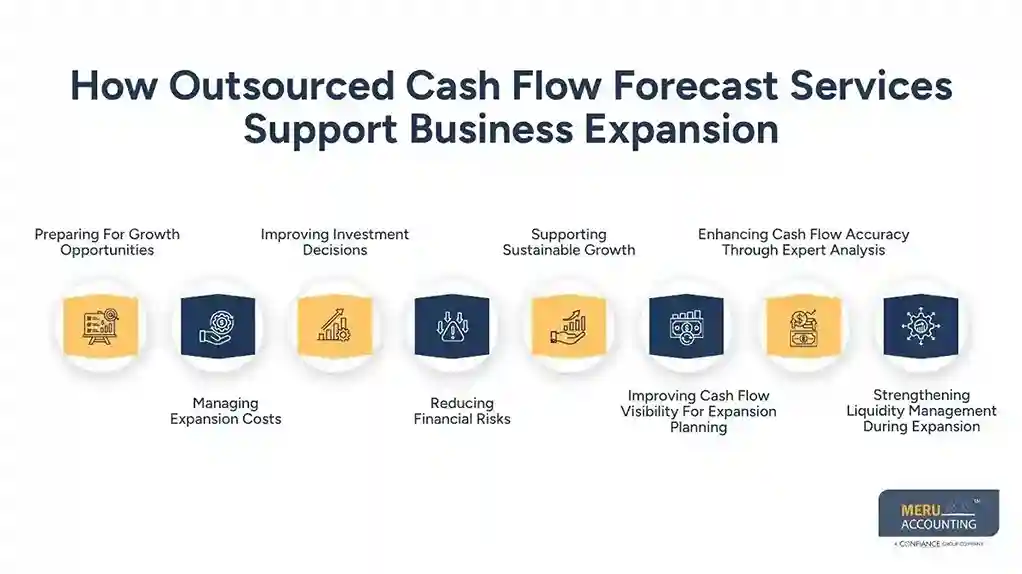
Supporting Sustainable Growth
Long-term growth depends on strong financial control. Outsourced experts organize financial data and prepare reports that show how business decisions may affect future cash flow.
With better planning and clear financial visibility, companies can expand with greater confidence.
Improving Cash Flow Visibility For Expansion Planning
Outsourced cash flow forecast services give businesses a clearer view of expected cash movement across different growth stages. This visibility helps owners understand when funds will be available and when pressure may occur.
A structured cash flow projection report allows better timing of expansion activities so businesses can avoid cash shortages during key growth phases.
Enhancing Cash Flow Accuracy Through Expert Analysis
Outsourced forecasting improves accuracy by using structured financial models and real business data. Financial projections remain closely aligned with current performance and updated cash patterns.
Strengthening Liquidity Management During Expansion
Liquidity planning ensures businesses have enough cash to manage ongoing expansion needs. Cash positions stay stable by tracking inflows and outflows across different growth stages.
Common Mistakes to Avoid in Your Cash Forecast Report
Errors in your cash forecast report can disrupt informed planning and limit growth. To keep your forecasting on track, be aware of and avoid these common pitfalls
Overstating Cash Inflows
Many businesses overestimate sales or loans. Stay realistic by using real past data and keeping future expectations modest and accurate.
Missing Key Costs
Some fixed or seasonal costs get ignored. Track and include everything from taxes and debt payments to surprise one-time business expenses.
Not Updating the Report
Using old data can lead to poor decisions. Update your report monthly or after major changes in cash flow to keep it useful.
Mixing Profit with Cash
Profit doesn’t mean cash in real business operations. Your profit can look strong on paper, but if the money isn’t in the bank, your business might still struggle during daily operations.
Using Complex Tools
Overly complex tools waste time and confuse teams. Choose tools that match your skills and make tracking easier, not harder.
Tips for Accurate and Reliable Cash Forecast Reports
A good cash forecast report is easy to read and update. Follow these tips to get better results.
Keep It Simple
Use basic rows, columns, and formulas. Include only the most needed data so your report stays clean and clear for daily use.
Be Honest with Assumptions
Don’t aim high with income. Use facts from earlier records, and always question unknowns before adding them to your forecast.
Build a Cash Buffer
Add a buffer of extra funds in your forecast. This gives safety when unexpected costs show up or income gets delayed.
Use Short Time Frames
Use weekly or bi-weekly time blocks for updates. These smaller chunks give a clearer view and allow quicker action if needed.
Test Different Scenarios
Check how your plan works under pressure. Try best, worst, and normal-case situations to know where you stand in any case.
Work with Experts
Accountants help spot gaps and offer a better structure. Their insights improve your forecast and make it more useful.
Tools and Templates to Simplify Preparing a Cash Flow Forecast
When preparing a cash flow forecast, it’s vital to select tools that match your business needs. Choose ones suited to your business size, user experience, and financial goals to ensure reliable forecasts.
Excel or Google Sheets
Use spreadsheets to create easy-to-edit tables. These tools are free, flexible, and perfect for small and mid-size businesses.
Accounting Software
Use software like QuickBooks or Xero. They offer built-in cash flow features and make syncing your bank data simple.
Cash Flow Apps
Apps like Float and Pulse help track cash in real time. They offer smart visuals and alerts for quick action.
Templates
Download free templates with set rows and columns. These are ready to use, making it easy even for beginners.
Custom Reports
Experts can create reports based on your needs. Custom tools reduce risk, save time, and boost forecasting accuracy.
Why Choose Meru Accounting?
Preparing a cash flow forecast builds a strong base for steady business growth by giving clear insight into expected cash flow. A detailed cash forecast report shows when cash will come in and when payments will go out, while also helping identify possible gaps in advance so planning becomes more practical and controlled.
At Meru Accounting, we work closely with businesses to manage cash flow forecast tasks in a structured and reliable way. Our team prepares accurate cash flow reports, builds forecast plans based on real business data, and runs scenario checks to understand how different financial situations may affect cash position.
We also use trusted tools like Excel and widely used accounting applications to keep the forecasting process simple, consistent, and easy to review. Each cash flow projection report is designed to reflect actual business conditions rather than assumptions, so decision-making becomes more grounded.
With Meru Accounting’s support, businesses gain a clearer financial direction through a well-prepared cash flow projection process. Our approach turns forecasting into a practical planning tool that improves visibility over cash movement and supports better control over day-to-day operations and future planning.
Our Expert Perspective
Cash flow forecasting is a continuous financial control system that helps businesses manage timing gaps between income and expenses, which often create liquidity challenges. A well-prepared cash forecast report supports proactive planning by identifying future cash pressure points and enabling timely adjustments in spending, credit, or collections.
In outsourced environments, financial experts strengthen accuracy through structured processes, benchmarking, and scenario analysis, while also improving decision-making confidence, lender trust, and long-term scalability.
Key Takeaways
- Cash flow forecasting helps businesses understand future liquidity before making financial commitments
- A structured cash forecast report improves visibility over income timing and expense planning
- Outsourced forecasting support enhances accuracy through expert review and financial modeling
- Regular updates to forecasts reduce risks linked to cash gaps and unexpected expenses
- Growth decisions become more reliable when backed by clear cash position insights
- Tools like Excel, accounting software, and forecasting apps simplify financial tracking
- Strong forecasting shifts business planning from reactive to proactive financial management
FAQs
The main goal is to track money coming in and going out. This helps you plan, avoid shortages, and make smart decisions for your business.
Update your report every month. Also, review it after any major change in sales, expenses, or business goals.
Yes, Excel is a great tool for creating a cash flow forecast. It lets you build easy tables, add formulas, and update data as needed.
If your report shows a shortfall, cut non-essential costs or delay some expenses. You can also try to speed up payments from customers.
No, a budget plans your profit and spending. A forecast report tracks your real-time cash inflow and outflow to avoid shortfalls.
optional anymore
on running the business