
The CAM statement says $48,000. The tenant’s records show $43,500. Which number is right?
That question is common when a commercial property reaches its year-end CAM reconciliation. The difference may not come from a simple math error. A repair may not be recoverable. A utility bill may cover both tenant space and common areas. The tenant’s share may have changed. Or the monthly CAM estimate may have been set too high or too low. This is where a property accountant has to look beyond the final numbers.
CAM reconciliation brings together the lease, property expenses, tenant area, allocation rules, and payments already made. One wrong expense or one wrong percentage can change the final amount billed to a tenant.
A sound reconciliation therefore starts with the lease and ends with a balance that can be traced back to the records. The goal is not just to make the numbers match. It is to make sure the right costs are being charged to the right tenants under the right terms.
What You Will Learn From This Blog
- How CAM reconciliation works from the first lease review to the final tenant balance.
- What does a property accountant do when actual property costs are ready for review?
- How eligible CAM expenses are separated from costs that should not be passed to tenants.
- How a tenant’s share is worked out.
- How estimated CAM payments are compared with actual costs.
- Where common errors can change a CAM reconciliation.
- How a complete CAM reconciliation example works from start to finish.
What Is CAM Reconciliation In Property Accounting?
CAM reconciliation is the process used to compare what a tenant was expected to pay with what the tenant’s actual share of eligible common-area costs turns out to be.
During the year, a tenant may pay estimated CAM charges each month. Once the accounting period ends, actual costs are known. The final calculation shows whether the tenant paid too much, too little, or the correct amount.
The Lease Sets The Rules
The expense ledger may show hundreds of property costs, but that does not mean every one belongs in CAM.
The lease decides which expenses are recoverable, how the tenant’s share is calculated, whether certain costs have limits, and which items must be left out.
The Expense Pool Comes Next
Once the lease rules are known, what does a property accountant do next? Eligible expenses are grouped into the CAM pool.
For example, common-area cleaning may qualify while a major building upgrade may not. The difference matters because the tenant’s share is calculated from the final eligible pool, not from every expense recorded for the property.
Each Tenant Has A Share
CAM is usually divided according to a tenant’s agreed proportion of the property.
If a tenant occupies 10% of the area used for the allocation, the tenant may bear 10% of the eligible CAM pool. The exact method, however, comes from the lease.
The Final Number Is A Reconciliation
The final CAM amount is not simply the tenant’s share of expenses.
The property accountant must also compare that amount with the tenant’s estimated payments and apply any permitted adjustments before arriving at the final balance.
What Does A Property Accountant Do During CAM Reconciliation?
Starts With The Lease
The first review is not the general ledger. It is the lease. The property accountant identifies the clauses that affect CAM, including recoverable expenses, exclusions, allocation rules, caps, billing periods, and any special provisions.
Builds The Expense Base
Next comes the property expense data.
Invoices, bills, accounting entries, service costs, tax records, insurance charges, and other relevant records are brought together for the period being reconciled.
Challenges The Expense List
This is where the work becomes more than simple bookkeeping.
A property accountant asks whether each cost belongs in the CAM pool. A valid property expense can still be a non-recoverable tenant expense if the lease says it should be excluded.
Checks The Tenant Share
The tenant’s area and agreed percentage are checked before the final calculation.
A 1% difference may look small, but on a large property it can create a material change in the tenant’s bill.
Tests The Payments
The amount already paid by the tenant is compared with the final calculated share.
This step shows whether the tenant has an amount due or has paid more than the final requirement.
Reviews The Final Statement
The final CAM statement should tell the story of the calculation.
The property accountant checks the expense pool, allocation, tenant payments, adjustments, and balance before the statement is issued.
How Does A Property Accountant Manage CAM Reconciliation?
Step 1: Review The Lease Agreement
Before touching the calculation, the property accountant marks the parts of the lease that affect CAM.
Suppose the lease permits repairs, landscaping, security, and common utilities but excludes capital improvements. Knowing what does a property accountant do starts with understanding how lease terms determine which property costs can be included in CAM.
Step 2: Collect CAM-Related Expense Records
The next task is to bring together the costs for the correct property and accounting period.
This can include maintenance bills, cleaning invoices, landscaping charges, security costs, utility bills, insurance, taxes, and management fees where the lease permits recovery.
Step 3: Categorize Eligible And Ineligible Expenses
Now the expenses are tested against the lease.
Imagine the property spent $300,000 during the year. If $30,000 relates to a major capital project that the lease does not allow in CAM, the calculation cannot start with $300,000.
The eligible pool would begin at $270,000.
Step 4: Calculate The Property’s Total CAM Expenses
After exclusions and required adjustments, the remaining eligible costs are added together.
This becomes the amount from which tenant shares are calculated. If the expense pool is wrong, every tenant’s final number can be wrong even if the allocation formula is perfect.
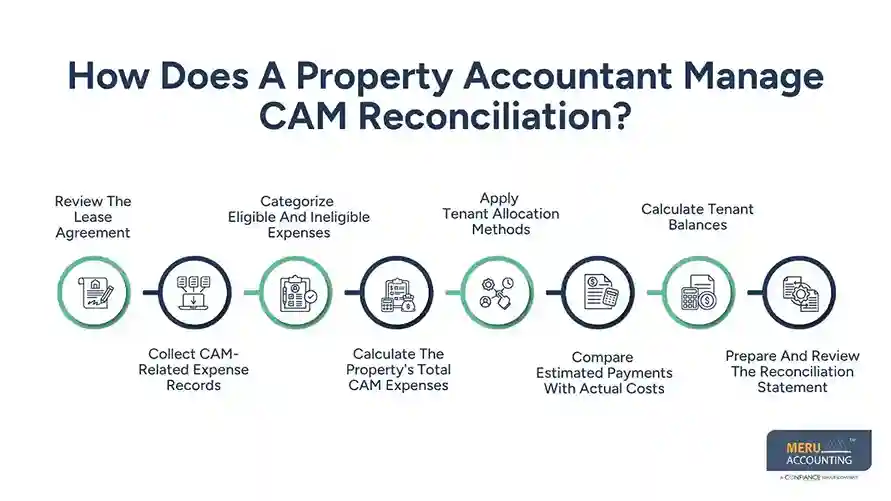
Step 5: Apply Tenant Allocation Methods
The property accountant then applies the allocation method stated in the lease.
For example, if a tenant has a 10% share of a $270,000 CAM pool, the starting charge is $27,000. A different lease may use another allocation method, so the percentage cannot simply be assumed.
Step 6: Compare Estimated Payments With Actual Costs
The next question is: how much has the tenant already paid?
If the tenant paid $25,000 during the year against a final CAM share of $27,000, there is a $2,000 difference before other adjustments.
Step 7: Calculate Tenant Balances
The calculation is then taken to its final stage.
Any permitted credits, caps, prior adjustments, or other lease-based items are applied. The result may be an amount due from the tenant or a credit in the tenant’s favor.
Step 8: Prepare And Review The Reconciliation Statement
The final statement brings the entire calculation together.
It should show the eligible CAM expenses, the tenant’s allocation, payments already made, adjustments, and final balance. The property accountant checks the statement before it reaches the tenant.
What Expenses Are Included In CAM Reconciliation?
Property Maintenance And Repairs
Routine work needed to maintain shared property areas may form part of CAM when the lease permits it.
Examples can include repairs to common facilities, routine upkeep, and maintenance of shared building systems.
Landscaping And Exterior Maintenance
A property’s outdoor areas can create a steady stream of costs.
Landscaping, lawn care, parking area upkeep, exterior cleaning, and similar services may be included when they meet the lease requirements.
Security And Janitorial Services
Security and cleaning are often recurring common-area expenses.
Guard services, common-area cleaning, waste collection, and janitorial work may enter the CAM pool when they relate to shared areas and are recoverable under the lease.
Utilities And Common-Area Services
Utility costs can be more difficult when one bill covers different parts of a building.
A property accountant may need to identify the portion related to common areas rather than place the entire bill into CAM.
Property Management Costs
Some commercial leases allow a management fee as part of operating costs.
The calculation must follow the lease. A management fee should not be added simply because it is common in other property agreements.
Insurance And Property Taxes, Where Permitted By The Lease
Insurance and property taxes can be significant property costs.
Whether they belong in CAM depends on the lease. The property accountant must also check the correct period and allocation before including them.
optional anymore
on running the business
Which CAM Expenses Should A Property Accountant Exclude?
Capital Expenditures
A major improvement can create one of the biggest CAM errors.
A new roof, major equipment replacement, or building upgrade may need separate treatment rather than being added to normal operating expenses. The lease determines whether and how such costs may be recovered.
Landlord-Specific Expenses
Not every cost incurred by the owner relates to the shared operation of the property.
Owner-specific legal work, financing costs, or expenses tied to the landlord’s own business may need to stay outside the CAM pool.
Costs Prohibited By The Lease
Sometimes the answer is clear because the lease says a particular cost cannot be passed to tenants.
In that case, the expense stays out even if it is a real and properly recorded property cost.
Duplicate Or Incorrectly Allocated Expenses
A duplicate invoice can quietly increase the CAM pool.
The same risk exists when an expense from another property, another period, or a tenant’s private space is included in the common-area calculation.
CAM Reconciliation Example: How A Property Accountant Calculates Tenant Charges
Sample Property Expenses
Consider a retail property with the following annual expenses:
Expense | Amount |
Common-area maintenance | $70,000 |
Landscaping | $25,000 |
Security | $40,000 |
Janitorial services | $30,000 |
Common-area utilities | $45,000 |
Property management | $20,000 |
Capital improvement | $35,000 |
Total recorded expenses | $265,000 |
The lease does not permit the $35,000 capital improvement to be included in normal CAM.
So the eligible CAM pool is:
$265,000 − $35,000 = $230,000
Tenant’s Pro Rata Share
Tenant A has a 10% share under the lease.
The calculation is:
$230,000 × 10% = $23,000
Tenant A’s actual CAM share is therefore $23,000 before any other lease-specific adjustment.
Estimated Vs. Actual CAM Payments
During the year, Tenant A paid $21,000 in estimated CAM charges.
Now the two numbers can be compared:
Actual CAM share: $23,000
Estimated payments: $21,000
Difference: $2,000
At this stage, the tenant has a preliminary balance of $2,000 due.
Final Reconciliation Amount
Now suppose the tenant has a $500 credit from an earlier billing correction.
The final calculation becomes:
$2,000 − $500 = $1,500
Tenant A therefore has a final CAM balance of $1,500 due.
This example shows why CAM reconciliation cannot be reduced to one simple formula. The property accountant first determines what belongs in the expense pool, then applies the tenant share, compares prior payments, and makes the adjustments required by the lease.
How Meru Accounting Handles Property Accounting Needs
CAM reconciliation is only as reliable as the accounting records behind it. If expenses are not classified correctly during the year, the final tenant calculation can take much longer to review.
Meru Accounting provides property accounting services with a focus on the records and calculations that support commercial property operations. So, what does a property accountant do beyond maintaining transaction records? The role can extend to expense reviews, reconciliations, tenant accounting, CAM calculations, and financial reporting.
Property expense recording
Property-related costs are recorded under the appropriate accounts so maintenance, utilities, repairs, management costs, and other expenses can be reviewed with less confusion.
Account reconciliation
Bank and account records are checked against recorded transactions to identify missing entries, duplicate amounts, or differences that may affect property reporting.
CAM expense review
Expense categories can be reviewed against the information available for the property so that the figures used for CAM calculations are easier to trace.
Tenant accounting records
Tenant charges, payments, balances, and related transactions are maintained in an organized manner, giving property owners a clearer view of tenant-level activity.
Financial reporting
Property owners can receive structured financial reports that show income, expenses, balances, and other key accounting information for their properties.
Accounting software
Meru Accounting provides services using platforms such as QuickBooks, Xero, Zoho Books, NetSuite, and Odoo, based on the accounting setup of the business.
Our Expert Perspective
The biggest CAM errors do not always come from bad arithmetic. They often begin much earlier, when an expense is placed into the CAM pool without checking the lease.
A strong property accountant therefore works from the lease outward, which also explains what does a property accountant do when reviewing CAM charges. First, the rules are identified, the costs are tested, the tenant share is calculated, and the amount is then compared with estimated payments.
That approach also makes the final statement easier to review. When a tenant asks why a charge changed, the answer should be traceable to a lease term, an expense record, or a clear calculation rather than a number that appeared at year-end.
Key Takeaways
- CAM reconciliation compares actual eligible costs with the CAM payments made by tenants.
- The lease should be reviewed before the expense calculation begins.
- Not every property expense is a recoverable CAM expense.
- Capital projects, landlord-specific costs, and prohibited charges may need to be excluded.
- A tenant’s share must follow the allocation method stated in the lease.
- Estimated CAM payments are compared with the tenant’s final calculated share.
- Credits and other permitted adjustments can change the final amount.
- A clear reconciliation statement should show how the final balance was reached.
- A property accountant should be able to trace the final number back to the source records.
FAQs
A property accountant reviews the lease, verifies eligible CAM costs, calculates each tenant’s share, and compares it with payments already made.
A property accountant calculates CAM charges by adding eligible costs, applying the tenant’s agreed share, and subtracting estimated CAM payments.
CAM reconciliation may include maintenance, landscaping, security, janitorial work, common-area utilities, management costs, insurance, and property taxes when allowed by the lease.
CAM reconciliation may exclude capital improvements, landlord-specific costs, duplicate charges, and other expenses that the lease does not allow the tenant to pay.
The final CAM amount is calculated by comparing the tenant’s actual share of eligible expenses with the estimated CAM payments made during the year.
optional anymore
on running the business