QuickBooks and real estate work well when a brokerage has a clear way to record sales, fees, commissions, deposits, and payouts. Brokerage statements often contain numerous line items, so a missed fee or duplicate entry can affect financial records.
A proper reconciliation process verifies each transaction against the corresponding bank activity and accounting records to identify discrepancies and ensure accurate financial reporting.
QuickBooks and real estate also need a set chart of accounts and a fixed review cycle. The goal is not just a zero balance. The goal is a clear trail for QuickBooks real estate accounting, from the broker statement to QuickBooks and then to the bank.
What You Will Learn From This Blog
- What a brokerage statement is and why it needs a check.
- How QuickBooks and real estate records can be linked in one clear flow.
- How to match gross commission, broker fees, splits, and net pay.
- How to find common errors before they affect reports.
- How QuickBooks real estate accounting can fit a monthly close.
- When a bookkeeper or CPA should review a hard item.
What Is Brokerage Statement Reconciliation?
Meaning Of Reconciliation
QuickBooks and real estate reconciliation is the task of matching the broker’s statement to the entries in QuickBooks and the related bank activity. Each amount should have a clear reason and source.
Main Items On A Statement
QuickBooks and real estate users should read the full statement, not only the final payout. The detail shows what was earned, paid, or held.
Gross Commission Check
Start with the gross commission shown on the deal record. Then check the broker split and other fees to see if the net amount paid agrees with the statement.
Net Payout Check
The net payout is often the key bank match. If the bank shows $8,400, the related statement should explain how that $8,400 came from the gross deal amount.
Why The Check Matters
A small error can affect income, fees, receivables, and tax data. Accurate accounting records remain more useful when each deal has a clear audit trail and supporting documentation.
How QuickBooks and Real Estate Accounting Work Together
Set The Chart Of Accounts
Use clear accounts for commission income, broker fees, referral fees, marketing, payroll, and other costs. QuickBooks and real estate accounting work best when each income and expense category is clearly separated for accurate deal-level reporting.
Use Classes Or Locations
QuickBooks real estate accounting can use classes or locations to track teams, offices, or business lines where the QuickBooks plan allows them. A fixed naming rule keeps reports easy to read in QuickBooks real estate accounting.
Record Deal Activity
Record each deal based on the firm’s accounting method and the source records. Do not book a bank deposit as income without checking what the deposit stands for.
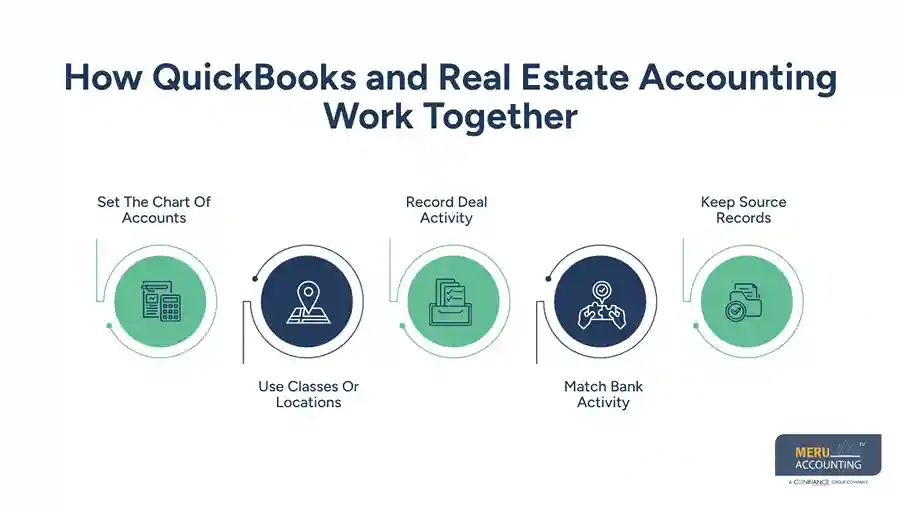
Match Bank Activity
For real estate accounting, bank feeds can bring in transactions, but each item still needs review. Intuit says reconciliation compares QuickBooks entries with bank or credit card statements and aims for a zero difference.
Keep Source Records
Save broker statements, closing sheets, invoices, and payment records with the related work. QuickBooks and real estate data is easier to review when source files are kept in order for QuickBooks real estate accounting.
optional anymore
on running the business
How To Reconcile Real Estate Brokerage Statements In QuickBooks
Gather The Records
For QuickBooks and real estate, get the brokerage statement, bank statement, closing sheet, and deal report for the same period. Confirm the dates and account names before you start.
Check The Opening Balance
Start with the last reconciled balance. Intuit notes that an incorrect opening balance is a common cause of a wrong first reconciliation.
Match Gross And Net
Compare the gross commission, broker split, fees, and net payout. The net amount should match the bank deposit or the amount due, based on the transaction flow.
Clear Matching Entries
Mark only the items that match the statement. QuickBooks shows the cleared balance as you select entries, and the goal is a $0 difference before the reconciliation is finished.
Review The Report
For QuickBooks and real estate, check the final reconciliation report and keep it with the period records. Intuit says QuickBooks saves a reconciliation report after the account is reconciled.
Common Brokerage Reconciliation Errors In QuickBooks
Duplicate Deposits
A deposit may be entered manually and also added through the bank feed. This can double-count income and make the bank balance difficult to reconcile.
Wrong Commission Amount
In QuickBooks and real estate, a gross commission may be recorded as the net payout, or the broker split may be missed. The brokerage statement should be reviewed to separate the commission, broker split, fees, and final payout correctly.
Missed Broker Fees
Desk fees, transaction fees, referral fees, and other charges may be left out during reconciliation. These gaps can make reported income appear higher than the actual amount received.
Wrong Date Or Deal
In QuickBooks and real estate, a payout may be posted to the wrong month or matched with the wrong transaction. Review the closing date, payout date, deal details, and statement period before making changes.
Old Reconciled Entries
Changing an entry from a previous reconciliation can affect the prior period balance. Older reconciled transactions should be reviewed carefully, and an accountant should be consulted when a past reconciliation requires correction.
Best Practices For QuickBooks Real Estate Accounting
Reconcile Each Month
For QuickBooks and real estate, a monthly close establishes a consistent period for reviewing bank activity, brokerage statements, and transaction records. Intuit recommends regular reconciliation, with monthly review serving as a sound accounting practice for identifying discrepancies and keeping financial records current.
Use One Deal Naming Rule
For QuickBooks and real estate, use a set format for deal names, clients, or property IDs. A simple rule makes reports easy to read in QuickBooks real estate accounting.
Keep A Review List
QuickBooks real estate accounting can use a short list for missing statements, unmatched deposits, old items, and unclear fees. Brokerage accounting work becomes easier to manage when open items are tracked and reviewed regularly.
Do Not Force A Zero
A $0 difference is not proof that the entry is right. A bad entry can still make the books balance, so the statement, bank, and source record must all agree. Real estate bookkeeping should focus on accurate transaction matching rather than simply reaching a zero difference.
Review Before Tax Work
Have the final accounting records reviewed before tax filing or major reports are issued. Real estate accounting records should be reviewed by a qualified bookkeeper or tax professional when a transaction has tax implications.
Why Choose Meru Accounting?
QuickBooks Bookkeeping Services
Meru Accounting provides QuickBooks bookkeeping services for real estate businesses that need regular recording, account review, bank reconciliation, and financial reporting. Our team works with the records supplied by the brokerage or real estate business.
Brokerage Statement Reconciliation
Meru Accounting provides brokerage statement reconciliation services to match commission statements with QuickBooks records and bank activity. Our process covers gross commissions, broker splits, fees, payouts, and unmatched items.
Real Estate Transaction Bookkeeping
Meru Accounting provides real estate transaction bookkeeping services for businesses that need deal-level records. Transactions can be recorded and classified based on the firm’s accounting setup and source documents.
Bank And Credit Card Reconciliation
QuickBooks and real estate records become more reliable when bank and credit card activity is reviewed against recorded transactions. Each period can be reviewed for duplicate entries, missing transactions, wrong classifications, and unmatched balances.
Financial Reporting Services
Meru Accounting provides financial reporting services for real estate businesses that need clear income statements, balance sheets, and other accounting reports. Reports can be prepared from properly maintained accounting records and reviewed financial data.
Ongoing Accounting Services
Meru Accounting provides ongoing accounting services for real estate firms that want regular bookkeeping and reconciliation work handled by an accounting team familiar with QuickBooks and real estate accounting requirements. Service scope can be set based on transaction volume, accounts, reporting needs, and the firm’s workflow.
Our Expert Perspective
Brokerage statement reconciliation should start with the deal record, not just the bank deposit. A proper review checks the gross commission, broker split, referral fee, transaction fee, and net amount against the related statement and bank entry.
Timing gaps can occur when a broker statement and bank payment fall in different periods, so each open item should be tracked rather than forced into a category. QuickBooks should then reflect the same deal flow through clear income and expense accounts.
From a QuickBooks and real estate accounting perspective, the key test is simple: each amount should have a source, each deduction should have a reason, and each bank entry should link back to a deal or valid business transaction. Regular monthly checks can also catch duplicate deposits, missed fees, wrong dates, and old unreconciled items before they affect financial reports or tax work.
Key Takeaways
- QuickBooks and real estate records should link the broker statement, books, and bank.
- Match gross commission, splits, fees, and net payout for each deal.
- Check the opening balance before starting a new reconciliation.
- Do not use a forced adjustment just to make the difference zero.
- Keep broker statements and other source records with the period file.
- Use QuickBooks real estate accounting with a fixed monthly review process.
- Ask a qualified accounting pro to review old or tax-sensitive corrections.
FAQs
Brokerage statement reconciliation in QuickBooks means matching commissions, broker splits, fees, and payouts with the brokerage statement and bank transactions.
To reconcile a real estate brokerage statement in QuickBooks, compare the gross commission, broker split, fees, net payout, and related bank transaction for each deal.
Match each commission deposit to the correct brokerage statement, deal record, and QuickBooks entry while checking that the net amount agrees with the bank deposit.
Common QuickBooks and real estate reconciliation issues include duplicate deposits, missing broker fees, incorrect commission amounts, wrong transaction dates, and entries assigned to the wrong deal.
A real estate brokerage should reconcile QuickBooks and brokerage statements at least monthly, with more frequent reviews when transaction volume is high.
optional anymore
on running the business