
Real estate financial reporting becomes more important as property businesses grow beyond simple income and expense tracking. In early stages, basic bookkeeping may seem enough, but it quickly falls short when portfolios expand across multiple properties, tenants, loans, and tax rules. At this stage, real estate financial reporting helps bring structure, clarity, and control over financial performance. It also supports better planning and risk control.
Many property owners also begin asking what is financial management analysis as they try to understand deeper financial patterns behind their investments and cash flow behavior. This blog explains how financial systems change as businesses scale and why stronger reporting methods are needed.
What You Will Learn From This Blog
- How financial tracking changes as property portfolios grow
- Why basic bookkeeping is not enough for scaling real estate businesses
- How structured reporting improves profit clarity and decision-making
- The link between reporting systems and financial planning quality
- Common mistakes property businesses make without strong reporting
- Practical steps to move from bookkeeping to advanced reporting systems
Introduction To Real Estate Financial Reporting In Growing Property Businesses
Shift From Basic Tracking To Structured Systems
In the early stage, most owners track rent and expenses in simple spreadsheets. As portfolios grow, real estate financial reporting becomes necessary to handle multiple data sources in a structured way.
Financial clarity improves when data moves from scattered sheets into organized reporting systems.
Increasing Volume Of Financial Data
More properties mean more transactions, repair costs, tax records, and loan details. Without structured reporting, it becomes difficult to keep records clean and reliable. Data errors also increase when financial activity grows without proper systems.
Need For Clear Profit Visibility
Investors need to know which property is earning well and which is not. Structured reporting gives a clear view of property-level profit and loss. This helps owners focus on improving weaker-performing assets effectively.
Better Control Over Cash Flow
Cash flow timing becomes complex with multiple tenants and mortgages. Structured reporting helps track inflows and outflows more accurately. Better visibility also reduces chances of payment delays or shortages.
Stronger Financial Discipline
As businesses grow, discipline in record-keeping becomes essential. Structured reporting ensures consistency across all properties and financial periods. Regular tracking habits also improve overall financial reliability over time.
Understanding Why Real Estate Financial Reporting Becomes Critical During Business Expansion
Portfolio Growth Increases Complexity
As properties increase, reporting becomes necessary for managing finances. Manual tracking breaks when each property has unique financial patterns.
Multiple Revenue Sources
Rental income, parking fees, and service charges need tracking. This is where real estate financial reporting helps combine data. Structured reporting improves clarity across all income streams efficiently.
Rising Compliance Requirements
Tax and legal rules become more detailed with expansion. Reporting helps maintain compliance accuracy across multiple property records. It also ensures audit readiness without last-minute documentation issues.
Risk Of Financial Misreporting
Without systems, errors occur in rent and expense tracking. Reporting reduces these risks through structured financial data organization. It ensures consistent accuracy across all property-level records.
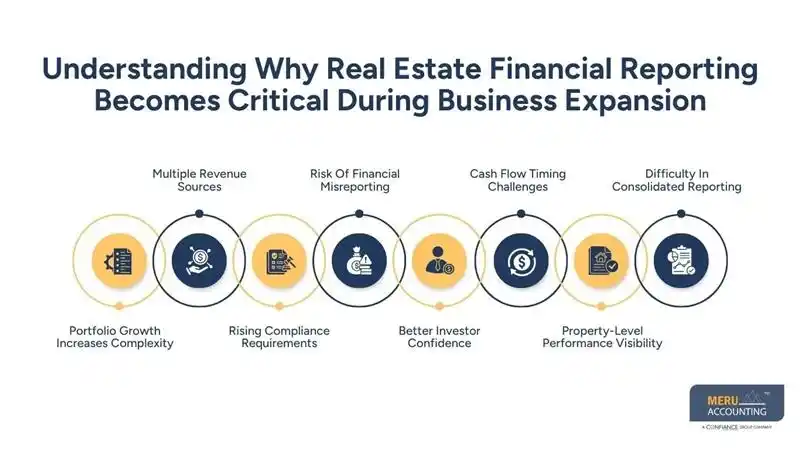
Better Investor Confidence
Clear reports help build trust with investors and lenders. Reporting improves transparency across all financial statements and summaries. This increases chances of securing funding for expansion plans.
Cash Flow Timing Challenges
As portfolios grow, timing gaps between payments increase significantly. Real estate financial reporting helps track these cash flow gaps. This supports better planning and avoids unnecessary financial stress.
Property-Level Performance Visibility
Large portfolios hide weak properties without structured reporting systems. Reporting highlights each property’s true financial performance clearly. This helps make better hold or sell decisions quickly.
Difficulty In Consolidated Reporting
Combining data across locations becomes difficult without structure. Reporting creates a unified financial view across all properties. This improves overall understanding of business’s financial health clearly.
Key Challenges Faced When Property Portfolios Scale Beyond Simple Accounting
Data Spread Across Multiple Properties
Information gets scattered across files and tools. This makes it difficult to maintain accuracy and consistency when handling large portfolios. Real estate financial reporting brings all data into one system and ensures every property is tracked in a structured way.
Difficulty In Expense Allocation
Shared costs like maintenance become hard to split correctly. This often leads to unclear profit calculations for individual properties. Without structured systems, owners may misjudge true performance across assets.
Lack Of Real-Time Insights
Basic systems do not show current financial health. Decisions are often made using outdated or incomplete data. This delay can affect planning, especially in fast-moving rental markets.
Poor Tracking Of Loan Structures
Multiple mortgages make tracking difficult. Interest rates, repayment schedules, and balances can get mixed up across records. This creates confusion in understanding actual financial exposure.
Inconsistent Record Keeping
Different formats create confusion and reduce clarity when reviewing financial performance. Real estate financial reporting standardizes records across properties and ensures data is consistent, accurate, and easy to analyze.
Role Of Real Estate Financial Reporting In Improving Decision-Making And Profitability
Better Investment Decisions
Real estate financial reporting helps investors identify high-performing properties easily. Guesswork is reduced significantly when selecting new investment opportunities carefully.
Accurate Profit Analysis
Profit appears clearly after expenses, taxes, and loan costs. A clear picture emerges of actual earnings from each property.
Long-Term Planning Support
Strong reporting supports planning, expansion, and acquisitions effectively. Forecasting becomes more realistic based on past financial performance data.
Cost Control Improvement
Unnecessary expenses across properties are clearly highlighted. Owners reduce wasteful spending and improve overall profit margins.
Performance Comparison
Different properties can be compared using reporting data. Better decisions follow when resource allocation becomes more informed.
What Is Financial Management Analysis And How It Supports Real Estate Growth
Understanding Financial Behavior
Many investors ask what is financial management analysis when they want to study income patterns and cost behavior in real estate.
This understanding helps them see how money moves across different properties clearly.
Link Between Data And Decisions
Financial management analysis helps convert raw numbers into meaningful insights. Better clarity emerges when financial data is interpreted in a structured way.
Support For Business Planning
It supports forecasting, budgeting, and long-term planning decisions. Future financial needs become easier to estimate with better accuracy.
Risk Identification
Financial performance analysis helps identify financial risks early in property operations. Early detection allows property owners to reduce potential financial losses.
Connection With Reporting Systems
It works closely with real estate financial reporting to improve accuracy. Together, both systems create a stronger financial understanding for property growth.
How Financial Management Analysis Enhances Real Estate Financial Reporting Accuracy
Better Data Interpretation
Real estate financial reporting becomes more effective when we explore what is financial management analysis and how it supports clearer evaluation of financial figures. Financial figures become easier to understand when reviewed through structured analytical methods.
Stronger Forecasting Ability
It helps predict future income and costs more accurately. Better forecasting supports more stable financial planning across property portfolios.
Improved Error Detection
Financial gaps can be identified early using what is financial management analysis. Early detection helps prevent small issues from becoming larger financial problems.
Better Cost Evaluation
It supports detailed cost breakdowns across properties. Clear breakdowns help identify unnecessary or excessive spending patterns.
Improved Reporting Quality
Combining real estate financial reporting with a clear understanding of what is financial management analysis improves overall accuracy and leads to more reliable financial insights for decision-making.
Core Components Of Effective Real Estate Financial Reporting Systems
Income Tracking Structure
Rental and other income must be recorded properly using real estate financial reporting systems. Accurate tracking ensures no income source is missed or recorded incorrectly.
Expense Classification System
Costs should be divided into maintenance, tax, and loan categories. Proper classification improves clarity when reviewing overall property expenses.
Asset And Liability Records
A clear record of property value and debt is essential. This helps owners understand their real financial position at any point in time.
Cash Flow Monitoring Tools
Structured systems ensure proper tracking of money movement. Consistent monitoring helps avoid liquidity issues during high expense periods.
Performance Dashboards
Dashboards help visualize property performance clearly. They make it easier to compare results across multiple properties quickly.
Common Mistakes Property Businesses Make Without Proper Financial Reporting
Mixing Personal And Business Funds
This leads to confusion in financial clarity. It also makes it difficult to understand true business performance accurately. Separate accounts help maintain cleaner and more reliable financial records.
Missing Expense Records
Untracked expenses reduce profit accuracy in real estate financial reporting. Small missing entries can significantly distort overall financial results. Even minor costs, when ignored, can impact final profit calculations.
Ignoring Cash Flow Timing
Late payments and loan dues create stress. This often results in unexpected liquidity shortages during operations. Proper timing awareness helps avoid financial pressure during peak expenses.
No Standard Reporting Format
Different formats reduce clarity and consistency. It becomes harder to compare financial data across properties. Standardization improves accuracy when reviewing long-term financial performance.
Lack Of Review Process
Without regular checks, errors stay unnoticed. Over time, small mistakes can grow into larger financial issues. Regular reviews help maintain accuracy and reduce long-term reporting risks.
Benefits Of Strong Real Estate Financial Reporting For Scalable Property Businesses
- Real estate financial reporting shows exact profit per property. Owners also understand true earnings after all expenses and obligations.
- Income and expenses get managed more efficiently through structured systems. Financial discipline improves across multiple properties consistently.
- Investors can plan better using clear data. Decisions become more accurate when based on structured financial insights.
- Errors and miscalculations reduce significantly over time. This leads to more stable financial outcomes and fewer unexpected losses.
- Growth becomes smoother with structured reporting. Expansion decisions become more confident and data-driven.
How To Transition From Bookkeeping To Advanced Real Estate Financial Reporting
Step From Spreadsheets To Systems
Move from manual records to structured tools using real estate financial reporting. Structured systems help reduce errors and improve data organization across properties.
Introduce Reporting Standards
Set consistent formats for all properties. Standard formats make financial comparison easier and more accurate.
Add Analytical Methods
Use financial management analysis to study financial patterns. Pattern analysis helps clearly identify trends in income and expenses.
Automate Data Entry
Reduce manual errors with automation tools. Automation also saves time and improves overall data accuracy.
Regular Financial Reviews
Frequent checks improve accuracy in real estate financial reporting. Regular reviews help detect issues early and maintain financial discipline.
Best Practices For Implementing Financial Management Analysis In Real Estate Firms
Define Clear Financial Goals
Use financial management analysis to align goals with data. Clear goals help track performance and measure progress more effectively.
Maintain Clean Data Records
Accurate data improves decision quality. Well-maintained records reduce errors during financial evaluation and planning.
Use Regular Reporting Cycles
Updated reporting practices play an important role in what is financial management analysis, helping maintain accuracy and relevance in financial evaluation.
Train Financial Teams
Teams must understand both reporting and analysis. Proper training improves consistency and reduces reporting mistakes.
Combine Tools And Expertise
Use systems along with expert review for better results. This combination improves accuracy and strengthens financial decision-making.
How Meru Accounting Supports Real Estate Financial Reporting
Meru Accounting helps property businesses move from basic bookkeeping to advanced financial systems. We specialize in building structured real estate financial reporting frameworks that match portfolio size and complexity.
Our team also applies financial performance analysis to help clients understand profit trends, risk areas, and growth opportunities. This combined approach improves financial clarity and decision-making.
We work with real estate firms, landlords, and investors to design reporting systems that reduce errors and improve cash flow visibility. With our experience in global accounting standards and software integration, we help businesses manage growth with confidence.
Key Takeaways
- Real estate businesses need structured reporting as they scale
- Basic bookkeeping is not enough for large property portfolios
- Real estate financial reporting improves clarity and control
- Interpreting financial data becomes more accurate when supported by an understanding of what is financial management analysis.
- Strong reporting reduces risk and improves profit tracking
- Systems and analysis together support long-term growth
FAQs
It helps track income, expenses, and profit clearly across multiple properties. Without it, financial control becomes weak and unclear.
In simple terms, what is financial management analysis means examining financial data to understand how a business is performing and to make informed decisions.
It shows which properties earn well and which create losses, helping owners take better decisions.
Yes, even small owners can use structured reporting to avoid mistakes and improve clarity.
Financial reporting in real estate becomes more accurate when supported by an understanding of what is financial management analysis, especially in how data is used for decision-making.