Real estate fund accounting software can make fund books much easier to track when a firm runs more than one fund, entity, or property group. Each fund may have its own cash, debt, fees, investors, capital calls, and payout rules. Keeping all of that in sheets can lead to errors and slow month-end work.
The right real estate fund accounting software gives fund teams one place to record and review key data. It can also bring fund books, investor data, asset records, and reports into one workflow. For firms with many funds, the main goal is not just basic bookkeeping. The system must also give clear fund-level and group-level reports.
This guide reviews eight well-known options for 2026 and looks at where each one may fit best. The right choice will depend on fund size, entity setup, investor needs, report needs, and the level of finance work done in-house.
What You Will Learn From This Blog
- What real estate fund accounting software is and how it works.
- Which key tools matter for firms with more than one fund.
- The best use case for eight major software options.
- How accounting software for real estate funds can aid fund and investor reports.
- What to check before buying a fund accounting system.
- How Meru Accounting can assist with fund books and reports.
What Is Real Estate Fund Accounting Software?
Real estate fund accounting software is made to record and track the money tied to real estate funds, entities, assets, and investors. It can cover income, costs, debt, cash, capital, fees, and fund-level reports.
Basic accounting tools may track a firm’s books, but fund work can call for more. A fund may have many investors, special capital rules, linked entities, and more than one asset. Accounting software for real estate funds is made to handle these needs in a clearer way.
Fund-Level Books
Fund-level books let a team view income, costs, assets, debt, and capital for each fund. Staff can review one fund without mixing its data with other funds.
Investor Capital
Investor records can show money paid in, money paid out, and each investor’s capital balance. Clear capital records are key for correct investor reports.
Entity Tracking
A real estate fund may own assets through many LLCs or SPVs. The software can link each entity to the correct fund while keeping separate financial records for each entity.
Group Reports
A fund manager may need a report for one fund and a wider report for all funds. Real estate fund accounting software can make both views easier when the chart of accounts and entity links are set up well.
Capital Events
Capital calls, distributions, fees, and other fund events need to be tracked with care. The right system can record each event and show its effect on investor accounts.
Review Trails
Finance teams need to know what was posted, when it was posted, and who made a change. User roles and audit logs can add more control to the close process.
Key Features To Look For In Real Estate Fund Accounting Software
Multi-Fund Accounting
A system should let a firm run books for many funds without forcing staff to keep each fund in a separate tool. Real estate fund accounting software should also make it easy to switch from one fund to another.
Multi-Entity Support
Many funds use holding firms, property firms, SPVs, and joint ventures. The system should track each entity while also showing how the entities connect to a fund.
Investor Account Tracking
Investor capital must stay tied to the right partner. Accounting software for real estate funds should record contributions, distributions, balances, and other investor activity.
Fund Reports
A fund team may need a balance sheet, income report, cash report, capital report, or investor statement. The software should allow these reports to be generated, checked, and exported when needed.
Consolidation
A group with many entities may need one combined view. Real estate fund accounting software with strong consolidation tools can reduce the need to build group reports by hand.
Data Connections
Bank data, property data, and other source data may feed the accounting system. These connections can reduce manual data entry and lower the risk of errors during the month-end close.
optional anymore
on running the business
8 Best Real Estate Fund Accounting Software Options In 2026
The eight tools below serve different types of real estate firms. No single system is best for every fund. Firms should test each option with real fund data before making a final choice.
Software | Best For | Multi-Fund Reporting Fit | Pricing Model |
Juniper Square | Investor reporting and fund administration | Strong | Custom quote |
Yardi Investment Management | Large real estate investment firms | Very Strong | Custom quote |
MRI Investment Central | Complex investment portfolios | Strong | Custom quote |
AppFolio Investment Manager | Private real estate investment managers | Strong | Custom quote |
FundCount | Complex multi-entity fund structures | Very Strong | Custom quote |
Investran | Institutional private capital and real estate funds | Very Strong | Custom quote |
Allvue | Alternative investment and private capital firms | Strong | Custom quote |
RealPage Investment Management | Real estate investment and portfolio management | Strong | Custom quote |
1. Juniper Square
Best for: Investor reporting and fund administration.
Juniper Square is a strong fit for firms that place a high value on investor records and fund reports. Its tools are aimed at fund managers that need clear capital data, investor statements, and fund records.
For firms that want real estate fund accounting software tied to investor work, Juniper Square is worth a close review. The platform combines fund accounting, investor records, capital activity, and investor-facing reports in one system.
2. Yardi Investment Management
Best for: Large real estate investment firms.
Yardi is suited to firms with many funds, entities, assets, and complex finance needs. Its investment tools can handle fund books, entity records, capital events, allocations, and group reports.
Large firms may find real estate fund accounting software from Yardi useful when the finance team needs one system for a broad set of real estate investment records.
3. MRI Investment Central
Best for: Complex investment portfolios.
MRI Investment Central is aimed at firms that need to track investment data across a large portfolio. Its tools can bring investment, fund, and portfolio data into a shared workflow.
For firms with complex asset and fund structures, accounting software for real estate funds such as MRI may be a good choice to assess.
4. AppFolio Investment Manager
Best for: Private real estate investment managers.
AppFolio Investment Manager focuses on investment data and investor work. Firms can use it to keep track of investor activity, asset data, reports, and related fund records.
For private managers that want real estate fund accounting software with a strong focus on investor and asset data, AppFolio can be part of the shortlist.
5. FundCount
Best for: Complex fund structures.
FundCount is built for firms with complex accounting and fund structures. Its tools cover general ledger work, partnership accounting, reporting, consolidation, capital accounts, and other fund needs.
FundCount can be useful when one firm has many linked entities and needs a single view of its books.
6. Investran
Best for: Institutional real estate funds.
Investran is known for private capital and fund accounting work. It can handle fund records, investor data, capital activity, allocations, and reports across large fund structures.
Institutional firms that need accounting software for real estate funds should look closely at how Investran handles their entity, investor, and reporting needs.
7. Allvue
Best for: Alternative investment firms.
Allvue offers fund accounting and reporting tools for private capital firms. Its system can bring fund data, investor records, accounting data, and reports into one place.
For firms with wider alternative investment needs, real estate fund accounting software from Allvue may be worth testing against the firm’s current finance process.
8. RealPage Investment Management
Best for: Real estate investment and portfolio management.
RealPage offers tools that cover investment accounting, asset data, portfolio work, and investor needs. Its broad focus can suit firms that want investment and accounting data within one system.
For firms with many real estate assets and funds, real estate fund accounting software from RealPage can be considered as part of a wider investment management setup.
How Accounting Software For Real Estate Funds Supports Multi-Fund Reporting
One View Of Many Funds
A firm with five or ten funds may have many bank accounts, entities, assets, and investor groups. Accounting software for real estate funds can bring these records into one controlled system.
Fund-Level Reports
Finance teams often need to review one fund at a time. Real estate fund accounting software can give staff fund-level reports without mixing data from other funds.
Investor Reports
Investors need clear data on capital paid in, cash paid out, and account balances. The software can pull these figures from fund records and reduce the need for manual report preparation.
Consolidated Reports
A parent group may need one report that combines data from many entities. Accounting software for real estate funds can apply set consolidation rules and give a group view.
Allocation Work
Funds may have set rules for fees, income, costs, or distributions. Real estate fund accounting software can apply these rules based on the setup and give the finance team a record to check.
Close And Audit Work
Month-end and year-end close work needs clean records. Accounting software can give teams a clear trail from entries to reports, which can make review work more orderly.
How To Choose The Best Real Estate Fund Accounting Software
Review Your Fund Structure
Start by listing all funds, entities, SPVs, joint ventures, assets, and investor groups. Real estate fund accounting software should fit the full structure rather than just one part of the business.
List Your Reports
Write down every report used each month, quarter, and year. Accounting software for real estate funds should be able to produce key reports without large amounts of manual work.
Check Capital Rules
Test how the system handles capital calls, distributions, fees, and investor balances. Ask the vendor to show these tasks with sample data, not just a sales demo.
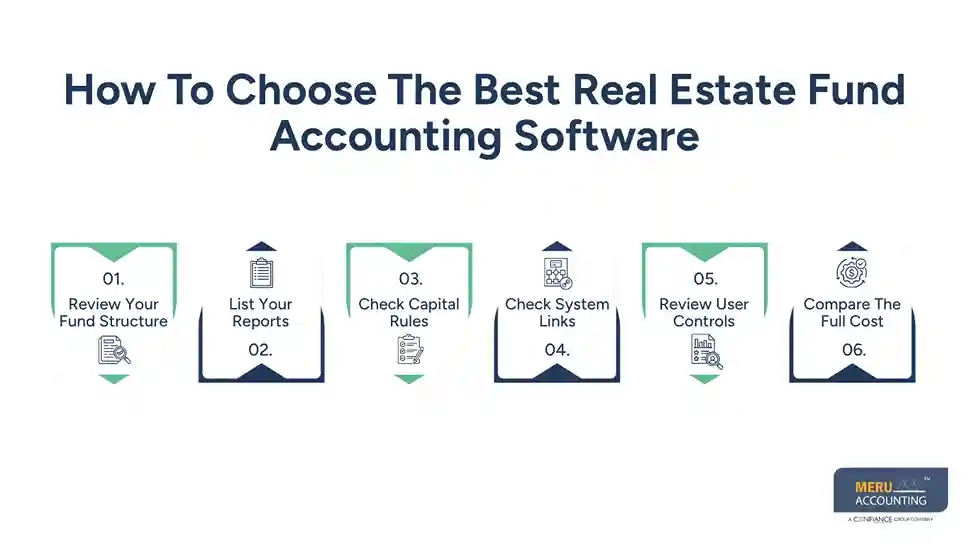
Check System Links
Review how the system connects with banks, property systems, tax tools, CRM tools, and investor portals. Poor data flow can add work even when the core accounting tools are strong.
Review User Controls
Ask about user roles, approval rules, change logs, backups, and access controls. Financial data should not be open to every user without limits.
Compare The Full Cost
Do not look only at the software fee. Ask about setup, data migration, users, support, extra modules, report tools, and training before you compare the full cost.
Real Estate Fund Accounting Software Comparison: Which One Is Right For You?
- Juniper Square may be a good fit for firms that place a high focus on investor reporting, fund administration, capital activity, and investor communication.
- Yardi Investment Management may suit larger real estate firms that manage many funds, entities, properties, and complex investment structures.
- MRI Investment Central can be considered by firms that need investment accounting, portfolio reporting, and tools for complex real estate investment structures.
- AppFolio Investment Manager may work well for private real estate managers that need investor data, asset information, fund reporting, and investor-facing tools.
- FundCount can be a strong option for firms with complex fund structures that need multi-entity accounting, consolidation, capital accounts, allocations, and detailed financial reports.
- Investran may fit institutional real estate funds that need fund accounting, partnership accounting, investor data, capital activity, and detailed reporting.
- Allvue can suit alternative investment firms that need fund accounting, portfolio data, investor reporting, and custom financial reports.
- RealPage Investment Management may be suitable for real estate investment firms that want investment accounting along with portfolio, asset, and investor management tools.
- The right real estate fund accounting software should match the firm’s number of funds, legal entities, investors, assets, reporting needs, and current finance process.
- Firms should also review integrations with banking, property management, tax, investor relations, and other finance systems before selecting a platform.
- A live product test can give a clearer view than a long feature list. Ask each vendor to process sample transactions based on your actual fund structure, such as capital contributions, distributions, fees, allocations, and consolidated reports.
- The final choice should balance reporting needs, fund complexity, ease of use, system controls, integration needs, vendor support, and total cost.
Why Choose Meru Accounting For Real Estate Fund Accounting?
Meru Accounting works with real estate firms that need clear books, account checks, reconciliations, fund records, and regular financial reports. Our team can work with the accounting tools already used by a firm and follow set financial workflows.
For firms reviewing accounting software for real estate funds, our team can also assist with day-to-day accounting work, data checks, account reconciliations, financial reports, and fund-level records.
Our team can organize financial data by fund, entity, and property so finance teams can review each part of the portfolio with greater clarity. We also focus on keeping records current and ready for monthly, quarterly, and annual reporting needs, giving fund managers a clear base for financial review and decision-making.
Our Expert Perspective
Software alone does not make fund accounting accurate. Clean source data, a clear chart of accounts, sound entity mapping, timely bank checks, and proper review steps matter just as much.
Our view is that firms should choose real estate fund accounting software based on actual fund work. Test capital calls, distributions, investor balances, entity entries, and group reports before making a long-term choice. A system that looks good in a demo may not fit the real work done by the finance team.
Key Takeaways
- Real estate fund accounting software is made for fund, entity, investor, and asset records.
- Multi-fund firms should check fund accounting, investor data, consolidation, and report tools.
- Accounting software for real estate funds should fit the firm’s entity and investor setup.
- Juniper Square is a strong option for investor reporting and fund administration.
- Yardi and MRI may suit larger and more complex real estate investment firms.
- AppFolio may fit private real estate investment managers.
- FundCount, Investran, and Allvue are worth reviewing for complex fund structures.
- RealPage can suit firms that need investment and accounting tools in one system.
- Firms should test real fund data before selecting a system.
FAQs
There is no one best system for every firm. Juniper Square, Yardi, MRI, AppFolio, FundCount, Investran, Allvue, and RealPage are options that real estate fund managers can compare based on their needs.
Accounting software for real estate funds records fund income, costs, assets, debt, investor capital, distributions, and other fund activity. Some systems also handle consolidation and allocation work.
Yes. Many fund systems are made to handle multiple funds and entities. Firms should still check how each product handles fund separation, shared entities, investor records, and consolidated reports.
Cost varies by fund count, users, entities, modules, setup, data transfer, support, and other needs. Many major systems use custom pricing rather than one public rate.
Yes. Software can record and process financial data, but accountants still need to check entries, reconcile accounts, review investor balances, assess reports, and handle issues.
Real estate fund accounting software works best when accountants review the data and verify key financial records before reports are issued.
optional anymore
on running the business