
Global firms are facing more Real Estate work than ever. They must track leases, pay bills, manage sites, review costs, and keep records in good shape. As firms grow, these tasks take more time and effort. New sites, new staff, and new rules add to the load. At the same time, firms want to cut costs and make the best use of staff time. They want teams to focus on growth, sales, and client needs rather than routine back-office work. This is one reason why more firms now use real estate outsourcing.
It gives firms access to skilled teams that can handle Real Estate work in a fast and cost-friendly way. It also helps firms improve workflow and keep costs under control. This shift is changing the way firms handle corporate real estate management. With the help of external experts, firms can get their Real Estate tasks done with more ease and less strain on in-house teams.
Today, real estate outsourcing is not just a way to save money. It is a key business tool that helps firms stay flexible and ready for growth. Let’s see why global firms are shifting to real estate outsourcing for corporate real estate management functions.
What You Will Learn From This Blog
In this blog, you will learn:
- What real estate outsourcing means.
- Why firms use it more than in the past.
- The main parts of corporate Real Estate management.
- The key reasons firms move real estate work to outside teams.
- How outsourcing helps improve real estate tasks.
- The top benefits firms get from this model.
What Is Real Estate Outsourcing and Why Does It Matter?
Real estate outsourcing means hiring an external team to manage some or all real estate functions. These functions may include lease administration, property accounting, invoice processing, reporting, data management, and vendor support. Years ago, many companies kept all real estate operations in-house. This model worked for some companies, but it often became difficult to manage as businesses grew. More properties meant more records, more invoices, and more work.
Real estate outsourcing helps solve this issue. Companies can work with teams that focus on real estate functions every day. These teams use proven processes and tools to complete work efficiently and accurately.
The need for outsourcing has also grown due to the increase in real estate data. Companies must track lease dates, occupancy costs, property taxes, maintenance expenses, and space utilization. When this work is handled by experts, the risk of errors can be reduced.
Real estate outsourcing also helps companies manage growth. As a company adds new properties, the amount of work tied to those properties grows as well. An external team can scale with ease and help the company keep pace.
For these reasons, many companies now view real estate outsourcing as a smart way to gain more value from their real estate operations.
Understanding Corporate Real Estate Management Functions
Corporate real estate management covers the work tied to a firm’s real estate assets. The goal is to make sure each site helps the firm meet its goals while keeping costs in check.
This work includes many tasks like:
Lease Management
Lease files hold key facts such as rent rates, due dates, end dates, and rent terms. Firms must track these facts with care to avoid extra costs.
Property Accounting
Property accounting covers rent costs, tax bills, repair costs, utility bills, and other site costs. Good records help firms see where funds go and where they can save.
Portfolio Management
Many firms own or lease more than one site. Some have sites in many states or nations. Teams must track how each site adds value and supports firm goals.
Vendor Management
Real estate sites rely on many vendors. These may include repair teams, cleaning crews, and lawn care firms. Good vendor management helps sites run well.
Reporting and Review
Leaders need facts to make smart choices. Reports help show site costs, site use, and key trends that may affect plans.
As these tasks grow, firms often find that real estate outsourcing gives them the support needed to manage the work well.
Key Factors Driving Global Firms Toward Real Estate Outsourcing
A range of factors now push firms toward real estate outsourcing.
Cost Savings
Cost control is one of the main goals for most firms. It can cost a great deal to hire, train, and keep a full real estate team.
With real estate outsourcing, firms gain the help they need while keeping fixed costs lower.
Access to Skilled Staff
Real estate work calls for strong skills. Teams must know lease terms, books, reports, and rules.
Outsourced teams work in this field each day. Their skills help firms get work done with less risk and better results.
Growth of Real Estate Portfolios
As firms grow, so does the size of their site portfolio. New sites bring new lease terms, new costs, and new tasks.
Real estate outsourcing helps firms handle this growth without adding large numbers of staff.
Focus on Core Goals
Most firms want staff to focus on sales, growth, client care, and new plans.
When real estate work is given to an external team, in-house staff get more time for these goals.
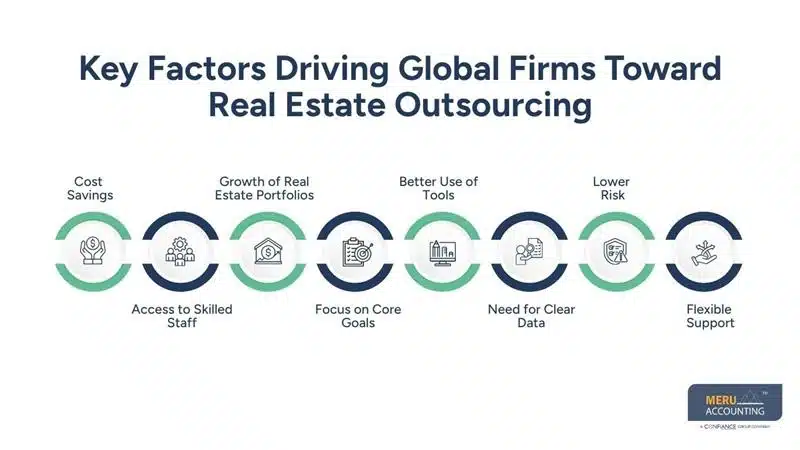
Better Use of Tools
Many outsourcing firms use modern tools to track data, create reports, and manage records.
This gives firms the gain of strong tools without the need to buy and run them on their own.
Need for Clear Data
Leaders need facts they can trust. Weak data can lead to poor choices and lost funds.
Real Estate outsourcing helps firms gain clean and well-kept data that supports smart planning.
Lower Risk
Real estate management must follow many rules and terms. Missed steps can lead to fines, fees, or other issues.
A skilled outsourced team helps lower this risk and keeps work in line with rules.
Flexible Support
Business needs change over time. Firms may grow, merge, or move into new markets.
Real estate outsourcing gives firms the option to scale support up or down based on current needs.
How Real Estate Outsourcing Improves Corporate Real Estate Management
The link between real estate outsourcing and strong corporate real estate management is easy to see.
Better Workflow
Outsourced teams follow steps that help cut delays. Tasks go through a set path that boosts speed and quality.
Strong Cost Control
Real estate costs can be hard to track. Outsourcing helps firms watch costs, manage budgets, and review trends more closely.
More Accurate Records
Errors in lease files or books can lead to extra costs. Real estate outsourcing helps improve accuracy through review and checks.
Better Reports
Reports help leaders see what is taking place across their real estate portfolio. Outsourced teams provide data that helps make smart choices.
Easier Compliance
Rules and standards can change over time. Outsourcing teams stay aware of these changes and help firms stay in line.
Better Use of Staff Time
When external teams handle routine work, in-house staff can focus on planning, growth, and other high-value tasks.
Clear View of Assets
Firms gain a better view of site costs, lease terms, and asset results. This helps support better long-term plans.
Support for Growth
Real estate outsourcing makes it easier to manage growth without major rises in overhead costs.
Major Benefits of Real Estate Outsourcing for Global Organizations
Here are some of the top benefits of real estate outsourcing for global organizations:
Lower Operating Costs: Outsourcing cuts the need for large in-house teams and lowers related costs.
Access to Real Estate Experts: Firms gain help from people who know real estate work and best practices.
Higher Efficiency: Dedicated teams often finish tasks faster and with more consistency.
Better Accuracy: Strong review methods help cut mistakes and improve data quality.
Lower Business Risk: Outsourcing helps firms stay aligned with lease terms, reports, and key rules.
Stronger Focus on Growth: Leaders and staff can spend more time on growth and less time on routine tasks.
Better Reports and Data: Clear reports provide insight into costs, site use, and asset results.
Support for Global Growth: As firms expand, outsourcing gives them the support needed to manage larger and more complex site portfolios.
Why Choose Meru Accounting for Real Estate Outsourcing Services?
At Meru Accounting, we know that real estate work calls for care, speed, and accuracy. Our real estate outsourcing services help firms manage key real estate tasks without the need for large in-house teams.
Our services include:
- Property accounting
- Lease support
- Accounts payable services
- Accounts receivable services
- Budget tracking
- Financial reports
- Data management
- Portfolio accounting support
- Custom reports
Our team works with firms of all sizes and helps them improve efficiency while cutting routine workloads. We use proven methods that support both real estate needs and wider corporate real estate management goals.
By working with Meru Accounting, firms gain a trusted team that helps improve accuracy, control costs, and support long-term growth.
Key Takeaways
- Real estate outsourcing helps firms cut costs and improve efficiency.
- More global firms are moving real estate work to outside teams.
- Corporate real estate management includes leases, books, reports, and vendor work.
- Outsourcing gives firms access to skilled staff and strong tools.
- Firms gain better data, stronger reports, and improved cost control.
- Real estate outsourcing supports growth without major rises in staff costs.
FAQs
CRE firms can outsource bookkeeping, lease administration, tax compliance, vendor management, financial reporting, and property maintenance coordination.
Outsourcing lowers labor expenses, reduces errors, saves on software costs, and offers flexible resource allocation based on demand. Firms also avoid long-term hiring costs and infrastructure investments.
Yes, reputable providers follow strict data security protocols and comply with industry regulations to protect confidential information.
Absolutely. Outsourced services are flexible and can be scaled up or down based on the number of properties or business needs.
Meru Accounting offers specialized expertise in commercial real estate, delivering accurate, timely, and compliant services that help firms reduce costs and improve overall operational efficiency.