
You buy a rental property for $450,000. A year later, you have collected rent, paid mortgage interest, repaired the roof, replaced appliances, paid property tax, and spent money on insurance and management. Now you are preparing your tax return. The obvious question is: How much tax do you owe? The better question is: Did you plan for the tax result before making those property decisions? That is where a real estate tax consultant can add value, particularly when real estate tax consultant services cover both year-round planning and tax preparation.
Real estate tax is not limited to putting rental income and expenses into a tax return. The timing of a property purchase, the way improvements are treated, depreciation, the sale of an asset, ownership structure, and even the records kept during the year can affect the final tax position.
For example, the IRS allows depreciation deductions for qualifying rental property, but the calculation depends on factors such as the property’s basis, recovery period, and applicable method. A later sale can also bring depreciation into the tax calculation.
So, tax work for property owners should not begin only when April approaches. It should begin when the property decision begins.
What You Will Learn From This Blog
- What a real estate tax consultant actually does for property owners and investors.
- Which tax services matter most for rental properties and investment portfolios.
- How real estate tax planning fits into buying, owning, and selling property.
- How deductions, depreciation, records, and property sales affect tax work.
- How to assess a tax professional before hiring one.
- When a tax consultant may be a better fit and when a real estate CPA may make more sense.
Introduction To The Real Estate Tax Consultant
A property sale can raise a tax question long before the tax return is due. For example, an investor planning to sell a rental property may compare the expected sale price with the original purchase price and assume the difference is the taxable gain. That calculation may miss key factors such as capital improvements, selling costs, depreciation, and the property’s adjusted basis.
A real estate tax consultant reviews these details as part of the wider tax picture and can flag issues before the transaction is complete. The need for this type of review can also vary by investor.
A first-time landlord may mainly need guidance on rental income, expenses, depreciation, and filing, while an investor with 20 rental units may have several properties, entities, states, depreciation schedules, and property sales to track. This is why real estate experience matters when choosing a tax professional.
Tax work is also about more than finding deductions. Each expense must meet the rules that apply to it and have suitable records behind it, while some costs may need to be capitalized instead of deducted at once.
Timing is another key part of real estate tax work. Consider an investor who plans to sell one rental property and purchase another. Waiting until after the sale to ask about the tax result may leave fewer planning choices than reviewing the transaction before closing.
A Section 1031 exchange, for instance, may apply to certain qualifying real property held for business or investment, but the transaction must meet specific tax requirements. This makes real estate tax planning part of the investment decision itself rather than a task reserved for tax filing season.
By reviewing the expected gain, adjusted basis, depreciation history, transaction costs, ownership structure, and other relevant facts in advance, the investor can make the decision with a clearer view of the potential tax effect.
What Services Does A Real Estate Tax Consultant Provide?
Real Estate Tax Planning And Preparation
Tax preparation looks backward at the year’s activity. Tax planning looks forward. A real estate tax consultant may review expected income, planned purchases, sales, improvements, and other events before the tax year ends. This gives the investor more time to make informed choices.
Rental Property Tax Services
Rental property creates a long list of financial records.
As part of real estate tax consultant services, rent received, repairs, insurance, mortgage interest, property taxes, management costs, and depreciation may all need review. The IRS provides specific guidance on rental income and expenses, including rules that may limit rental losses.
Tax Deductions And Expense Review
Not every payment made for a property receives the same tax treatment.
A repair may be treated differently from an improvement. A personal expense may not qualify as a rental expense at all. A real estate tax consultant reviews the nature of the cost before deciding how it should appear in the tax records.
Depreciation And Cost Segregation Considerations
Depreciation can be one of the most important tax areas for rental property owners.
The basic idea is that the cost of qualifying property is recovered over a set period rather than deducted all at once. Cost segregation may also be considered in some cases, but it requires a property-specific analysis and proper documentation.
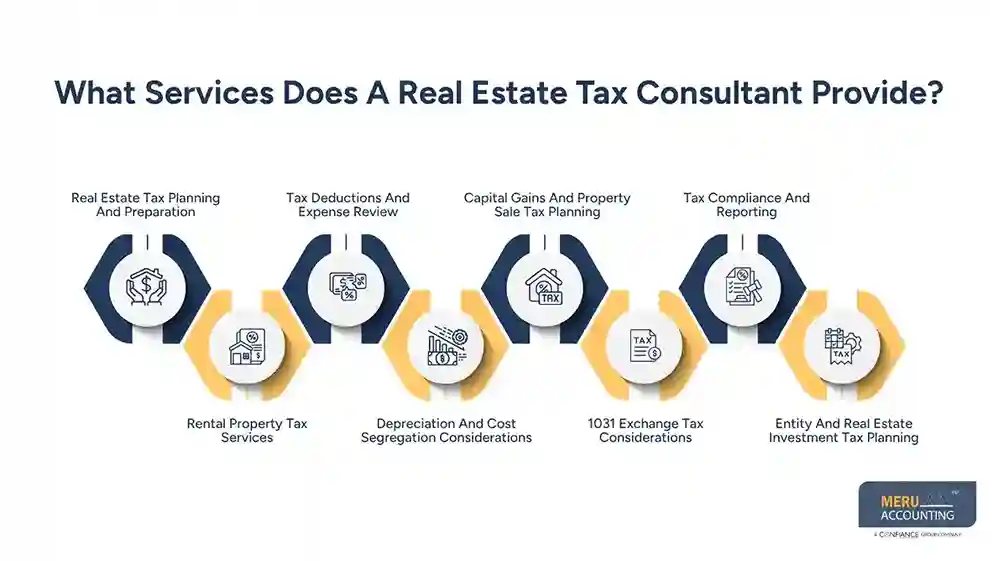
Capital Gains And Property Sale Tax Planning
Selling a property can create a tax bill even when the owner has held the asset for many years.
The calculation can involve the property’s adjusted basis, selling costs, depreciation, and the nature of the transaction. Planning before the sale gives the owner time to review these items.
1031 Exchange Tax Considerations
A 1031 exchange is not simply a way to sell one property and buy another.
Section 1031 has specific requirements, and the tax treatment depends on the facts of the transaction. A real estate tax consultant can review the tax side of a proposed exchange, while qualified legal or exchange professionals may be needed for other parts of the transaction.
Tax Compliance And Reporting
Real estate investors may have federal and state filing duties based on their income, property activity, ownership structure, and location.
The right professional can identify the forms and records needed for the owner’s situation and ensure that the reported figures are accurate and properly supported.
Entity And Real Estate Investment Tax Planning
An investor may hold property personally or through an entity.
The choice can affect reporting and tax administration, but there is no single structure that works for every investor. Entity decisions should be reviewed with the appropriate tax and legal professionals before the structure is changed.
optional anymore
on running the business
The Difference Between A Good Tax Year And A Well-Planned Tax Year
A property owner may finish the year with a properly filed return and still have missed planning opportunities.
Consider an investor who plans to sell a rental property in December. If the tax review starts in January of the following year, many choices have already been made.
A stronger process looks at the transaction before it happens.
This is one reason real estate tax planning should not be treated as a once-a-year task. It can become part of the investor’s normal financial review.
How Real Estate Tax Consultant Services Support Property Investors
Finding The Expenses That Deserve A Closer Look
Property owners often have dozens of transactions each month.
A review can separate routine operating costs from improvements, personal costs, financing costs, and other items that may have different tax treatment.
Making Rental Records Easier To Review
A clean rental file should show rent collected, property costs, loan activity, improvements, and other key transactions.
This gives the real estate tax consultant a stronger source for tax preparation and reduces the need to rebuild the records at year-end.
Reviewing A Purchase Before Closing
The purchase price is only one part of the tax discussion.
The investor may also need to consider closing costs, basis, depreciation, financing, improvements, and the planned use of the property.
Preparing For A Sale
Before a sale, the owner should know the likely tax effect.
A tax review can examine the adjusted basis, depreciation history, expected proceeds, selling costs, and possible transaction strategies before the closing date.
Keeping Multiple Properties Separate
An investor with five properties should not have one large pile of expenses.
Property-level records make it easier to see income, costs, improvements, loans, and tax details for each asset.
Benefits Of Working With A Real Estate Tax Consultant
Better Tax Planning
Tax planning gives investors time. Instead of finding out the tax result after a transaction, the owner can review the likely outcome before making the decision.
More Accurate Tax Reporting
Real estate returns can contain many figures from many sources. A real estate tax consultant can compare tax records with bookkeeping data, closing statements, depreciation schedules, and other source documents.
Stronger Deduction Tracking
A clear expense system makes it easier to identify costs and retain the records needed to support them. This is especially important when an investor owns multiple properties.
Fewer Costly Filing Mistakes
A wrong figure on a tax return may create more work later. Reviewing income, expenses, basis, depreciation, and required forms before filing can reduce the risk of avoidable errors.
Better Preparation For Property Transactions
Buying and selling property can create tax consequences that are difficult to fix after closing. Early real estate tax planning gives the investor more time to assess those consequences.
Clearer View Of Tax Obligations
An accurate tax process should answer simple questions: What income was earned? What costs were paid? What deductions may apply? What property was sold? What records are missing?
That clarity matters when tax decisions involve large assets.
How To Choose The Right Real Estate Tax Consultant
Look For Real Estate Experience
Ask how many real estate clients the professional serves and what types of properties they handle.
Experience with rental homes may not be the same as experience with commercial property, development projects, or large investment portfolios.
Check Credentials
A CPA, enrolled agent, attorney, or other qualified tax professional may provide tax services depending on their credentials and scope of practice.
The IRS states that enrolled agents, CPAs, and attorneys with the relevant status have unlimited representation rights before the IRS. Paid tax return preparers also generally need a valid PTIN.
Ask About State Tax Knowledge
An investor who owns property in several states may face different filing rules.
Ask whether the professional has experience with the states where the properties are located and where the investor has tax filing obligations.
Ask How Tax Planning Is Handled
Do not ask only, “Do you prepare tax returns?”
Ask:
- Do you review property purchases before closing?
- Do you review planned sales?
- Do you work with depreciation records?
- Do you review 1031 exchange situations?
- Do you provide year-round tax planning?
The answers can show whether the service is focused only on filing or includes broader planning.
Check The Link Between Accounting And Tax
Tax work depends on the quality of the underlying records.
If the tax professional can work with bookkeeping data, bank records, property reports, and financial statements, the year-end process may be more organized.
Understand The Fee Before Signing
Ask what is included in the fee.
A basic tax return, multi-property return, tax planning meeting, 1031 review, amended return, and entity return may all have different costs.
A clear scope prevents surprises.
Real Estate Tax Consultant Vs. Real Estate CPA: What Is The Difference?
Area | Real Estate Tax Consultant | Real Estate CPA |
Tax preparation | Often a core service | Often a core service |
Tax planning | Common focus | Common service |
Bookkeeping | Depends on provider | May be offered |
Financial statements | May be outside scope | Often available |
Audit services | Usually outside scope | May be available |
Real estate tax experience | Depends on provider | Depends on provider |
Best fit | Focused tax needs | Broader accounting and tax needs |
Scope Of Tax Services
The title alone does not tell you what a professional can do. Look at actual experience, credentials, service scope, and the types of real estate clients served.
Accounting And Financial Reporting
A CPA may be the better fit when the investor needs accounting, financial statements, tax work, and other accounting services in one relationship.
Tax Planning And Compliance
Both professionals may provide real estate tax planning and tax compliance, depending on their credentials and service model.
The important question is not which title sounds better. It is whether the professional has the skills needed for your situation.
Which Professional Fits A Rental Investor?
A small landlord with a few properties may need focused tax preparation and planning.
A growing investor with multiple entities, properties, employees, or complex financial reporting may need broader CPA services.
Why Partner With Meru Accounting For Real Estate Accounting And Tax Support?
One View Of The Numbers
Tax decisions are only as good as the financial data behind them. Meru Accounting provides bookkeeping and accounting services that can give property businesses cleaner financial records for tax work and financial review.
Tax Preparation Support
We provide tax preparation services for US businesses and work with professionals with CPA and EA backgrounds.
Property-Level Records
Real estate businesses often need records that show income and costs by property.
A structured bookkeeping process can make it easier to review rent, operating costs, improvements, and other transactions before tax filing.
Accounting Software Integration
Meru Accounting works with platforms such as QuickBooks, Xero, NetSuite, Odoo, and other accounting systems, allowing businesses to keep their accounting workflow aligned with their reporting needs.
Our Expert Perspective
The best time to assess a property’s tax impact is before the transaction is finalized. In our experience, tax work becomes more effective when financial records, property documentation, transaction data, and tax planning are reviewed as part of an ongoing process throughout the year rather than being addressed only at filing time.
Key Takeaways
- A real estate tax consultant does more than prepare a tax return; the role can include planning around rentals, purchases, sales, depreciation, and compliance.
- Real estate tax planning is most useful when it starts before major property decisions.
- Rental owners should keep clear records for income, repairs, interest, taxes, insurance, improvements, and other costs.
- Depreciation and adjusted basis can affect the tax result when a property is sold.
- A 1031 exchange has specific IRS rules and should be reviewed before the transaction is completed.
- Credentials matter, but real estate experience matters too.
- Compare the professional’s services, experience, state knowledge, accounting links, and fees before hiring.
- The right real estate tax consultant services should match the size and complexity of the property portfolio.
FAQs
A real estate tax consultant reviews property income, expenses, deductions, depreciation, sales, and other tax matters for property owners and investors.
Real estate tax consultant services may include tax preparation, rental property tax review, depreciation analysis, tax compliance, and planning for property purchases or sales.
Real estate tax planning should begin before major purchases, property sales, refinancing, or other transactions that may affect your tax position.
Yes, a real estate tax consultant can review rental income, expenses, deductions, depreciation, and applicable federal and state tax rules.
Compare experience, credentials, real estate tax consultant services, knowledge of federal and state rules, planning skills, and pricing before making a choice.
optional anymore
on running the business