
You buy a rental property, replace the roof, add new appliances, or purchase a vehicle for your real estate business. At tax time, these costs may look like simple business expenses, but they can have very different tax treatment. A realtor tax accountant can help determine what should be depreciated, what may be deducted now, and what needs to be added to the property’s basis.
Depreciation can get even more complex when you own rental property or make major improvements. The date an asset is placed in service, how it is used, its cost, and the type of property can all affect the deduction. A mistake in one year can also affect your tax basis when you sell the property later.
In this guide, we’ll cover the key depreciation deductions real estate agents should know, including rental property, improvements, equipment, vehicles, cost segregation, and recordkeeping. We’ll also explain when working with a tax professional can make depreciation easier to manage.
What You Will Learn From This Blog
- How depreciation works for real estate agents
- Which assets may qualify for depreciation
- Common depreciation deductions for real estate professionals
- How a realtor tax accountant works out depreciation
- When cost segregation may be useful
- How to keep depreciation records ready for tax filing
- When to work with a tax accountant for real estate agents
What Is Depreciation for Real Estate Agents?
Depreciation lets you recover the cost of certain property over time through tax deductions. It applies to property used in a trade or business, or to produce income, subject to the tax rules for that asset. The IRS explains that depreciation is not based on the market value of the asset. It starts with the asset’s tax basis and then applies the right recovery period and method.
For a real estate agent, depreciation may come up in two main ways.
First, you may own rental or investment property. In that case, the building may be depreciable, while land is not. Residential rental property is generally depreciated over 27.5 years under the standard MACRS rules, using the straight-line method and a mid-month convention. Nonresidential real property generally has a longer recovery period.
Second, you may have business assets used in your real estate work. These can include computers, office equipment, furniture, and certain vehicles. The tax treatment depends on the asset, how it is used, when it is placed in service, and which tax rule applies.
Depreciation also affects the tax basis of property. The IRS states that depreciation reduces basis, which can affect the gain or loss when you later sell or exchange the property.
Which Real Estate Assets Can Realtors Depreciate?
Not every cost tied to real estate can be depreciated. A key step is to identify the asset and how it is used.
Rental buildings
If you own a rental property that qualifies for depreciation, the building may be depreciated over its set recovery period. The land is not depreciable, so the cost of land must be kept separate from the building cost.
Your records should support how the purchase price was split between land and the building. A realtor tax accountant can help review the closing statement, purchase records, and other data used to set the tax basis.
Improvements
Certain improvements may need to be added to the property’s basis rather than deducted as a current expense. For example, the IRS notes that a major furnace replacement for residential rental property is generally treated as a capital improvement and depreciated as a separate asset.
This is why it helps to keep repair bills and improvement bills separate. A simple label such as “repair” does not always decide the tax treatment.
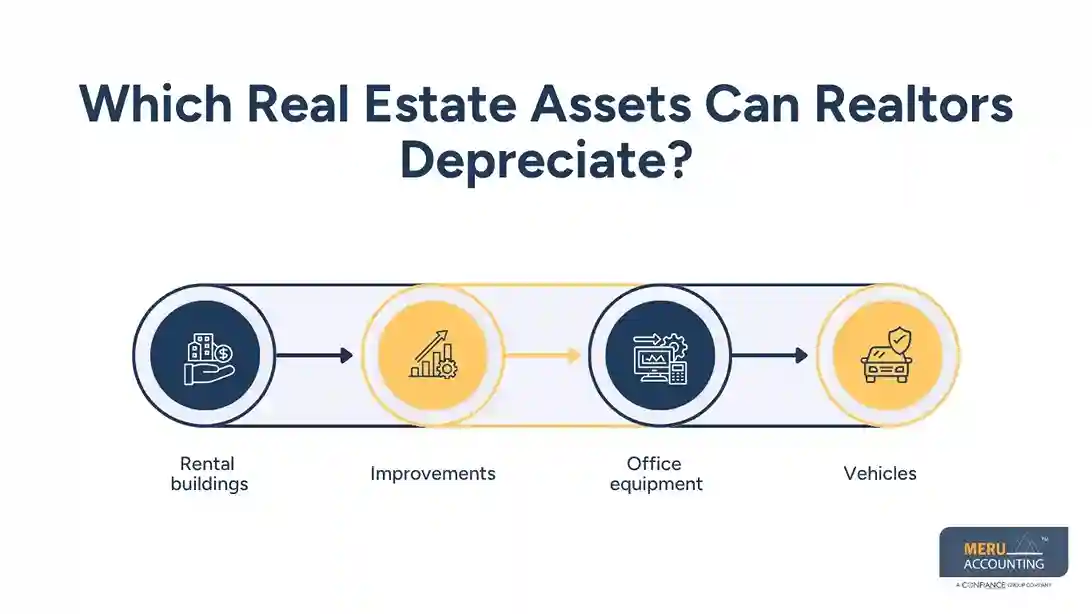
Office equipment
Real estate agents may also have depreciable business assets such as computers, printers, desks, and other equipment. The recovery period and deduction can vary by asset.
Some qualifying assets may also be eligible for Section 179 or the additional first-year depreciation deduction, subject to the rules in effect for the tax year.
Vehicles
A car, SUV, truck, or van used for business may have depreciation implications. The rules can be complex because business use, personal use, vehicle type, and other limits can affect the deduction.
For 2026, the IRS has published specific depreciation limits for passenger automobiles placed in service during the year.
A tax accountant for real estate agents can help make sure vehicle use is tracked in a way that supports the tax treatment.
optional anymore
on running the business
Key Depreciation Deductions Real Estate Agents Should Know
Depreciation can cover more than the main building. The right deduction depends on the asset and how it is used.
Building depreciation
For a qualifying residential rental property, the building is generally depreciated over 27.5 years. For nonresidential real property, the standard recovery period is generally 39 years under the general depreciation system.
The first-year deduction is also affected by when the property is placed in service. The IRS uses a mid-month convention for residential rental property.
Improvements
Capital improvements can create a new depreciable asset. This can include certain major work that adds value to a property, restores it, or adapts it to a new use.
The tax treatment depends on the facts. Some repair costs may be deducted in the current year, while an improvement may need to be capitalized and depreciated.
Furniture and equipment
Rental owners may have furniture, appliances, and other items that are separate from the building. These assets can have different recovery periods from the building itself.
Keeping each major asset in a proper fixed-asset list makes it easier to track cost, date placed in service, depreciation, and remaining basis.
Vehicle depreciation
A real estate agent who uses a vehicle for business may have depreciation or other vehicle deductions to consider. But personal use must be separated from business use.
Good mileage and expense records are key. The IRS has special rules for listed property and business-use requirements, so the method used should fit the actual use of the vehicle.
Bonus depreciation
Bonus depreciation can allow eligible property to receive an additional first-year depreciation deduction.
Current IRS guidance says the 2025 tax law changes made the additional first-year depreciation deduction permanent at 100% for eligible property acquired after January 19, 2025.
This does not mean every real estate asset gets 100% depreciation in the first year. Eligibility rules still apply, and building property does not simply qualify because it is used in a real estate business.
Section 179
Section 179 can allow a business to expense the cost of certain qualifying property in the year it is placed in service, subject to limits and eligibility rules. The IRS treats Section 179 as a way to recover part or all of the cost of certain qualifying property in the year it is placed in service.
A realtor tax accountant can review Section 179 and bonus depreciation together with regular depreciation before a return is filed.
How a Realtor Tax Accountant Calculates Depreciation
Depreciation starts with the tax basis of the asset. But finding the right basis is often more work than it sounds.
For rental property, the basis may include the purchase price and certain costs tied to the purchase. The value of land must be separated because land is not depreciated.
Next, the asset is placed into the right property class. The recovery period and depreciation method then depend on that class.
The placed-in-service date also matters. This is generally the date the property is ready and available for its intended use, not simply the date the purchase closed. The IRS defines “placed in service” in this way for depreciation purposes.
A realtor tax accountant may also review prior tax returns and depreciation schedules. This matters when an agent already owns rental property or has carried assets over from earlier years.
The final depreciation amount is then reported using the proper tax forms. Form 4562 is used for depreciation and amortization in many cases, while rental activity may also involve Schedule E and other forms depending on the taxpayer and property.
What Is Cost Segregation and When Does It Matter?
Cost segregation is a method used to break certain parts of a building into shorter-lived asset groups instead of treating the whole building as one long-lived asset.
This can matter when a real estate owner has a large property or has made major improvements. Certain items may have a shorter recovery period than the main building, which can change the timing of depreciation deductions.
Cost segregation is not needed for every property. The cost of the study, property size, expected tax benefit, ownership period, and other factors should be weighed before moving forward.
A realtor tax accountant can help review whether a cost segregation study may fit the property and tax plan. For larger properties, the accountant may also work with a qualified cost segregation specialist.
The goal is not to create a larger deduction without support. The goal is to place each qualifying asset in the right tax class and keep the records needed to support the treatment.
How to Keep Depreciation Records Tax-Ready
Good records make depreciation much easier to manage.
Keep the purchase agreement, closing statement, settlement records, and other documents that support the property’s cost. Also keep records that show the land and building allocation.
For each depreciable asset, track:
- Asset name
- Purchase cost
- Date acquired
- Date placed in service
- Business or rental use
- Recovery period
- Depreciation method
- Depreciation taken each year
- Adjusted basis
- Sale or disposal date
Keep records for improvements too. A large remodel, new HVAC system, roof work, or other major project may need different treatment from a normal repair.
The IRS says taxpayers should keep permanent records needed to work out depreciation, basis, and gain or loss when property is sold.
Tax software for realtors can help organize asset data, but software does not replace a review of the tax rules. The quality of the result still depends on the data entered and the tax treatment selected.
Realtor Tax Accounting Services by Meru Accounting
Real estate income can come from commissions, rentals, and property investments, each with its own records and tax needs. Meru Accounting helps real estate agents keep those records organized and ready for tax work.
Our realtor tax accounting support includes:
- Monthly bookkeeping and bank reconciliation
- Commission and rental income tracking
- Property income and expense tracking
- Fixed-asset and depreciation records
- A/P and A/R support
- Monthly financial reports
- Catch-up and cleanup bookkeeping
- Tax-ready financial records
We work with the accounting software and workflow you already use, helping keep your books current throughout the year so you can spend less time sorting out records at tax time.
Our Expert Insight
One mistake we often see is treating every cost on a property closing statement the same way. Land, the building, improvements, and certain closing costs can have different tax treatment, so putting everything into one account can create problems later.
Our approach is to review the purchase details before entering the costs into the books. This creates cleaner records, supports accurate tax reporting, and can save time and money when the property is sold.
Key Takeaways
- Depreciation lets you recover the cost of certain income-producing or business property over time.
- Land is not depreciable, so it should be kept separate from the building cost.
- Residential rental property is generally depreciated over 27.5 years under MACRS.
- Business equipment, furniture, and some vehicles may have different depreciation rules.
- Bonus depreciation and Section 179 can affect the timing of deductions for qualifying assets.
- Current IRS guidance provides for a permanent 100% additional first-year depreciation deduction for eligible property acquired after January 19, 2025.
- Cost segregation may be worth reviewing for some larger properties.
- Good asset and basis records help support depreciation and future sale calculations.
- A realtor tax accountant can help review depreciation, asset records, and tax treatment.
- Tax software for realtors can help with tracking and workflow, but the data and tax rules still need to be right.
FAQs
A realtor may be able to depreciate qualifying buildings, equipment, furniture, vehicles, and certain improvements. Land itself is not depreciable.
No. The cost of land must be separated from the building because land is not depreciable.
Depreciation generally starts when the property is placed in service, meaning it is ready and available for rental use.
Only the qualifying business or rental-use portion may generally be depreciated. Personal use does not qualify.
Yes, tax software for realtors can calculate depreciation when the asset details and tax treatment are entered correctly. For complex property transactions, a tax accountant for real estate agents can review the treatment before filing.
optional anymore
on running the business