
Most retail store owners want to grow their business. For this, they may open new shops, add more goods, sell in new areas, or serve more buyers. Growth is a good sign, but it can also bring new financial management issues. As a store grows, it must deal with more sales, more stock, more staff, and more costs. This means the work tied to retail store accounting can get hard to manage. A small shop may have a basic system to track sales and costs.
When the firm starts to grow, that setup may no longer work well. Owners must track cash, stock, payroll, tax data, and store results for more than one site. If they do not maintain bookkeeping, they may miss key facts that help the firm. Strong retail store accounting helps owners stay in charge of cash flow, stock, and profit. It also helps them spot weak areas and make smart plans for growth. As a firm adds new stores and new sales lines, the need for good records grows as well.
In this blog, we look at why retail store accounting gets harder to manage as a firm grows and what steps can help keep books in good shape.
What You Will Learn From This Blog
In this blog, you will learn:
- Why growth can make book work more hard
- How more than one store can add new tasks
- Why stock control gets tough as a firm grows
- The need for clear reports from each store
- How retail accounting services can help a firm grow
- Ways to keep books neat and up to date
The Growing Complexity of Retail Store Accounting
When a retail firm grows, the amount of bookkeeping grows too. Each new shop adds more sales, more bills, more stock, more staff, and more data. This can put a strain on the team that keeps the books.
With one shop, it is much easier to track sales, costs, stock, and cash. Once a firm adds more sites, the flow of data grows fast. Each shop may have its own staff, rent, bills, and stock needs.
Store owners may need to track:
- More bank accounts
- More sales tools
- More stock lines
- More staff pay
- More tax data
- More store costs
The task is not just to track more data. The goal is to make sure all data is right and easy to find when it is time to make a choice.
This is why retail store accounting gets harder as a firm grows. A small error in one shop may lead to much larger issues when a firm has many sites. As growth continues, many firms turn to new tools and skilled retail accounting services to help keep books correct and up to date.
More growth can also mean more ways to sell. A firm may sell in a shop, on a site, or through a sales app. Each sale must be logged the right way. If data from all sales channels does not match, the books may show the wrong profit or cash on hand.
This is why many firms change how they track data as they grow. A plan that works for one shop may not work for five or ten shops. Retail store accounting helps keep growth on track and helps owners make correct choices.
Managing Multiple Store Locations and Financial Records of Retail Firms
One of the main issues that comes with growth is the need to track more than one shop at the same time.
Each shop may have:
- Its own sales
- Its own costs
- Its own staff pay
- Its own stock use
- Its own cash flow
- Its own bills
The owner must see how each shop is doing while also seeing how the entire firm is doing. For this, the owner needs a plan for how data will be tracked and stored.
If one shop logs costs one way and a new shop logs them in a new way, the books may not match. This can make reports less useful and can lead to poor choices.
As a firm grows, it must also check:
- Bank data
- Card sales
- Cash logs
- Stock logs
- Bills from vendors
These checks help make sure the books stay correct. Many firms use one shared system so all shops send data to the same place. This helps save time and reduce bookkeeping errors.
Retail accounting services can also help set up rules and steps that make it easy to track data from all shops in the same way.
More shops can also mean more staff and more cash flow to track. Each site may have its own payroll, work hours, and cash use. If these items are not tracked well, it can lead to gaps in the books and make it hard to know how each shop is doing.
When the records are maintained correctly, it helps owners see which shops do well and which ones may need help. This makes it much easier to plan for the next stage of growth.
Inventory Management Challenges During Retail Firm Expansion
Inventory is one of the most vital parts of a retail firm. As a firm grows, inventory management gets much harder to handle.
A small shop may have a set stock count that is easy to track. But, when new shops are added, stock has to move from place to place. This can make it hard to know what stock is on hand at each site.
Some key inventory management challenges include:
Stock Moves Between Shops
Many firms move goods from one shop to another. This helps meet buyer demand and keeps stock in the right place.
Each move must be logged the right way. If not, stock counts may be off and books may not match real stock on hand.
More Risk of Stock Errors
As stock grows, so does the risk of:
- Wrong stock counts
- Lost stock logs
- Missed stock moves
- Price errors
Even small stock errors can hurt profit and lead to poor stock plans.
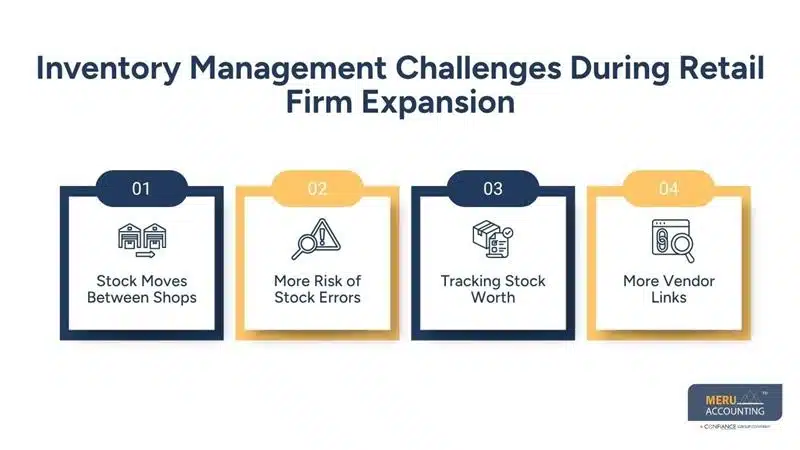
Tracking Stock Worth
Store owners must know what their stock is worth. This helps with tax work and year-end reports.
To do this, firms must track:
- Purchase costs
- Shipping costs
- Price cuts
- Cost changes
- Stock loss
If stock worth is wrong, profit may look too high or too low.
More Vendor Links
Growth often means more firms that ship goods to the store. Each vendor may have its own terms, bills, and due dates.
This adds more work for the team that keeps the books. Strong retail store accounting helps keep stock data right and helps stop waste and loss.
Correct stock records also help owners know when to buy more goods and when to slow down new purchases. This can help free up cash and reduce waste.
Financial Reporting and Performance Analysis for Multiple Locations
As a retail firm grows, the owner can no longer rely on a quick look at sales to judge how the firm is doing. They need facts and numbers from each shop as a whole. Hence, financial reporting and performance analysis are crucial. Here’s how they benefit:
Store-Level Profit Review
Not all shops bring in the same profit. One shop may do very well, while a new site may need more time to grow.
Good reports help owners track:
- Sales by shop
- Gross profit
- Staff costs
- Rent costs
- Stock use
These facts help show which shops add the most value.
Full Firm Reports
When a firm has more than one shop, owners need one set of books that shows the full view.
These reports may show:
- Cash on hand
- Sales totals
- Profit totals
- Debt and bills
- Cash flow
This helps owners know if growth is helping the firm or putting stress on cash.
Plans for Growth
Growth takes cash. A firm may need more stock, more staff, or more shop space.
Good reports help owners plan for:
- New hires
- More purchases
- New shop costs
- Sales goals
When plans are based on good data, there is less risk of poor choices.
Cash Flow Control
Many firms grow fast but still face cash issues. A shop may post good sales and still run short on cash if stock costs rise too fast or bills pile up. Good reports help owners see cash trends and fix issues before they grow into large problems. This is one key reason why firms use retail accounting services as they grow.
Meru Accounting's Retail Store Accounting Services
At Meru Accounting, we know that growth brings new tasks related to bookkeeping. Our retail store accounting team helps firms maintain books as they grow.
Our retail store accounting services include:
- Daily Bookkeeping: We track sales, costs, bills, and cash flow to help keep books neat and up to date.
- Multi-Store Support: We help firms track data from more than one shop while still keeping one clear set of books.
- Stock Tracking: We help track stock, stock worth, and stock moves so firms can keep a close watch on goods and profit.
- Reports and Cash Flow Review: We give clear reports that help owners see sales, costs, profit, and cash flow.
- Bill Payment and Dues: We help track bills that must be paid and funds that are due from buyers.
- Payroll: We help firms in keeping staff payment correct and up to date.
- Tax Support: We help firms keep tax data in good shape and stay consistent for tax time.
Our retail accounting services give store owners more time to focus on sales, growth, and day-to-day work.
Our Expert Insight
Growth is essential for any retail firm. Yet with growth, you face more bookkeeping, more inventory tracking, more staff to pay, and more cash to watch. Many store owners put most of their focus on sales and new shops. While these goals are good, they must also make sure their accounting grows with the firm.
Strong retail store accounting gives owners a clear view of sales, stock, profit, and cash flow. It helps them spot weak points, fix issues fast, and make smart choices.
A good accounting setup can help stop errors, save time, and make growth easier to manage. With the right tools, the right team, and the right support, firms can grow with less stress and more trust in their books.
Key Takeaways
- Growth makes retail store accounting harder and more time consuming.
- More shops mean more sales, more stock, and more bookkeeping.
- Stock tracking gets more tough as goods move from site to site.
- Clear reports help owners track profit and cash flow.
- Strong books help firms make smart growth plans.
- Retail accounting services can help firms have accurate books.
- Good retail store accounting also supports long-term growth.
FAQs
Growth adds more sales, more stock, more staff, and more data. This makes book work take more time and care.
Each shop has its own sales, costs, and stock. All of this data must be kept in one clear set of books.
Stock is a key part of store costs and profit. If stock data is wrong, the books may not show true profit.
Retail accounting services help track books, stock, cash flow, pay, and tax data so owners can focus on growth.
Store owners should track sales reports, profit reports, cash flow reports, stock reports, and cost reports to help guide growth.