Sales tax is one of the most common taxes applied to goods and services, but its impact goes beyond the amount collected at the final sale. For many businesses, sales tax can create a cascading effect where tax costs move through different stages of the supply chain.
When each business pays tax on purchases and passes costs forward, the final price may rise and affect profit, planning, and customer demand. The cascading effect is one of the most common problems in taxation. It occurs when tax is charged on a value that already includes another tax. This means businesses and consumers end up paying a tax on tax. It looks simple at first, but in practice, it creates high costs for the economy.
In the U.S. taxation system, this issue is clearly visible because many states do not offer an input tax credit, causing tax to build up at each stage of the supply chain. This cascading structure increases costs, reduces business profits, and raises prices for consumers. In this blog, we will explain this system, its impact, and ways to reduce its effects.
What You Will Learn From This Blog
- What the cascading effect means and how it works in a sales tax system.
- Why does tax cascading happen during different stages of the supply chain.
- How the sales tax system in the USA can create additional cost burdens for businesses.
- The impact of the cascade tax on businesses, consumers, and the economy.
- Differences between sales tax and GST/VAT systems.
- Ways businesses can reduce the effect of tax cascading through better planning and technology.
- How professional accounting support can help businesses manage tax-related challenges.
What is the Cascading Effect?
- The cascading effect refers to paying tax on top of tax during different stages of a transaction.
- The situation occurs when each stage of trade adds tax without adjusting for the tax already paid at an earlier stage.
- A manufacturer may pay tax on raw materials, and the wholesaler may later pay tax on the full product price that already includes the earlier tax.
- The same process can continue through distributors and retailers before the product reaches the final consumer.
- The final buyer may end up paying a higher price because the tax amount keeps increasing at every step.
Why Does Tax Cascading Happen?
- The absence of an input tax credit system in some sales tax structures makes tax-on-tax situations more common.
- Taxes may be applied to the total transaction value instead of only the additional value created at each stage.
- Different tax rules across various states in the USA can make tax calculation more complex for businesses.
- Small businesses may face difficulties due to limited record-keeping systems and fewer resources for tax tracking.
- Multiple transactions between suppliers, manufacturers, distributors, and retailers allow the tax burden to increase step by step.
- These factors contribute to the growth of the tax cascade problem and can raise the final cost of products.
Features of Cascade Tax
- Tax is charged multiple times as goods move from suppliers to manufacturers, wholesalers, retailers, and final buyers.
- Sellers do not receive input tax credit benefits for the tax already paid during earlier transactions.
- The final product price becomes higher because tax costs are added at different stages of the supply chain.
- Businesses may find tax tracking difficult due to multiple transactions and changing tax requirements.
- Small and medium-sized businesses often experience a greater impact because they have fewer resources for tax management.
Example of Tax Accumulation in the U.S. Sales Tax System
A simple example can explain how this works in practice. Suppose a manufacturer buys raw materials worth $100 and pays $10 as tax. The manufacturer then produces a good and sells it to a wholesaler for $200, adding $20 in tax.
Later, the wholesaler sells the product for $300 with $30 tax included. At each stage, tax is applied on a value that already includes earlier tax costs.
As the product moves through the supply chain, the overall tax burden continues to rise. The final consumer pays a higher price because the same product carries multiple layers of tax.
Problems Caused by the Cascading Effect
- The final price of goods and services rises because tax costs are added at different stages of the supply chain.
- Customer demand may decrease when products become more expensive compared to other options.
- Small businesses often experience greater financial pressure because extra costs can affect their limited resources.
- Large companies may manage these added expenses better, creating a gap between different business sizes.
- Consumers carry the additional cost because businesses usually include higher expenses in the selling price.
- Repeated tax charges can create unfair conditions and make trade activities more difficult.
- Double taxation may reduce confidence among buyers and sellers when charges are not properly managed.
- These issues show why removing repeated tax charges is important for a balanced system.
Cascading Effect in the Sales Tax USA System
- In the USA, sales tax is mainly applied at the final stage when goods or services are sold to consumers.
- Tax rates vary from state to state, creating differences in tax structures across the country.
- The system does not provide a complete input tax credit mechanism like a VAT system.
- Businesses may end up paying tax on inputs, increasing the overall cost of products and services.
- These extra costs are often passed on to customers through higher prices.
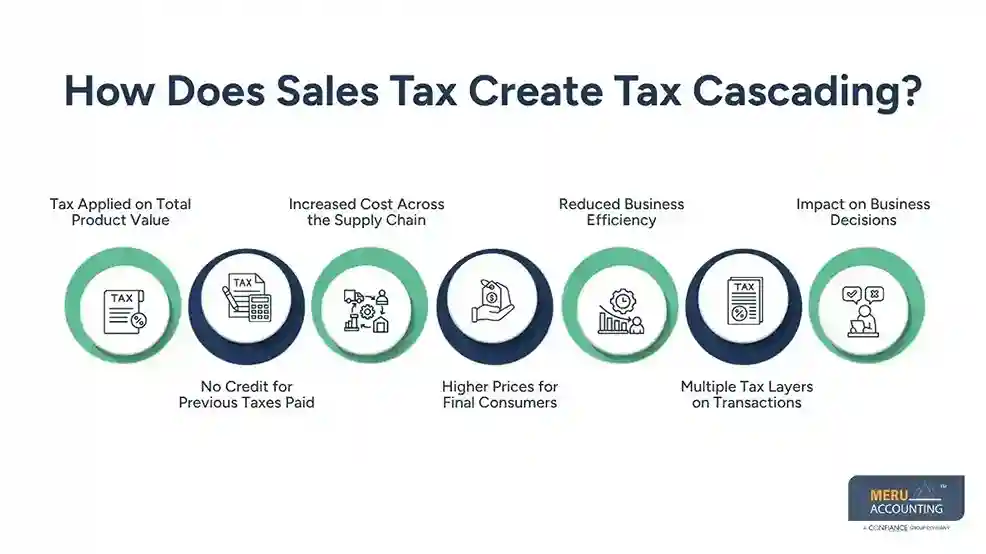
How Does Sales Tax Create Tax Cascading?
Tax Applied on Total Product Value
Sales tax is charged on the full selling price of goods or services. The tax amount increases as the product moves through the supply chain.
No Credit for Previous Taxes Paid
Businesses cannot claim credit for taxes paid at earlier stages. The previously paid tax becomes part of the product cost.
Increased Cost Across the Supply Chain
Products often move through manufacturers, wholesalers, and retailers. Each stage adds a new tax, causing the overall cost to rise.
Higher Prices for Final Consumers
The accumulated tax burden is added to the final selling price. Customers ultimately pay more due to the increased product cost.
Reduced Business Efficiency
Tax cascading increases expenses and affects profit margins. Businesses may face difficulties in maintaining competitive pricing.
Multiple Tax Layers on Transactions
Different businesses handle the same product before the final sale. Each transaction layer can add an additional tax burden.
Impact on Business Decisions
Higher costs can influence pricing, production, and supply choices. Businesses may adjust operations to manage the extra tax burden.
Impact of Cascading Effect on Businesses
- Profit margins go down due to high taxes.
- Exports become less competitive in the market.
- Firms are forced to raise product prices.
- New businesses find it hard to grow.
- Tax planning becomes confusing for all.
- The cascade tax hits small firms hardest in the USA trade.
Impact of Cascading Effect on Consumers
- Customers pay much higher prices for goods.
- It reduces the overall buying power of families.
- People often shift demand to cheaper imported items.
- Middle and low-income groups suffer the most.
- Quality goods become less affordable for buyers.
- This shows why tax cascading harms the economy.
Economic Impact of Cascade Tax
- Economic growth may slow down over time due to higher business costs.
- Demand for luxury and premium goods can decline as prices increase.
- Tax evasion risks may rise in some business environments.
- Market conditions may become less balanced and more unequal.
- Differences in tax rules across states can create confusion for businesses.
- Overall efficiency of the tax system may be reduced due to layered taxation.
- Introduce input tax credit at each level.
- Apply tax only on the value added at each stage.
- Use uniform rules across all US states.
- Improve record-keeping by all businesses.
- Give training to small firms on compliance.
- These steps can reduce tax cascading in the USA.
Global Examples of Tax Cascading Solutions
- Many countries replaced sales tax with VAT or GST.
- VAT/GST allows input tax credit to all firms.
- This avoids double taxation at each step.
- Example: India shifted to GST to simplify and streamline taxation.
- Such reforms help both businesses and customers.
- These models show solutions for cascade tax issues.
Sales Tax USA vs GST/VAT
Comparison Point | Sales Tax USA | GST/VAT |
Tax Application Method | Tax is applied mainly on the final sale to the consumer. | Tax is charged on the value added at each stage of production and sale. |
Input Tax Credit | Businesses generally cannot claim credit for taxes paid at earlier stages. | Businesses can claim input tax credit on taxes already paid. |
Impact on Tax Cost | Lack of credit can increase the overall cost of goods and services. | Input credit helps reduce the total tax burden. |
Cascading Effect | Sales tax can create a cascading effect as taxes accumulate through the supply chain. | GST/VAT reduces tax cascading by allowing credit adjustments. |
Business Impact | Businesses may face higher costs and pricing challenges. | Businesses benefit from a more transparent and efficient tax structure. |
Need for Reform | The retail taxation framework in the USA may require improvements to reduce tax inefficiencies. | GST/VAT is often considered a fairer tax model due to its credit mechanism. |
Challenges in Replacing Sales Tax in the USA
- Each state controls its own sales tax rules and regulations independently.
- No federal taxation system exists across the entire country today.
- Political challenges often block major national tax reform efforts.
- States fear a significant loss in government revenue collections.
- Businesses worry about new compliance requirements and reporting changes.
- These challenges slow down effective solutions to reduce tax cascading issues.
Steps Businesses Can Take to Manage Cascading Effects
- Maintain detailed tax records for every sale and transaction made.
- Use reliable accounting and bookkeeping software for accurate tax tracking.
- Plan product pricing strategies while considering applicable tax costs.
- Seek guidance from tax professionals for complex tax-related decisions.
- Stay updated with changing tax laws across different states.
- These steps help reduce the impact of the cascade tax effectively
Key Differences Between Sales Tax and Excise Duty
Point of Difference | Sales Tax | Excise Duty |
Definition | Applied to the sale of goods and services. | Applied to the manufacture or production of specific goods. |
Stage of Levy | Charged at the point of sale to the final consumer. | Charged at the point of production or manufacturing. |
Cascading Effect | Leads to tax cascading if no input credit is available. | It can also create a cascading tax if no credit system exists. |
Impact on Costs | Increases the final price of goods and services. | Increases the production cost of specific goods. |
Scope | Applies broadly to many goods and services. | Applies only to selected goods (like alcohol, fuel, tobacco). |
Tax Planning Role | Understanding helps in pricing and sales strategy. | Understanding helps in cost control and production planning. |
State-Wise Variations and Their Role in Tax Cascading
- Each state in the USA has its own unique sales tax rules and regulations.
- Some states have higher tax rates, while others have comparatively lower rates.
- A few states, like Delaware and Oregon, have no sales tax at all.
- Businesses operating across many states face complex compliance and reporting issues.
- Different state tax rules increase the chances of the cascading effect occurring.
- Uniform tax rules could help reduce this problem across the nation.
Role of Technology in Reducing Cascade Tax Burden
- Advanced accounting software improves accuracy in tracking tax transactions across the supply chain.
- Automation reduces manual errors and ensures more reliable tax calculations.
- Cloud-based systems provide real-time visibility of tax at each stage of business operations.
- Digital reporting tools make tax filing faster, simpler, and more efficient.
- Technology helps reduce inefficiencies and minimizes the impact of tax buildup across stages.
Why Understanding Cascading Effect is Important
- Understanding the cascading effect helps in better financial planning decisions.
- Firms can avoid unnecessary overpricing of their goods and services.
- Businesses can support and demand reforms from lawmakers effectively.
- Consumers understand the reasons behind increasing product and service prices.
- Greater awareness creates demand for a more balanced tax system.
- This is why knowing about tax cascading is highly important.
How Meru Accounting Supports Businesses in Managing Sales Tax Challenges
Managing sales tax requirements can be difficult for businesses operating across different regions. Changing tax rules, multiple transactions, and complex reporting requirements can increase the chances of errors and unnecessary tax costs.
At Meru Accounting, we support businesses in maintaining accurate financial records and managing their accounting processes efficiently. Our team handles organized bookkeeping, transaction tracking, financial reporting, and tax-related record management to improve financial clarity and compliance.
We assist businesses with:
- Maintaining accurate sales and expense records.
- Tracking financial transactions across different business activities.
- Improving bookkeeping systems for better tax visibility.
- Reducing errors through proper accounting practices.
- Preparing organized financial data for tax compliance needs.
- Understanding the impact of taxes on pricing and profitability.
With professional accounting support, businesses can focus on growth while keeping their financial records accurate, updated, and ready for tax requirements.
Our Expert Perspective
The cascading effect in sales tax can increase business costs and reduce profit margins when taxes are applied at multiple stages. Accurate record-keeping and proper tax management are essential to control unnecessary expenses. Businesses with organized accounting systems can improve tax visibility, make informed decisions, and manage compliance more effectively.
Key Takeaways
- The cascading effect occurs when tax is charged on a value that already includes previous taxes.
- Sales tax systems without input tax credit can increase the overall cost of products and services.
- Businesses may face reduced profits, higher pricing pressure, and complex tax management challenges.
- Consumers often bear the final impact through increased product prices.
- GST/VAT systems reduce tax cascading by allowing input tax credit at different stages.
- State-wise sales tax differences in the USA create additional compliance challenges.
- Technology and proper bookkeeping can help businesses manage tax records more effectively.
- Professional accounting support helps businesses maintain accurate financial data and improve tax planning.
optional anymore
on running the business
FAQs
It is the tax-on-tax problem where tax is charged again on a taxed value.
It happens due to the absence of input tax credit, where tax is charged on the total value instead of only the value added.
Small businesses and consumers face the biggest impact.
Consumers ultimately pay higher prices for goods and services because accumulated taxes are passed down through the supply chain.
Yes, accounting software improves tracking, reduces errors, and helps manage taxes more efficiently across stages.