
Startups and small businesses rarely fail because of a lack of ideas. More often, they struggle because of weak money control and poor planning. Early-stage choices around pricing, hiring, growth, and funding need clear data that basic bookkeeping or tax support cannot give. This is where money leadership becomes key. But hiring a full-time Chief Financial Officer is not always a good fit in the early stages. The cost is high, and the workload may not justify a full-time role. As a result, many growing companies are now turning to outsourced small business CFO services to gain clear money guidance without taking on heavy fixed costs.
This shift is not just about saving money. It is about getting the right skill at the right time. In this blog, we will break down why this model works and how it supports better choices for startups and small businesses.
What You Will Learn From This Blog
- What small business CFO services actually include
- How CFO services for startups differ from basic accounting
- Why early money leadership matters for growing businesses
- The cost and work benefits of outsourcing
- A comparison between in-house and outsourced CFO roles
- How to choose the right path for your business stage
What Are Small Business CFO Services?
Small business CFO services go beyond bookkeeping and tax work. They focus on giving money direction that helps business owners make sound choices.
Instead of just recording entries or filing tax returns, a CFO works on plans, forecasts, and money strategy.
Typical tasks include:
- Financial planning and budgeting
- Cash flow control
- Profit check and review
- Financial reports with clear meaning
- Risk check and control
- Support for key business choices
Small business CFO services exist specially to give business owners a better view of where they stand and what steps they should take next.
For startups and small businesses, this kind of clear insight is often missing. That gap is what outsourced CFO support fills.
How CFO Services for Startups Differ from Traditional Accounting
Traditional accounting focuses on the past. It shows what has already taken place. Reports, tax work, and checks are all backward-looking. In contrast, CFO services for startups are forward-looking. They focus on using current and past data to guide future money plans, cut risk, and support steady business growth.
This gap becomes clear as startups deal with changing markets, low funds, and high risk. Relying only on past records does not give enough clarity for planning ahead or making on-time choices.
Here’s the key difference in approach:
Focus on Strategy vs Compliance
Accountants make sure that records are right and follow rules. CFOs focus on what those numbers mean for next steps. They help link money data with business goals, making sure that choices support long-term growth and stable results, not just rule-based work.
Decision Support vs Data Recording
Bookkeeping tracks entries. CFO services read those entries to guide pricing, hiring, and growth choices. They also explain results in a clear way, helping business owners see key trends and take action based on real data instead of guesses.
Forecasting vs Past Reporting
CFOs build models that help predict results. This lets firms plan for different cases instead of reacting late. These forecasts include cash flow plans, sales estimates, and cost control, which are key for avoiding cash gaps and keeping smooth work.
Business Link vs Isolated Finance
CFO services link money data with business goals. Instead of working alone, they support choices across teams. This makes sure that money plans match sales targets, hiring plans, and full business goals.
For startups, this shift is key. Growth brings risk, and relying only on past data is not enough to manage that risk. With the help of CFO services for startups, firms can combine correct records with forward planning, leading to better control, clear direction, and more informed choices.
Why Startups and Small Businesses Need Financial Leadership Early
Many founders delay money leadership until they reach a certain size. By that time, many choices have already been made without clear money insight. These early choices often include pricing, cost setup, hiring, and vendor terms, which directly affect margins and cash position.
This often leads to issues like:
- Poor cash flow control
- Wrong pricing models
- Unchecked costs
- Delayed money reports
- Weak investor trust
Poor cash flow control can result in missed payments or an inability to fund daily operations. Wrong pricing models may lead to low margins even when sales are growing. Unchecked costs reduce profitability over time. Delayed money reports limit visibility, making it harder to act on time. Weak investor trust affects funding opportunities and business credibility.
Early access to small business CFO services helps avoid these problems. It ensures that financial data is reviewed regularly, key metrics are tracked, and decisions are based on actual numbers rather than assumptions.
Better Cash Flow Control
Cash flow is one of the main reasons small businesses struggle. CFO support makes sure that inflow and outflow are planned, not guessed. This includes tracking receivables, managing payables, and maintaining a clear cash position to meet business needs.
Improved Decision-Making
Every business choice has a money impact. Having clear insight helps founders pick options that support long-term health. CFO input ensures that decisions are evaluated based on cost, return, and financial impact.
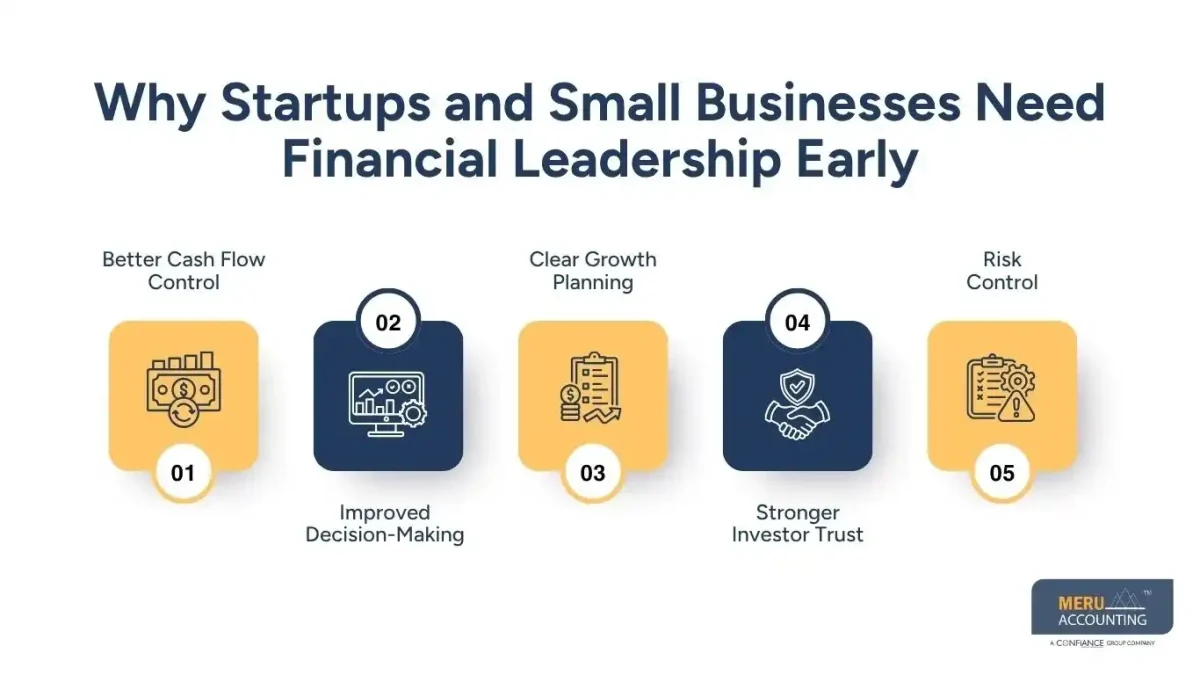
Clear Growth Planning
Scaling without a plan often leads to stress. CFO services give a path based on real money limits. This includes setting budgets, defining targets, and aligning growth with available funds.
Stronger Investor Trust
For startups, clear reports and forecasts are key. Investors expect clear data, not rough guesses. Accurate financial reports and realistic projections improve trust and support better communication with investors.
Risk Control
Finding money risks early helps avoid bigger issues later. This includes debt control, cost checks, and market changes. Regular financial review helps identify gaps and take corrective steps on time.
In simple terms, money leadership is not something to add later. It is something to build early.
Cost Advantages of Outsourced Small Business CFO Services
One of the main reasons businesses choose outsourced support is cost control.
Hiring a full-time CFO involves:
- High salary costs
- Staff benefits
- Long-term deals
- Extra overhead costs
For many startups and small businesses, this is not a good fit. Outsourced small business CFO services offer a more flexible choice. Here’s how:
Pay for What You Need: Businesses can choose the level of help based on their current stage. This avoids extra costs.
No Long-Term Lock-In: Outsourced services can be scaled up or down as needed. This freedom is key for growing firms.
Access to Skilled Experts: Instead of relying on one person, businesses gain access to a team with wide skills.
Faster Setup: Outsourced teams already have tools and systems. This cuts the time needed to set up money work.
The goal is not just to cut cost, but to use funds in a better way.
In-House vs Outsourced Small Business CFO Services: What Works Better?
Both models have their place, but the right choice depends on the business stage and needs.
In-House CFO
Advantages:
- Full focus on one firm
- Deep link with daily work
- Quick access
Limitations:
- High cost
- Limited outside view
- Less flexible
Outsourced CFO
Advantages:
- Lower cost
- Flexible setup
- Access to wider skills
- Scalable support
Limitations:
- Not always on-site
- Needs clear talks and updates
For most startups and small businesses, outsourced small business CFO services give a good balance. They offer skill without adding heavy cost. As the business grows and gets more complex, firms can later decide if a full-time role is needed.
Meru Accounting’s CFO Services
At Meru Accounting, we provide complete CFO support made for startups and small businesses. Our small business CFO services have helped multiple businesses and startups scale their business correctly. Our approach is not limited to reports. We focus on helping business owners read their numbers and use them to make better choices.
Our CFO services for startups and small businesses include:
- Financial planning and forecasts
- Cash flow checks and control
- Budget setup and tracking
- Profit checks
- Reports with clear meaning
- Help with funding and investor talks
We work closely with businesses to build clear money systems from the start. Whether it is setting up tools, improving reports, or planning growth, our small business CFO services give steady financial direction to your business.
With work across many fields, we know that each business has its own needs. Our CFO services for startups and small businesses are made to fit those needs without adding extra load.
Our Expert Perspective
At Meru Accounting, we see that many startups and small firms do not face problems due to low sales, but due to weak money view and late review of key numbers. Small gaps in cash flow track, cost split, or profit view can slowly impact daily work and lead to poor business calls over time.
In our work, we find that small business CFO services work best when money data is checked on a set base and tied to real business action. A clear system for records, regular review of key numbers, and simple report flow helps cut errors, improve cash control, and support long term growth with less risk and more clarity.
Key Takeaways
- Small business CFO services give money leadership beyond basic accounting
- Startups gain from early planning and clear insight
- CFO services for startups focus on forecasts, strategy, and decision support
- Outsourcing gives cost control and access to skilled experts
- Choosing the right model depends on busines stage and goals
- Strong money direction supports growth, trust, and long-term successs
FAQs
They include financial planning, budgeting, cash flow control, reporting, and support for key business choices. These services help businesses move beyond basic accounting and focus on growth.
Yes, early money guidance helps avoid common mistakes in cash flow, pricing, and planning. It also prepares startups for future growth and funding.
Bookkeeping records entries, while CFO services study those numbers and give direction for future choices.
Outsourcing helps businesses get expert support without the cost of a full-time hire. It also offers flexibility based on changing needs.
Small business CFO services should be considered when financial choices become complex, growth planning is needed, or there is a need for better financial clarity.