Small business federal tax can feel hard to plan for when sales rise and costs shift. The amount owed is not a flat fee on sales. Your tax bill can change with profit, business type, filing status, deductions, credits, and self-employment tax. For 2026, federal tax rates for single filers range from 10% to 37%, while the standard deduction is $16,100. These rates apply to taxable income, not gross sales.
Knowing how small business federal tax works can make cash planning easier. The key is to track profit, claim valid costs, and review estimated payments during the year.
What You Will Learn From This Blog
- How small business federal tax works for common business types.
- Why profit matters more than gross sales when planning tax.
- How tax deductions for small business can lower taxable income.
- How to prepare a federal tax return with clear records.
- How to plan cash for tax payments during the year.
- Which common errors can raise your final tax bill.
Introduction To Small Business Federal Tax
What Federal Tax Covers
Small business federal tax may include income tax, self-employment tax, payroll tax, or other taxes based on the business setup. A sole owner often reports business profit on Schedule C with Form 1040.
Why Profit Matters
Federal tax is not based only on sales. A firm with $150,000 in sales and $50,000 in valid costs has a lower tax base than a firm with $150,000 in sales and $10,000 in costs.
Business Type Changes The Filing
A sole owner, partnership, S corporation, and C corporation can face different tax rules. The right form and payment plan depend on the legal and tax setup.
Self-Employment Tax
A self-employed owner may owe self-employment tax on net earnings. The rate is 15.3% for Social Security and Medicare, subject to the rules and limits that apply for the year.
Federal Tax Is Not State Tax
Small business federal tax is only one part of the tax picture. State income tax, sales tax, local tax, and employer tax may also apply based on the firm and its location.
How Much Should A Small Business Expect To Pay In Federal Tax?
A Flat Rate Does Not Apply
There is no single small business federal tax rate for every firm. Many owners pay tax through a personal return, while some corporations pay tax at the business level.
Use Taxable Income, Not Sales
A good starting point is net profit. The final tax amount then reflects allowed adjustments, deductions, credits, filing status, and other income. A lower taxable income can lead to a lower tax bill.
Example Of A Small Firm
Suppose a sole owner has $100,000 in sales and $30,000 in valid business costs. The net profit is $70,000 before other tax items. The final tax bill will depend on the owner’s full tax position.
Marginal Rates Matter
For 2026, the federal rates for a single filer are 10%, 12%, 22%, 24%, 32%, 35%, and 37%. The top rate does not apply to all income just because some income reaches a higher band.
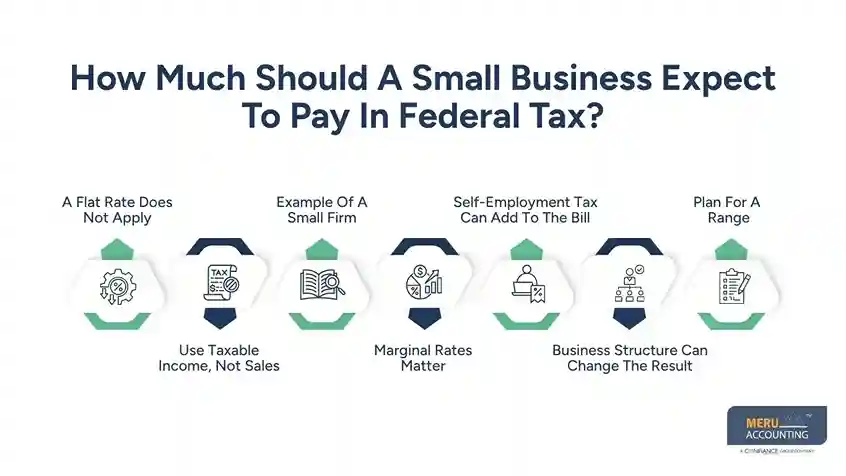
Self-Employment Tax Can Add To The Bill
A self-employed owner may owe self-employment tax along with income tax. The tax covers Social Security and Medicare and is based on net earnings from self-employment under IRS rules.
Business Structure Can Change The Result
Sole proprietors, partnerships, S corporations, and C corporations follow different tax rules. The structure can affect where income is reported and which taxes apply, so owners should review their setup before estimating tax.
Plan For A Range
Do not set aside cash based only on sales. Track profit each month and use an updated tax estimate that reflects income, costs, deductions, credits, and prior tax data. That gives a better view of small business federal tax.
What Factors Determine Your Small Business Federal Tax Bill?
Net Business Profit
Net profit is a key driver of small business federal tax. More profit can mean more taxable income, though deductions, credits, and other rules can change the result.
Business Structure
Your legal setup affects how income is taxed and reported. A sole proprietor may use Schedule C, while other structures may use separate federal forms.
Filing Status
Your filing status can change tax brackets and the standard deduction. For 2026, the standard deduction is $16,100 for single filers and $32,200 for married couples filing jointly.
Other Income
Wages, interest, rent, gains, and other income can raise total taxable income. Review all income before making a small business federal tax estimate.
Credits And Adjustments
Tax credits can cut tax owed, while certain adjustments can reduce income used in the tax calculation. The final result should come from the full return, not business profit alone.
What Tax Deductions For Small Business Can Reduce Your Tax Bill?
Ordinary Business Costs
Tax deductions for small businesses can include costs that are ordinary and necessary for the trade or business. Common items may include supplies, rent, software, insurance, and some professional fees.
Vehicle And Travel Costs
A business may deduct eligible travel and vehicle costs under IRS rules, which can reduce small business federal tax when properly documented.
For 2026, the standard business mileage rate is 72.5 cents per mile, subject to the rules for business use.
Home Office Costs
Some owners may claim a home office deduction when the space meets IRS rules. Keep records that show the space, its use, and related costs.
Equipment And Depreciation
Equipment and other assets may be handled through depreciation or other tax rules. The right method depends on the asset, cost, use, and current law.
Keep Proof For Each Claim
Tax deductions for small businesses need sound records. Keep receipts, invoices, bills, bank records, mileage logs, and notes that show the business reason for each cost. Good records can also make a federal tax return easier to review.
optional anymore
on running the business
How To Prepare Your Federal Tax Return For A Small Business
Gather Income Records
Start with sales reports, invoices, payment data, bank records, and tax forms. Match the records so income is not missed or counted twice.
Review Business Costs
Group costs by type and check each item for business use to identify deductions that may lower small business federal tax. A clear expense record makes the federal income tax return easier to prepare and review.
Check Required Forms
Forms depend on the business structure and tax items. A sole proprietor may need Form 1040 with Schedule C and Schedule SE, while other firms may need different forms.
Review Prior-Year Data
The prior federal income tax return can serve as a useful base for planning. Compare prior profit, tax, deductions, payments, and major changes in the new year.
File And Save Records
File the federal tax return by the due date that applies to the business. Keep the return and source records for the period required under IRS rules.
After filing, business owners may want to check the status of their return or confirm whether the IRS has received it. If you are asking, “where’s my federal tax return,” use the IRS’s official return-status tools and keep your filing confirmation and records available.
How To Estimate And Plan For Your Federal Tax Payments
Track Profit Each Month
Monthly books give a clearer view of sales, costs, and profit. That makes it easier to spot a rise or drop in the expected small business federal tax bill.
Use Prior Tax Data
The IRS notes that prior-year tax data can be a useful start for estimated tax work. Update the estimate when income, deductions, or credits change.
Set Cash Aside
A separate tax savings account can keep tax cash apart from daily spending. Base the reserve on an updated estimate rather than a fixed guess.
Know Estimated Tax Rules
Individuals such as sole proprietors, partners, and S corporation shareholders generally may need estimated payments when they expect to owe $1,000 or more. Corporations generally use a $500 threshold.
Check Each Quarter
Estimated tax is paid in set periods during the year. Late or low payments can lead to a penalty, so review the amount before each due date.
Common Mistakes That Increase Small Business Federal Tax
Mixing Personal And Business Costs
Mixed records can make it hard to spot valid costs. Separate business and personal spending where possible to keep the tax records clear.
Missing Income
Cash sales, card sales, platform income, and other receipts all need review. A complete income check can prevent errors in your federal tax return.
Poor Receipt Records
A bank line alone may not show why a cost was paid. Keep the receipt and a short note when the business reason is not clear.
Late Estimated Payments
An owner may face a penalty when enough tax is not paid on time. IRS rules provide safe-harbor methods in many cases, but special rules can apply.
Guessing The Tax Bill
A rough guess based on sales can miss key tax items. Use current profit, deductions, credits, and payment records to build a better small business federal tax estimate.
How Meru Accounting Can Help With Small Business Federal Tax
Clear Monthly Books
Meru Accounting can review bank activity, sales, bills, and key account balances. Clean books give the tax team a sound base for planning small business federal tax.
Tax Record Review
Our team can review records used for tax deductions for small business and tax filing. The aim is to spot missing data early and keep support for key claims.
Payment Planning
We can use current books and prior tax data to build a tax estimate. The plan can then be updated as profit or tax rules change.
Federal Tax Return Support
Meru Accounting can assist with federal tax return work based on client records and tax needs. Complex cases may need review by a CPA or tax attorney.
Our Expert Perspective
In our work with small firms, tax planning works best when books are kept clean all year. Waiting until filing time can leave gaps in records and cash planning. A monthly review gives owners a better view of profit and tax needs.
Our Expert Perspective
Our expert perspective is simple: small business federal tax should be planned throughout the year, not only at filing time. Monthly bookkeeping gives owners a clear view of income, costs, profit, and possible tax needs.
Regular review also makes it easier to find valid tax deductions for small business, track estimated payments, and keep records ready for the federal income tax return. A good tax plan starts with accurate books and current numbers.
Key Takeaways
- Small business federal tax is based on tax rules, not a flat share of sales.
- Net profit, filing status, business type, and other income can change the tax bill.
- Tax deductions for small business can lower taxable income when IRS rules are met.
- Self-employed owners may also owe self-employment tax.
- Estimated payments may be needed during the year.
- Good books and records make tax planning clearer.
- A federal tax return should be based on full and correct records.
- Current IRS guidance should be checked before filing.
FAQs
There is no fixed amount. Small business federal tax depends on taxable income, business type, filing status, deductions, credits, and other tax items.
Usually, income tax is not based on gross sales alone. Valid business costs and other allowed tax items can reduce the income used for the tax calculation.
Common tax deductions for small businesses may include supplies, rent, insurance, software, travel, and some vehicle or home office costs when IRS rules are met.
No. Many self-employed people need them, but the rule depends on expected tax and other factors. The IRS says individuals generally face the rule when they expect to owe $1,000 or more.
A federal tax return depends on the business type. A sole proprietor often reports business income and costs on Form 1040 with Schedule C, while other structures may use other federal forms.
optional anymore
on running the business