
Manufacturing companies work in a fast and complex setting. They deal with raw materials, labor costs, machine use, shipping, and sales all at the same time. Along with daily operations, they must also follow tax rules that can change often. This mix of work makes tax compliance hard to manage without strong financial support. Many firms now rely on tax bookkeeping services to keep records clear and stay ready for tax time. These services help track income, costs, invoices, and tax duties in a clean and simple way. They also reduce the risk of mistakes that can lead to fines or delays.
In this blog, you will learn how manufacturing companies use structured bookkeeping support to stay compliant, reduce stress, and improve financial control. You will also see how solutions like outsourced tax preparation help firms focus more on production and less on paperwork.
What You Will Learn From This Blog
This blog will help you understand:
- What tax bookkeeping services are and how they work
- Key tax issues faced by manufacturing firms
- How bookkeeping improves tax compliance
- The value of outsourcing tax tasks
- Real benefits for cost, time, and accuracy
- How expert firms like Meru Accounting support manufacturers
By the end, you will see why tax support is not just a back-office task but a key part of smooth business growth.
What Are Tax Bookkeeping Services?
Tax bookkeeping services refer to the process of recording, sorting, and managing all financial data needed for tax filing. These services also ensure that every transaction is properly categorized and stored for review. They help create a clear financial record that supports both compliance and planning.
These services include tracking sales, expenses, payroll, and tax-related entries in an organized system. They also help identify gaps in records before tax season begins. This reduces last-minute corrections and improves filing speed.
For manufacturing companies, this also means managing:
- Cost of raw materials
- Production expenses
- Vendor payments
- Inventory records
- Tax deductions and credits
These records often connect directly to production output and pricing decisions. They also help managers understand where costs can be reduced without affecting quality.
The goal is to keep all records accurate and ready for tax filing at any time. This also helps during audits or financial reviews. When records are clean, companies can file taxes faster and avoid errors. It also reduces stress on internal finance teams during peak periods.
In many cases, firms also use outsourced tax preparation along with bookkeeping. This means they hire external experts to prepare and file tax returns based on well-managed financial data. It also helps reduce dependency on internal staff during busy cycles. This reduces internal workload and improves accuracy. It also ensures that filings follow updated tax rules and standards.
Common Tax Compliance Challenges in Manufacturing
Manufacturing firms face several tax-related issues that can slow down operations and create risk. These challenges often build up over time if not managed properly. Some of the most common challenges include:
Complex Cost Tracking
Manufacturers deal with many cost layers like labor, materials, transport, and overhead. Tracking each cost correctly for tax use is not easy. It often requires detailed systems to avoid misreporting. Small errors can affect total tax liability.
Large Volume of Transactions
Daily transactions are high in manufacturing units. Without a system, records can become messy and hard to review during tax filing. This also increases the chance of missing key entries. It can delay reporting cycles.
Changing Tax Rules
Tax laws often change at local, national, and global levels. Keeping up with updates takes time and attention. Many firms struggle to apply changes quickly. This can lead to compliance gaps.
Inventory Valuation Issues
Inventory plays a key role in tax reports. Wrong valuation can lead to incorrect tax reports. It also affects profit reporting and cost structure. Accurate tracking is essential for compliance.
Time Pressure During Tax Season
End-of-year tax filing can become stressful when data is not ready or is poorly organized. Teams often rush to complete records at the last minute. This increases the risk of errors. It also affects overall productivity.
These issues show why many companies now depend on structured tax bookkeeping services to stay on track. They also help reduce operational stress during peak financial periods.
Tax Bookkeeping vs. In-House Accounting for Manufacturers
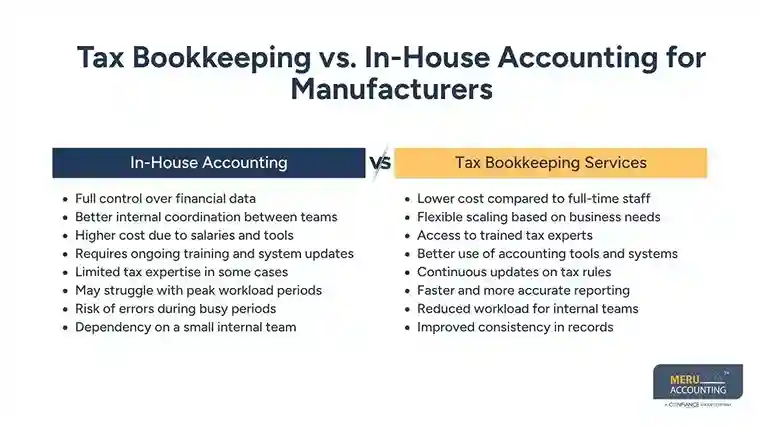
Manufacturers often face a choice between in-house accounting teams and external bookkeeping support. Both options have value, but they serve different needs depending on company size and complexity.
In-House Accounting
- Full control over financial data
- Better internal coordination between teams
- Higher cost due to salaries and tools
- Requires ongoing training and system updates
- Limited tax expertise in some cases
- May struggle with peak workload periods
- Risk of errors during busy periods
- Dependency on a small internal team
Tax Bookkeeping Services
- Lower cost compared to full-time staff
- Flexible scaling based on business needs
- Access to trained tax experts
- Better use of accounting tools and systems
- Continuous updates on tax rules
- Faster and more accurate reporting
- Reduced workload for internal teams
- Improved consistency in records
When combined with outsourced tax preparation, businesses get full tax support without building large internal teams. This approach helps firms stay flexible and cost-efficient. It also improves response time during audits and filings.
Key Benefits of Using Tax Bookkeeping Services
Manufacturing companies gain several strong benefits when they use professional bookkeeping support. These benefits impact both daily operations and long-term planning.
Better Tax Accuracy
Clean records reduce errors in tax filing. This helps avoid penalties and audits. It also improves trust with tax authorities. Accurate data supports better financial planning.
Time Savings
Teams spend less time on manual data entry and more time on production and growth. This improves overall productivity. It also reduces burnout in finance teams.
Cost Control
Outsourcing reduces the need for large in-house finance teams and lowers overhead costs. It also reduces software and training expenses. This improves budget efficiency.
Strong Compliance Support
Experts stay updated with tax laws and help firms follow rules without confusion. This reduces the risk of non-compliance. It also improves filing consistency.
Easy Financial Tracking
Real-time data helps managers make better decisions based on clear numbers. It also improves forecasting accuracy. Leaders can react faster to changes.
Improved Audit Readiness
Well-kept records make audits smooth and stress-free. It reduces preparation time during reviews. It also improves confidence during inspections.
Together, these benefits make tax bookkeeping services a smart choice for modern manufacturers. They also support long-term business stability and growth.
Meru Accounting's Tax Bookkeeping Services
Meru Accounting offers structured and reliable support for manufacturing companies that want better tax control and clear financial records. Their approach focuses on accuracy, consistency, and ease of use.
Our services include:
- Full tax-ready bookkeeping
- Monthly and yearly financial reports
- Expense and income tracking
- Inventory-linked tax records
- Support for compliance and filings
- Coordination with outsourced tax preparation needs
- Ongoing data review and correction support
- System-based record organization for faster access
Our focus is on making tax work simple and stress-free. Our team helps manufacturers reduce manual work and avoid last-minute tax issues. We also help improve data flow between departments.
By using updated tax systems and expert review, Meru Accounting helps firms stay ready for tax season at all times. This allows business owners to focus more on production, supply chains, and growth planning. It also supports better financial visibility across the organization.
Our Expert Insight
In manufacturing, tax issues are often not caused by high taxes but by poor data flow. When records are scattered, even simple tax work becomes hard. It also slows down reporting and decision-making. Tax bookkeeping services fix this problem by keeping all financial data in one place. They also improve accuracy across all reporting levels. With outsourced tax preparation, companies gain a complete model that reduces stress and improves control. This combination also helps reduce internal workload during peak periods.
The key insight is simple: clean books lead to easy taxes. And easy taxes lead to better business focus. This also leads to stronger long-term financial health.
Key Takeaways
- Manufacturing firms face complex tax and cost systems
- Poor records can lead to tax errors and penalties
- Tax bookkeeping services bring order and clarity
- They also improve reporting speed and consistency
- Outsourcing tax work improves speed and accuracy
- It also reduces pressure on internal teams
- Expert support reduces cost and improves compliance
- Strong systems help businesses focus on growth
FAQs
Tax bookkeeping services are systems that track and organize financial data needed for tax filing. In manufacturing, they include costs, inventory, payroll, and sales records. They also help ensure data is ready for audits and reviews.
They need them to manage complex costs, large transactions, and tax rules. These services help reduce errors and improve compliance. They also improve overall financial control and reporting speed.
Outsourced tax preparation allows experts to handle tax filing using clean financial data. It saves time and improves accuracy. It also ensures compliance with updated tax rules.
For many manufacturers, yes. They reduce cost, improve accuracy, and give access to trained tax experts without hiring large teams. They also provide more flexibility during peak periods.
Yes. They keep records organized and ready, which makes audits faster, easier, and less stressful. They also reduce the chance of missing or incorrect data.