Importing goods into Singapore is very common for both small and large businesses. Companies bring in raw materials, finished goods, and equipment to support their operations. At the time of import, businesses are required to pay Singapore import tax in the form of Goods and Services Tax (GST). This tax is charged at the point of entry and can affect cash flow if not managed properly. The good news is that businesses can often claim back the GST paid on imports called Import Tax Claims.
This process is known as claiming input tax. When done correctly, it reduces costs and makes the entire supply chain more efficient. Knowing the correct rules of tax in Singapore is important for every business owner and finance team.
What You Will Learn From This Blog
- Understand how Singapore import tax works and when businesses can make Import Tax Claims.
- Learn the eligibility requirements, documents, and filing process for claiming import GST.
- Discover common mistakes that lead to rejected claims and penalties, along with best practices for staying compliant with IRAS regulations.
What is Singapore’s Import Tax?
- Singapore’s import tax is GST applied to goods entering Singapore from overseas.
It is designed to ensure fair competition between local and foreign products. - The standard GST rate is currently 9%, and it applies to most imports.
This rate may change in the future depending on government policies. - Both individuals and companies must pay import GST at the time of entry.
However, only GST-registered businesses can have tax claims. - This makes it important for importers to understand their registration status.
Knowing this helps avoid unnecessary costs and errors in claims.
Why Tax Claiming on Inputs is Important
- Input tax claiming reduces the final cost of imported goods.
This allows companies to keep prices competitive in the market. - Businesses can improve cash flow by claiming the GST they already paid.
This extra liquidity can then be used for expansion or daily expenses. - It helps maintain accurate financial records for the company.
This builds trust with auditors and tax authorities. - Following the tax rules in Singapore also keeps the business legally safe.
Non-compliance can cause penalties, which may harm business growth.
Who Can Have Tax Claims on Imports?
- Only GST-registered companies in Singapore can have input tax claims.
Registration must be completed before making claims. - Imports must be strictly for business use, not for private consumption.
Goods for personal purposes are not eligible for claims. - The imports should relate directly to taxable business activities.
Exempt supplies, like certain financial services, are not claimable. - Companies must keep proper permits and invoices for all imports.
These records serve as proof during audits or inspections. - Payment of Singapore import tax must be clearly supported with documents.
Without proof, the claim is usually rejected by IRAS.
Conditions for Claiming Import GST
- The business must be GST-registered before imports are made.
Registration ensures the legal right to claim input tax. - Goods must be linked to the company’s taxable business activities.
Using them for non-business purposes makes them non-claimable. - GST should be fully paid at the point of import into Singapore.
Partial or unpaid tax cannot be claimed. - Import permits and supplier invoices should be valid and accurate.
Errors may delay or cancel tax claims. - The business must file GST returns correctly and on time.
Missing deadlines may lead to penalties and rejection of claims. - Claims should be included in the right filing period.
Late or backdated claims are usually disallowed.
Documents Needed for Input Tax Claims
- An import permit issued by Singapore Customs must be provided.
This document shows legal import approval. - An invoice from an overseas supplier is required for proof.
It confirms the value of goods being imported. - A bill of lading or airway bill must also be included.
This shows the shipment details and ownership of goods. - Proof of payment of import tax in Singapore should be attached.
This confirms that GST was paid during customs clearance. - Accounting records should reflect the use of goods in the business.
This ensures tax claims are tied to actual taxable supplies.
How to Get Input Tax Claims on Singapore Import Tax
Register for GST with IRAS
- First, register your company for GST with IRAS.
- This is the main requirement for making claims.
Pay GST at Customs Clearance
- Pay the GST at the customs clearance stage during imports.
- Payment can be done directly or through a freight forwarder.
Collect and Organize Supporting Documents
- Collect and organize all supporting documents from suppliers and customs.
- Keeping them safe helps during filing and audits.
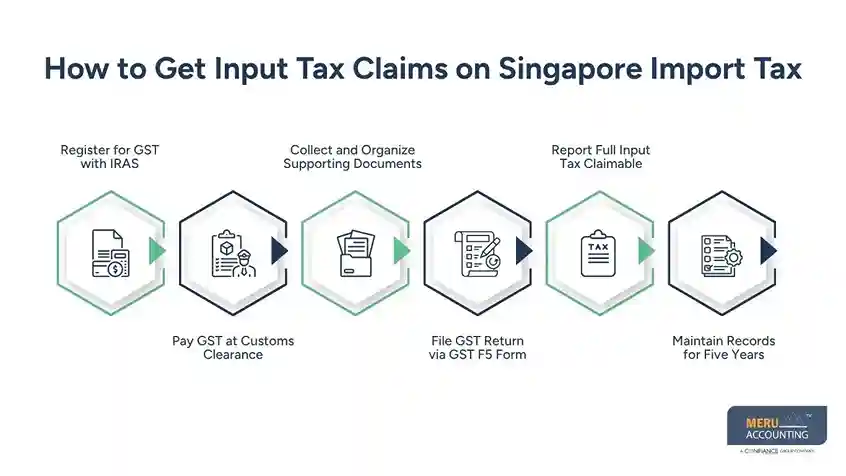
File GST Return via GST F5 Form
- File your GST return online using the GST F5 form on the IRAS portal.
- Claims are made under input tax in this return.
Report Full Input Tax Claimable
- Include the full amount of input tax claimable in the return.
- Make sure figures match invoices and permits.
Maintain Records for Five Years
- Keep all records for at least five years after the claim.
- This is a legal requirement under Singapore tax law.
Common Mistakes in Input Tax Claiming
- Some businesses try to claim tax for goods used privately.
This is not allowed under Singapore tax rules. - Others submit tax claims without proper supplier invoices.
Missing documents usually lead to rejection. - A few businesses forget to pay GST at the point of import.
Without payment, no claim can be made later. - Late filing of claims is another common issue.
This can lead to lost refunds and penalties. - Claiming GST while not being properly registered is also a mistake.
Companies must check their GST registration status first.
Example of Import Tax and Claim
- Suppose a company imports machinery worth SGD 20,000.
At 9% GST, they pay SGD 1,800 as import tax in Singapore. - This amount is paid during customs clearance.
The payment is recorded with the import permit. - Since the machinery is for business use, the company can claim it.
They report the SGD 1,800 in their GST F5 return. - As a result, the company recovers the full tax amount.
This reduces overall costs and improves cash flow.
Benefits of Correct Input Tax Claim
- Saves large amounts of money for regular importers.
This directly improves profit margins. - Ensures full compliance with IRAS and customs laws.
Compliance avoids fines and audits. - Builds a strong reputation with suppliers and tax authorities.
This creates trust in long-term trade relations. - Improves the accuracy of financial statements and reports.
Better records support smart business planning. - Helps companies scale with reduced import costs.
This is useful in industries with frequent imports.
Reverse Charge on Imports
- Some services or digital products fall under reverse charge rules.
Businesses must account for GST themselves in such cases. - The GST is reported both as input tax and output tax.
This balances the tax and prevents revenue loss. - Reverse charge mainly applies to imported services.
Goods usually follow the standard GST import process. - Knowing this rule helps businesses manage import tax in Singapore correctly.
Ignoring it may lead to under-reporting and penalties.
Exempt and Non-Claimable Inputs
- Goods imported for private or family use are not claimable.
Businesses must separate such imports clearly. - Imports not linked to taxable business activities cannot be claimed.
This includes charitable or non-commercial goods. - Certain exempt supplies, like financial services, are excluded.
These services are GST-free under Singapore law. - Free samples or gifts not tied to sales are also non-claimable.
Claims are only for goods that generate taxable supplies.
Role of Singapore Customs
- Singapore Customs manages the entry of goods into the country.
They issue permits for every import transaction. - They ensure the correct GST is paid at the border.
This keeps the system fair for local businesses. - Customs officers verify compliance with Singapore tax rules.
Wrong declarations can result in penalties or confiscation. - They also work closely with IRAS to share import data.
This improves tax tracking and enforcement.
GST Relief on Small Imports
- Low-value goods sometimes qualify for GST relief.
This helps reduce the tax burden on small imports. - However, rules for GST relief are strict and may change.
Businesses must always check IRAS updates. - Relief usually applies to non-commercial imports of small items.
Commercial goods may still be taxed even if low value. - Importers must confirm if their goods qualify before filing.
This avoids mistakes during claims.
Steps to Stay Compliant
- Check GST registration status regularly before importing. This prevents invalid tax claims later.
- Maintain proper and organized import and tax records. Well-kept records make audits easier to handle.
- File GST returns on time every quarter or filing period. Late filing often leads to penalties.
- Claim input tax only for goods used in business operations. This ensures compliance with IRAS rules.
- Consult with tax professionals if rules seem unclear. Expert help reduces the risk of errors.
Penalties for Wrong Tax Claims
- Over-claiming input tax can lead to heavy financial penalties.
This can also attract audits from IRAS. - Incorrect filings may result in interest charges.
These charges increase business expenses. - Fraudulent claims can cause legal action and reputation loss.
Trust once lost is hard to rebuild. - Businesses may also lose eligibility for future GST schemes.
This increases costs for future imports.
How Businesses Can Plan for Import GST
- Always estimate GST cost before placing import orders. This helps manage working capital.
- Keep enough funds ready for Singapore tax payments. Lack of funds may delay clearance at customs.
- Work with freight forwarders or customs brokers for smoother processes. They guide on proper paperwork and payment.
- Use modern accounting software to track GST payments and claims. This reduces errors in returns.
- Review claims regularly to ensure they meet all IRAS rules. A small check can prevent costly mistakes later.
Support from Tax Advisors
- Tax advisors help businesses with correct input tax claims. Their expertise saves both time and money.
- They review documents and prepare GST returns for clients. This reduces errors in filing.
- Advisors ensure full compliance with import tax in Singapore Compliance builds trust with authorities.
- They also provide training for internal finance teams. This builds long-term capacity in the company.
Why Understanding Input Tax is Key for Importers
- Importers deal with high-value shipments every month. Even small errors in GST claims can cost thousands.
- Correct claiming improves profit margins across all imports. This helps businesses remain globally competitive.
- It ensures smooth customs clearance and fewer audits. Less disruption means faster deliveries.
- Businesses gain better cash flow by reclaiming GST quickly. This supports growth and expansion.
optional anymore
on running the business
Future of Import Tax in Singapore
- GST rates may increase further in the coming years. Businesses should plan for these changes early.
- Digital tools are making GST claims faster and simpler. Automation reduces paperwork and delays.
- IRAS is adopting stronger data systems for compliance. This means closer monitoring of import records.
- Businesses must stay updated with every new rule. Ignoring updates may lead to costly mistakes.
It is a necessary cost in international trade, but businesses can reduce its impact by claiming input tax correctly. By keeping proper documents, filing GST returns on time, and ensuring compliance with IRAS rules, companies can save money and improve their financial health.
At Meru Accounting, we understand the challenges businesses face in managing import tax in Singapore. Our team offers expert guidance in GST registration, input tax claims, and customs compliance. We help companies maintain proper records, avoid penalties, and recover maximum tax benefits. With years of experience in global trade accounting, we provide reliable support for smooth import operations. Partnering with Meru Accounting ensures accuracy, cost savings, and peace of mind.
Our Expert Insight
Managing import GST is more than a compliance requirement—it is a valuable opportunity to improve cash flow and reduce operating costs. Businesses that maintain accurate records, file GST returns on time, and understand IRAS requirements can recover eligible import tax efficiently while avoiding costly errors. Working with experienced tax professionals also helps streamline the claims process, minimize compliance risks, and ensure businesses receive the maximum tax benefits available.
Key Takeaways
- Singapore import tax is generally charged as GST on most imported goods.
- Only GST-registered businesses can claim import GST, provided imports are for taxable business activities.
- Accurate import permits, supplier invoices, shipping documents, and proof of GST payment are essential for successful claims.
- Import GST claims must be reported correctly through the GST F5 return within the appropriate filing period.
- Common errors such as late filing, missing documents, or claiming non-business expenses can result in rejected claims and penalties.
- Proper import tax planning improves cash flow, strengthens compliance, and supports long-term business growth.
- Professional tax advisors can help businesses maximize eligible claims, maintain compliance, and simplify the entire GST reporting process.
FAQs
Singapore import tax is primarily Goods and Services Tax (GST) charged on most goods imported into Singapore. The GST is usually paid during customs clearance by the importer or their appointed freight forwarder.
Only GST-registered businesses can claim import GST in Singapore. The imported goods must be used for taxable business activities, and the business must meet all IRAS documentation and filing requirements.
To make Import Tax Claims, businesses typically need an import permit, supplier invoice, bill of lading or airway bill, proof of GST payment, and supporting accounting records that show the goods were imported for business use.
Businesses claim import GST by reporting the eligible input tax in their GST F5 return filed through the IRAS portal. All claims must be supported by accurate records and submitted within the correct GST filing period.
Incorrect Import Tax Claims can result in penalties, interest charges, rejected claims, and IRAS audits. Keeping accurate records and following Singapore GST regulations helps businesses avoid compliance issues and recover eligible tax correctly.