
A restaurant’s tax return tells a story that goes beyond sales and profits. Every supplier bill, payroll run, equipment purchase, and repair job can affect how much of your income is taxable. Yet, many owners focus on daily costs and overlook expenses that could qualify as write-offs. Knowing the tax deductions for restaurant owners can help you make better use of these costs when you file your taxes.
The key is knowing what the IRS allows you to deduct, what comes with limits, and what needs to be reported differently. A food purchase, a new commercial oven, and a kitchen upgrade may all have different tax rules.
Let’s break down the expenses you can claim, the less obvious write-offs worth checking, and the records you need to support your deductions.
What You Will Learn From This Blog
- Which day-to-day restaurant costs may qualify as tax deductions.
- How to spot less common write-offs that owners often miss.
- How tax rules apply to cafes, food trucks, and catering firms.
- Which records to keep before filing your tax return.
- How good bookkeeping and tax support can help you claim costs with care.
Understanding Tax Deductions for Restaurant Owners
A tax deduction is a business cost you can subtract from your taxable income if it meets IRS rules. For most small businesses, a cost must be both ordinary and necessary to qualify. In simple terms, it should be common in your line of work and helpful for running your business.
For example, food supplies, staff pay, rent, and kitchen repairs are common costs in the food trade. You may be able to deduct them if they relate to your business and you keep proper records.
It is also vital to know the difference between a tax deduction and a tax credit. A deduction lowers the income used to work out your tax. A tax credit cuts the tax you owe. Both can help, but they work in different ways.
Your business setup also matters. A sole owner, partnership, S corporation, or C corporation may report income and claim costs in different ways. Some costs, such as owner draws, are not business deductions. So, review your setup with a tax pro before you file.
optional anymore
on running the business
Common Tax Deductions for Restaurant Owners
Most restaurants have a set of costs that keep daily work on track. Here are some key expenses that may qualify as tax deductions for restaurant owners.
1. Food, Drinks, and Ingredient Costs
Food and drink supplies are a major cost for most restaurants. Meat, produce, dairy, spices, cooking oil, and drinks all form part of the cost of goods sold (COGS).
You must track stock bought, stock used, and stock left at the end of the year. This helps you work out the cost of goods sold with care. Do not claim the same cost twice as both an expense and an inventory cost.
2. Employee Wages and Payroll Taxes
Pay for cooks, servers, cashiers, cleaners, and other staff is a key business cost. You may also deduct the employer share of payroll taxes and some staff benefits, if they meet IRS rules.
Keep payroll reports, time sheets, tax forms, and proof of payment. These records help show who you paid, how much you paid, and what work they did.
3. Rent, Utilities, and Property Costs
If you rent a space for your restaurant, rent is often a deductible cost. You may also claim business costs for power, gas, water, internet, and waste pickup.
If you own the building, the tax rules differ. Mortgage interest may be deductible, but loan payments toward the principal are not. Property costs may also need to be split if you use part of the space for personal reasons.
4. Kitchen Equipment and Furniture
Ovens, fridges, freezers, dishwashers, tables, chairs, and other tools help keep a restaurant running. The tax treatment depends on the cost, useful life, and type of item.
Some items may qualify for a current-year write-off under Section 179 or bonus depreciation. Others may need to be depreciated over time. Keep bills and note when each item was placed in service.
5. Repairs, Upkeep, and Cleaning Supplies
Costs to keep your space and tools in good shape may qualify as deductions. These can include fixing a fridge, servicing an oven, pest control, floor cleaning, and routine plumbing work.
But a major upgrade or change that adds value to the building may need to be treated as a capital cost. The line between a repair and an upgrade matters when you file.
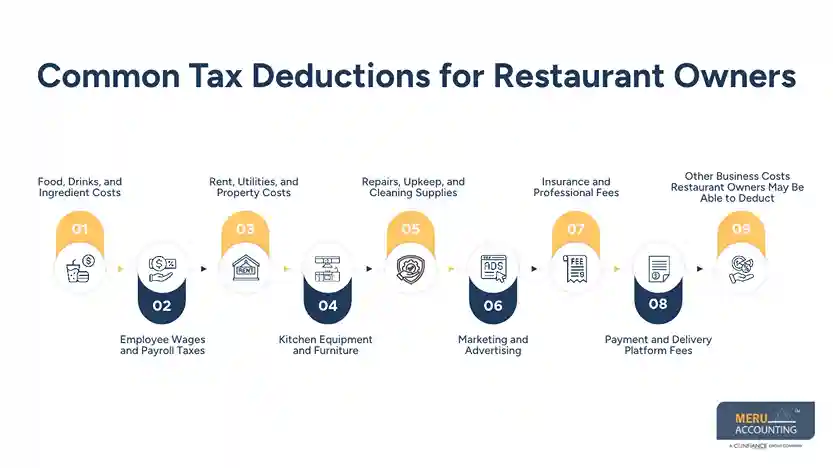
6. Marketing and Advertising
You may deduct costs for local ads, social media campaigns, menu design, flyers, signs, and website upkeep. Fees paid to a marketing firm may also qualify when the work is for your business.
Keep copies of bills and campaign reports. This helps you track what you spent and link the cost to your restaurant.
7. Insurance and Professional Fees
Business insurance may cover your space, stock, staff, and public risk. Premiums for valid business coverage may qualify as a write-off.
You may also deduct fees paid to bookkeepers, tax preparers, lawyers, and other experts for business work. Keep clear bills that show the service and date.
8. Payment and Delivery Platform Fees
Card fees, online order fees, and delivery app charges can take a share of each sale. These costs may be deductible when they relate to your restaurant’s sales.
Track the gross sale and the fee as separate entries. If you record only the net amount paid to your bank, your sales and costs may both be understated.
9. Other Business Costs Restaurant Owners May Be Able to Deduct
Some smaller expenses can add up over the year. Depending on how you use them and the tax rules that apply, you may also deduct:
- Office supplies: Paper, printer ink, pens, and other items used for daily business tasks.
- Bank fees: Business account charges and transaction fees.
- Delivery costs: Packaging, takeaway boxes, bags, and other supplies used for customer orders.
- Business travel: Qualifying travel costs for supplier visits, trade events, and other business needs.
- Vehicle costs: Eligible mileage, fuel, and upkeep for vehicles used for business.
- Business licenses: Fees for permits, food safety checks, and required local licenses.
Keep each cost in the right account. A clear record makes it easier to see what you spent and what you may claim.
Overlooked Restaurant Tax Deductions That Can Reduce Your Tax Bill
Many owners track high costs but miss smaller expenses that may also qualify. Reviewing these costs can help you find valid write-offs.
1. Staff Uniforms and Protective Gear
Aprons, chef coats, gloves, and safety gear may qualify if they are required for work and are not suitable for everyday wear. Regular clothes that staff can wear outside work do not qualify just because the restaurant asks them to follow a dress code.
2. Employee Meals
Meals given to staff can have special tax rules. The reason for the meal, who gets it, and when it is served all matter. Some meals may qualify for a business deduction, while others face limits or may not be deductible.
From 2026, certain employer-provided meals that were once covered by a temporary deduction are no longer deductible. Some exceptions apply, including specific rules for restaurants. Check the current IRS rules before claiming these costs.
3. POS Systems and Business Software
A point-of-sale (POS) system helps track sales, stock, and payments. You may be able to deduct software fees, cloud subscriptions, and other tech costs used to run your restaurant.
If you buy costly hardware or software, check whether the cost needs to be depreciated or qualifies for a current-year deduction.
4. Staff Training and Professional Development
Training costs may qualify when they help staff do their current jobs. Food safety courses, kitchen training, and service skills programs are common examples. Keep course bills, staff details, and proof of payment.
5. Licenses and Industry Memberships
Some trade group fees, food service permits, and business licenses may be deductible. Make sure the fee relates to your business and is not a personal or non-deductible cost.
Tax Deductions for Food Service Businesses Beyond Traditional Restaurants
The rules for tax deductions for food service businesses can apply to many types of food firms. Still, each business has its own costs and records to track.
Here are some examples:
- Cafes and coffee shops: Coffee beans, milk, cups, takeaway lids, small kitchen tools, and pastry supplies.
- Catering firms: Food transport, event setup, serving gear, storage, and costs tied to client events.
- Food trucks: Fuel, vehicle repairs, cooking gear, parking fees, and permits for approved trading spots.
- Bakeries: Flour, sugar, baking tools, ovens, packaging, and costs linked to daily production.
- Quick-service restaurants: Takeout boxes, drive-through tools, order systems, and food delivery fees.
For each type of business, the key is to link costs to sales and daily work. For example, a food truck owner should keep vehicle records that show business use. A bakery should track its stock and the cost of goods sold. A catering firm should keep bills for each event.
These steps help owners claim valid costs and avoid mixing personal and business spending.
How to Claim Restaurant Business Tax Deductions Correctly
Knowing which costs may qualify is only part of the work. You also need clear records to back up each claim.
1. Keep Daily Records of Income and Costs
Record sales, refunds, stock buys, wages, rent, and other costs as they occur. Use POS reports and bank feeds to check that all sales and payments are in your books.
2. Save Bills, Receipts, and Invoices
Keep proof of each major cost. Your records should show the date, amount, seller, and reason for the expense. The IRS says good records help you track income, support deductions, and prepare tax returns.
3. Track Food Stock and Cost of Goods Sold
Do not treat all food purchases as a separate write-off without checking how your books handle stock. The cost of goods sold calculation must account for stock at the start and end of the tax year. Avoid claiming the same cost twice.
4. Review Equipment and Other Large Purchases
Do not assume every large purchase can be written off at once. Some assets must be depreciated over time. Others may qualify for Section 179 or bonus depreciation, based on the rules for the tax year and the asset.
5. Check Meal and Entertainment Rules
Business meals are often subject to a 50% deduction limit, though some exceptions apply. Entertainment costs are usually not deductible. Keep a note of the business purpose, date, people involved, and cost.
6. Review Your Books Before Filing
Check for missing bills, duplicate costs, wrong account codes, and personal spending in business accounts. A monthly review can help you spot errors well before tax season.
How Meru Accounting Helps Restaurant Owners Manage Tax Deductions
A restaurant’s tax records should tell the full story behind its sales and expenses. For example, food purchases need to match inventory records, payroll costs should agree with wage reports, and equipment purchases should be tracked separately from routine repairs. When these records don’t line up, tax preparation becomes harder and eligible deductions may be missed or reported incorrectly.
Meru Accounting helps restaurant owners bring these numbers together. Our team understands the cost structure of restaurants and other food service businesses, from food inventory and labor costs to supplier payments and equipment expenses. We provide dedicated accounting support to keep these records organized throughout the year.
Our services include:
- Restaurant Expense Accounting: Record and classify food purchases, rent, utilities, insurance, repairs, marketing, and other operating costs.
- Inventory and COGS Accounting: Track food purchases, stock records, inventory changes, and cost of goods sold to support accurate financial reporting.
- Payroll Accounting: Maintain wage records, employer payroll costs, staff payments, and related entries.
- Accounts Payable Management: Track supplier invoices, food vendor payments, equipment bills, and outstanding balances.
- Fixed Asset and Depreciation Records: Maintain records of kitchen equipment, furniture, appliances, and other business assets for proper accounting treatment.
- Tax Preparation Support: Organize expense data, financial reports, and supporting records to help streamline tax return preparation.
From an independent restaurant to a growing multi-location group, Meru Accounting provides accounting support that fits your business needs. Our trained accounting professionals, multi-industry experience, and quality review processes help maintain reliable financial records throughout the year.
With better expense records and clear financial reports, you can approach tax season with greater confidence and make informed decisions about your restaurant’s finances.
Our Expert Insight
One mistake restaurant owners should avoid is treating every payment made by the business as a tax deduction. A payment leaving your bank account does not always mean you can write off the full amount on your current tax return.
Consider a restaurant that spends $15,000 on a new commercial kitchen setup. Although the full amount is paid upfront, the purchase may need to be recorded as a business asset and deducted over time through depreciation. The same applies to major kitchen upgrades. By contrast, routine repairs may qualify as current business expenses.
This distinction matters because bookkeeping and tax accounting do not always follow the same timing. An expense may affect cash flow today but have a different tax impact over several years. Section 179 and bonus depreciation may allow certain assets to be deducted sooner, subject to current IRS rules and eligibility.
Our advice is to review large purchases before closing your books for the year. Check whether each item is a repair, an improvement, or a new asset, and confirm its tax treatment with a qualified tax professional. This can help prevent incorrect write-offs and give you a more accurate view of your restaurant’s profits.
Key Takeaways
- Many restaurant costs, such as food supplies, wages, rent, utilities, and repairs, may qualify as business deductions.
- Some costs, such as equipment and major upgrades, may need to be depreciated instead of deducted at once.
- Staff meals, business meals, uniforms, and training have specific tax rules.
- Cafes, food trucks, bakeries, and catering firms can claim costs linked to their business work.
- Keep receipts, payroll reports, stock records, and bank statements to support your claims.
- Review your books often to catch missing costs and errors before filing your tax return.
- Work with a tax professional to check that each deduction meets IRS rules.
FAQs
Yes. Food and beverage costs are generally accounted for through cost of goods sold (COGS). The deduction depends on your inventory accounting method and the stock sold or used during the tax year.
Yes. Commercial kitchen equipment may qualify for Section 179, bonus depreciation, or regular depreciation. The available deduction depends on the asset, its use, and the tax rules for the year it is placed in service.
Yes. Fees paid to third-party delivery platforms, payment processors, and credit card companies are generally deductible business expenses when they relate to restaurant sales.
Not always in full. Routine repairs may qualify as current expenses, while major renovations and improvements generally need to be capitalized and depreciated. The nature of the work determines the tax treatment.
A new restaurant may deduct eligible operating costs, such as rent, wages, utilities, advertising, and supplies. Certain startup and organizational costs may also qualify for special deductions, subject to IRS limits and rules.
optional anymore
on running the business