A $300 tax bill can feel reasonable—until you see someone else pay $1,000 for what seems like the same service. The difference often comes down to what’s behind the return. Tax preparation costs can change based on the forms you file, your business structure, the number of states involved, and how much work your records need.
A basic Form 1040 may take far less time than a return with self-employment income, rental property, investments, or itemized deductions. Business returns can vary even more. A sole proprietor, partnership, S corporation, and C corporation all have different filing needs, which can lead to very different fees.
So, what should you expect to pay in 2026? This guide breaks down common tax preparation fees by tax form and business structure, explains what drives the price, and shows what to look for when comparing quotes from tax preparers or CPAs.
What You Will Learn From This Blog
- Typical tax preparation cost by tax return type in 2026
- The average cost of tax preparation for individual taxpayers
- How fees can vary by business structure
- The main factors that affect tax preparation fees
- What CPAs may charge for tax work
- How to keep tax prep costs under control
Average Tax Preparation Cost by Tax Return Type
There is no single fee that applies to every tax return. A tax pro may set a flat fee, charge by the hour, or use a mix of both. The range can also vary by city, firm, return size, and the work needed.
Here are common return types and broad fee ranges that may help with planning:
Tax Return Type | Typical Fee Range |
Simple Form 1040 | $150–$300 |
Form 1040 with itemized deductions | $250–$500+ |
Form 1040 with Schedule C | $400–$800+ |
Form 1065 partnership return | $800–$2,500+ |
Form 1120-S S corp. return | $900–$2,500+ |
Form 1120 C corp. return | $1,000–$3,000+ |
State return | $50–$200+ |
These are planning ranges, not fixed market rates. A return with several schedules or state filings may fall well above these figures.
The tax preparation cost also depends on how ready your records are. If income and expenses are already sorted and reconciled, the preparer may spend less time getting the return ready. If the books need cleanup first, that work may be billed apart from tax preparation.
Average Cost of Tax Preparation for Individual Taxpayers
The average cost of tax preparation for individual taxpayers can range from a low fee for a basic return to several hundred dollars for a return with more forms and tax issues.
A simple Form 1040 with W-2 income, standard deductions, and few other items is often at the lower end of the range. Add itemized deductions, self-employment income, rental income, stock sales, or other forms, and the fee can rise.
For example, a self-employed person may need Schedule C to report business income and costs. The return may also need forms tied to self-employment tax, health costs, retirement plans, or estimated tax payments. That makes the work more than a basic wage-earner return.
State returns can add to the bill as well. A taxpayer who lives and works in one state may have a much simpler filing job than someone who earns income in several states.
When comparing the average cost of tax preparation for individual returns, look at what the quoted price covers. One firm may include a state return and basic review, while another may charge for each added form or state.
Tax Preparation Cost by Business Structure
Your business structure is one of the biggest factors in tax work. Different entities use different returns, have different rules, and may need more records and forms.
Sole Proprietorship and Single-Member LLC
A sole proprietor usually reports business income and costs on Schedule C with Form 1040. A single-member LLC is often taxed in the same way unless it has made a different tax election.
The tax preparation cost may be lower than that of a separate corporate return because the business activity is part of the owner’s individual return. Still, many Schedule C returns need more review than a basic Form 1040.
Partnership and Multi-Member LLC
Partnerships generally file Form 1065. The business return reports income and other items, while each partner gets a Schedule K-1.
Fees can rise with the number of partners, states, transactions, assets, and special tax items. A return with many partners may take far more time than a small partnership with clean books.
S Corporation
An S corporation generally files Form 1120-S and gives shareholders Schedule K-1 forms. The tax work can involve payroll records, shareholder basis, distributions, fixed assets, and other items.
Because of this, the tax preparation cost for an S corporation is often higher than for a simple individual return.
C Corporation
A C corporation files Form 1120. Its books and tax return may involve more detailed work around income, expenses, assets, debt, depreciation, and other tax items.
A C corporation with several states, large activity, or complex transactions can have a much higher fee than a small corporation with clean records.
Nonprofit Organizations
Tax work for a nonprofit can vary based on its size, activities, and filing needs. Some organizations may need Form 990, while smaller groups may qualify for a different filing.
Because nonprofit returns can have special reporting rules, the fee should be based on the actual filing work rather than the entity name alone.
What Factors Affect Tax Preparation Cost?
Several details can change your final bill. Knowing them can help you understand a quote before you hire a tax pro.
Number of Forms and Schedules
Each extra form can add review and data work. Investment sales, rental activity, business income, retirement income, foreign income, and other items may all require added forms.
Business and Transaction Volume
A business with many bank, card, loan, payroll, and sales records can take more time to review. High transaction volume does not always mean high fees, but it can when records need sorting or checking.
Number of States
Multi-state tax work can raise the tax preparation cost because each state may have its own filing rules, forms, and income sourcing needs.
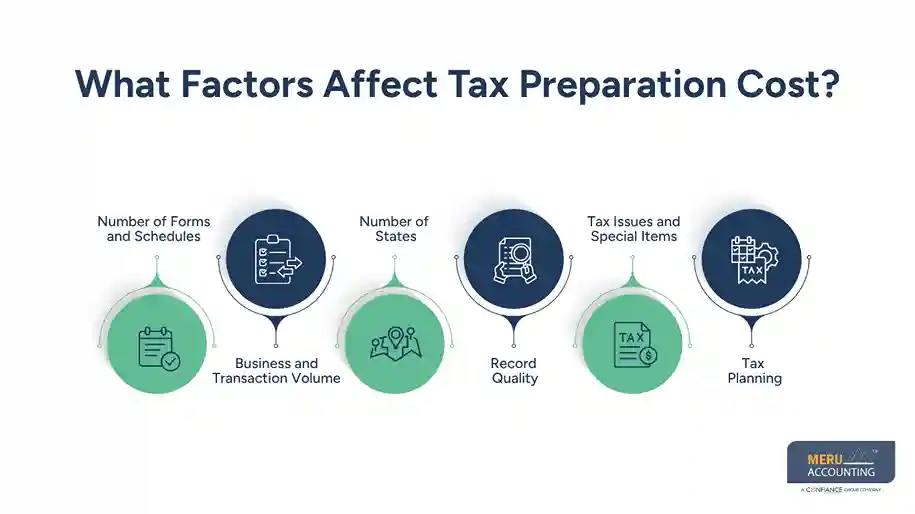
Record Quality
Clean books can make tax prep much faster. Missing reports, unreconciled accounts, mixed personal and business costs, or old bookkeeping issues can lead to extra work.
Tax Issues and Special Items
Capital gains, rental property, depreciation, stock compensation, foreign accounts, business losses, and other special items may need added review.
Tax Planning
Tax preparation and tax planning are not the same service. A basic return may only cover the filing. Planning can include year-end review, estimated tax work, entity choice, retirement planning, and other steps. Those services may carry a separate fee.
optional anymore
on running the business
How Much Does a CPA Charge for Tax Preparation in 2026?
CPA fees can vary widely based on location, experience, firm size, and return complexity. A basic individual return may cost a few hundred dollars, while business returns can run into the thousands.
A CPA may charge a flat fee for a defined return or use an hourly rate for work that is harder to predict. Some firms also charge extra for tax planning, bookkeeping cleanup, amended returns, state filings, or tax notices.
When you compare CPA fees, don’t focus only on the lowest number. Ask what the fee includes, which forms are covered, whether state returns are included, and how extra work is billed.
For a business owner, a higher tax preparation cost may make sense when the preparer also brings strong knowledge of the business structure and tax rules. The goal is not simply to pay less. It is to get accurate work and avoid costly errors or missed tax needs.
Meru Accounting’s Tax Preparation Services
Tax work gets easier when the people handling the books understand what tax preparers need to see. At Meru Accounting, we support businesses with the accounting work that sits behind tax filing, drawing on 12+ years of experience across 20+ industries worldwide.
Services We Offer
- Tax Preparation – Support for individual business owners, LLCs, partnerships, S corporations, and C corporations.
- Bookkeeping & Accounting – Day-to-day bookkeeping, account reconciliation, and month-end close.
- Financial Reporting – Income statements, balance sheets, cash flow reports, and other financial reports.
- Payroll Support – Payroll records and related accounting support.
- Tax-Ready Bookkeeping – Organizing financial data and resolving book issues that can slow down tax work.
Our team works with QuickBooks, Xero, and Zoho Books, so we can work within the system your business already uses. The goal isn’t simply to prepare another tax return. It’s to give business owners dependable financial support throughout the year, with accounting records that are useful for both tax work and day-to-day decisions.
Our Expert Insight
One issue we see often is that tax problems don’t always start with the tax return. They can start in the books. An incorrect loan balance, a missed asset purchase, or owner transactions posted to the wrong account can change the numbers a tax preparer works with. Catching these items early gives the tax team a more reliable starting point.
For business owners, it’s worth asking what happens before the return is prepared. If the quote assumes clean books, but the accounts need cleanup first, the scope can change. A clear review of the books, tax forms, and filing needs at the start can help avoid that surprise and lead to a smoother filing process.
Key Takeaways
- The tax preparation cost in 2026 depends on the return type, records, forms, states, and tax issues.
- A simple individual return may cost far less than a business return.
- The average cost of tax preparation for individual taxpayers rises as more schedules and income sources are added.
- Partnerships, S corporations, and C corporations often cost more to prepare than basic individual returns.
- Clean, reconciled books can reduce the time needed for tax preparation.
- Always ask what is included in a quoted fee before hiring a tax preparer.
- Tax planning, bookkeeping cleanup, amended returns, and extra state filings may cost more.
FAQs
A basic individual return may cost around $150 to $300, while complex individual and business returns can cost much more. Fees vary by the forms, schedules, and level of work involved.
The average cost of tax preparation for individual taxpayers may range from about $150 to $500 or more. Self-employment income, investments, rental income, and itemized deductions can raise the fee.
A CPA may be worth the added cost when you have a business, complex income, multiple states, or tax planning needs. For a simple return, a qualified tax preparer may be enough.
Some tax preparation fees may be deductible when they relate to business or income-producing activities. The tax treatment depends on what the fee covers and your specific situation.
The same form can require different levels of work. Record quality, additional schedules, state filings, and tax issues can all affect the final fee.
optional anymore
on running the business