Everyone wants to save on taxes more each year. But not many know how much smart tax planning helps. With the right tax strategies, you can lower your taxes and grow your savings. If you wait until tax season, it may be too late to change things. Smart tax planning helps you take charge of your money. It gives you control and helps you meet goals faster. Simple steps taken early can give big results.
Tax rules change often. So, keeping a plan in place helps avoid stress. The right plan lets you use tax breaks, credits, and claims in the best way. With good advice and smart moves, you can keep more of what you earn and worry less later.
What You Will Learn From This Blog
By reading this blog, you will learn:
- What are tax strategies? A simple overview
- Effective ways to save on taxes for your business
- How to maximize tax efficiency for your business
- Avoiding common mistakes in tax planning
What Are Tax Strategies? A Simple Overview
Tax strategies are plans to lower what you owe the tax office. These plans are legal and help you use the rules to your advantage.
Save More with Better Planning
When you use the best tax strategy, you avoid paying more than you must. It helps you cut costs every year.
Works for Both Personal and Business Use
Tax strategies work for both individuals and businesses. They can guide how you spend, save, and invest.
Keep You Ready for the Year Ahead
Smart planning helps avoid tax shocks. You know what to expect and how to plan each move.
Good tax strategies often focus on:
- Lowering taxable income
- Using all valid write-offs
- Claiming open tax credits
- Managing gains from assets
- Planning retirement deposits
- Setting up firms in a tax-efficient way
When used the right way, these methods can help taxpayers save money year after year.
Why Professional Tax Planning Is Important
Many people think tax planning and tax filing are the same thing. But, they are not.
Tax filing reports past financial activity and figures out the tax due. Tax planning looks ahead and finds ways to lower future tax costs.
Tax planning by a pro is important because tax laws change often. New rules, limits, and credits may create chances that taxpayers might miss on their own.
Tax pros help clients:
- Know their tax duties
- Find tax-saving chances
- Plan big financial choices
- Lower tax risks
- Stay in line with tax laws
Without planning, taxpayers may miss write-offs, fail to claim credits, or make financial choices that raise costs. Only a professional can make sure that tax strategies are used the right way and at the right time.
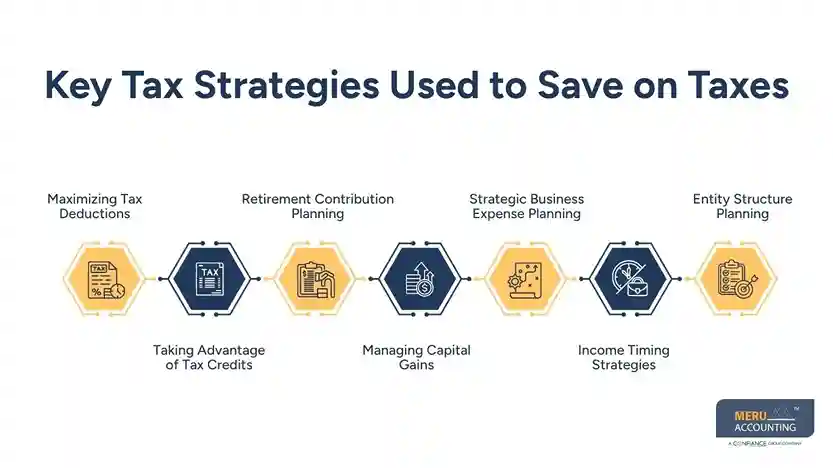
Key Tax Strategies Used to Save on Taxes
Running a business in the U.S. comes with many duties. One of them is paying taxes. You must give a share of your income to the government. While you can’t avoid taxes, you can lower them. Here are some key tax strategies for business owners who want to save on taxes:
Claim Deductions That You Deserve
A smart tax-saving tip is to claim all valid deductions. Many small business owners miss them.
- If you use part of your home as your office, claim home office costs.
- If you drive for work, claim car-related costs like fuel, tolls, and parking.
- Keep records of all your work-related spending.
These help reduce your total taxable income.
Use Income Splitting to Pay Less
The U.S. and Canada both have a marginal tax system. When you earn more, your tax rate also rises. That’s where income splitting helps.
- If you make all the money in the household, you’ll pay a high tax rate.
- If you share income with your spouse or adult children, your tax load drops.
- It is legal if they help with your business
Always pay a fair wage and keep proper records.
Think About Incorporating Your Business
Incorporating your business can lower your taxes and give you legal protection.
- In Canada, small corporations get lower tax rates.
- In the U.S., you may gain from forming an S Corp or LLC.
- You’ll also gain better ways to plan your pay and profits.
Speak to a tax expert to see if this fits your plan.
Add to Retirement Plans for Extra Savings
Putting money into retirement plans saves tax now and helps in the future.
- Set up a 401(k) for your staff.
- If self-employed, use a SEP IRA.
- Your contributions lower your taxable income.
It’s a smart plan for you and your staff in the long run
Use Section 179 to Write Off Equipment
Buying tools or gear for your business? You may not need to wait years to claim them.
- Under Section 179, you can deduct the full price in the year you buy them.
- This rule applies to things like laptops, software, machines, or work trucks.
- It boosts your savings fast and helps you stay current with tools.
Be sure the item is in use by year-end to get the full benefit.
Get Tax Credits for Hiring and Benefits
The government rewards you for giving jobs and perks to staff.
- Use the Work Opportunity Tax Credit (WOTC) when you hire veterans or workers facing job gaps.
- The Employee Retention Credit (ERC) helps if COVID-19 hit your business.
- You can also deduct the cost of health insurance for your staff.
These credits cut what you owe and help you build a strong team.
How to Maximize Tax Efficiency for Your Business
Choosing the Right Business Structure for Tax Efficiency
Sole Proprietorship
- Simple and low-cost to establish.
- Business income is reported on the owner’s tax return.
- No separation between business and personal assets—liable for all debts.
- Self-employment tax applies to all net earnings.
Partnership (General & Limited)
- Income is passed through to partners and taxed at individual rates.
- General partners are personally liable for business debts.
- Limited partners have limited liability but restricted management roles.
- Requires a formal partnership agreement to outline profit-sharing.
Limited Liability Company (LLC)
- Pass-through tax (profits taxed on the owner’s tax return).
- Can choose to be taxed as Sole Prop, Partnership, or Corp.
- Shields’ assets from business debts.
- No double tax unless taxed as a C-Corp.
S-Corporation (S-Corp)
- Pass-through tax: profits/losses flow to the owner’s tax returns.
- Skips double tax, unlike a C-Corp.
- Owners can lower self-employment tax by taking part pay and part shares.
- Limit of 100 U.S. owners (must be people or some trusts).
C-Corporation (C-Corp)
- Businesses are taxed at a flat 21% U.S. rate.
- Pays tax twice (corp tax + owner tax on shares).
- Can grow with no limit—may sell stock to raise funds.
- Best for firms that plan to scale or seek big backers.
Non-Profit Org (501(c)(3))
- No fed tax if it meets IRS rules.
- Must serve a cause (charity, faith, school, or social aim).
- Profits go back to the cause, not to owners.
Use Tax Credits
Tax credits cut your tax bill right away and may help save on taxes more than write-offs. Key credits:
- R&D Credit: Cuts tax for firms that spend on new ideas.
- WOTC: Gives perks for hiring from target groups.
- Small Biz Health Credit: Helps small firms that give staff health cover.
- Energy Credit: For firms that use green tools or upgrades.
Smart use of tax credits can mean big tax cuts for your firm.
Plan Pay and Staff Perks
How you pay staff can shape tax. Key points:
- HSAs & FSAs – Tax-free funds for health costs.
- Stock or Shares – Let’s staff delay some tax.
- Perks – Tax-free perks like transit, school aid, or child care.
These perks help keep staff and cut taxes at the same time.
Pay Est Tax on Time
Firms must pay the estimated tax 4 times each year. This avoids fines and keeps cash flow smooth. Steps:
- Use last year’s return as a guide.
- Adjust pay based on this year’s income.
- Use software or a tax professional to check the math.
Use Tax-Advantaged Accounts and Investments
Investing in Qualified Opportunity Zones (QOZs) and utilizing Municipal Bonds can provide tax-free or deferred tax benefits. Additionally, businesses should evaluate investments that offer tax incentives.
Work with a Tax Professional
Tax laws are constantly evolving, making it essential to work with a CPA or tax professional who can:
- Identify applicable deductions and credits.
- Ensure IRS compliance.
- Optimize tax strategies based on industry-specific opportunities.
Avoiding Common Mistakes in Tax Planning
Even with solid planning, small mistakes can cost you. Avoid them to get the best out of your tax strategies.
Missing Out on Claims
Many people forget to claim what they can. Always check what you spend on work, tools, or travel.
Not Keeping Records
Without good proof, you may lose a claim. Save bills and use a record system that works.
Late Lodgement
Missed due dates can mean fines. Mark your calendar and lodge your tax return on time.
Ignoring Tax Advice
Tax rules change. Get help from a pro to stay up to date and avoid risks.
Poor Income Split
If you split income without care, it may break tax rules. Always plan this with expert advice.
Meru Accounting's Expert Tax Strategies
At Meru Accounting, we help clients find the best tax strategies to reduce their tax burden. We offer complete services for both personal and business tax needs. Our team checks each case with care and gives custom tax plans to cut costs. For small firms, we offer full tax service with claims, setup, and records to stay legal and save more.
Our approach includes:
- Full tax reviews
- Income and cost review
- Tax-efficient business setup
- Retirement tax planning
- Write-off and credit review
- Asset tax planning
- Ongoing tax support
We work with people, startups, small firms, and growing firms to find ways that help save on taxes while staying in line with tax laws.
By mixing hands-on skills with deep financial review, we help clients boost tax savings and improve overall financial health.
Our Expert Perspective
The best tax planning does not start during tax time. It starts months before key financial choices are made. Many taxpayers focus only on filing returns, but real tax savings often come from planning. Choices tied to assets, retirement plans, business growth, pay plans, and major purchases can all affect tax bills.
Tax strategies by a pro work best when it becomes an ongoing process and not just a once-a-year task. Steady reviews and timely updates help taxpayers deal with changes in income, business needs, and tax laws. The sooner planning starts, the more chances there are to lower taxes legally and smartly.
Key Takeaways
- Tax planning helps lower tax bills through legal and planned methods.
- Tax strategies help both people and firms.
- Write-offs, credits, retirement plans, and income timing are common tax-saving tools.
- Firms can boost cash flow and profits through planning ahead.
- Poor records and late planning often lead to lost tax-saving chances.
- Tax pros give custom help and tax support.
FAQs
These are smart, legal methods to lower tax bills. They help manage income, claim deductions, and use credits so you save more and stay compliant.
They can claim business expenses, shift income, use retirement savings plans, and apply for tax credits. Picking the right business structure also helps cut down on taxes.
No. Tax-saving methods follow the law. Tax evasion breaks it. A solid plan helps save on taxes while avoiding penalties and audits.
Yes. These tools don’t just work for this year. They also help you build future savings with smart investments and income timing.
Professionals know current tax laws. They design custom plans that fit your business. This leads to better savings and fewer costly errors.
optional anymore
on running the business