Most firms start their financial management with simple tools like sheets, basic billing apps, or even manual record keeping. At the early stage, these tools feel enough because deals are small and financial flow is not hard to track. However, as the firm grows, financial work becomes more layered, fast, and more hard to manage. This is where limits start to show up in daily use.
Growing firms soon see that basic tools are no longer enough to manage cash flow, track costs in a right way, keep tax rules in place, or build real time financial insight. This shift often leads them to look at more advanced systems and then check top accounting software made for scale, auto work, and high level data care.
In this blog, we will look at why firms move past basic tools, what drives this change, and how new age financial systems improve accounting work in a clear and simple way.
What You Will Learn From This Blog
By reading this blog, you will understand:
- Why businesses outgrow basic accounting tools
- What operational challenges force the shift toward top accounting software
- Key limitations of spreadsheets and entry-level tools
- Clear signs your business needs an upgrade
- Essential features that modern systems should offer
- How professional accounting services support this transition
- Practical insights to improve financial decision-making and scalability
What Drives the Shift Toward Top Accounting Software in Growing Businesses
The move from basic tools to advanced systems is not quick or sudden. It builds step by step as business work grows and financial flow becomes more complex across daily tasks.
One of the main drivers is higher transaction load. When a business handles many invoices each month, manual tracking starts to slow down and become less reliable. Also, mixed income sources like online sales, subscriptions, and offline deals make simple tools harder to use in a proper way.
Another key factor is faster decision needs. Business owners today need real time financial data, not slow reports made at month end. This need pushes firms toward top accounting software, which gives live dashboards, auto updates, and quick reporting for better control.
Rule and tax needs also play a big role. Tax laws, GST rules, and audit checks need clean and correct records at all times. Basic tools often fail to give the control level needed for proper compliance and safe reporting.
Last, growth and scale are very important. As firms grow, they need systems that grow with them without break in flow. Advanced systems are made to link with banks, payroll tools, CRM systems, and stock tools, which basic tools cannot manage in a stable and smooth way.
Limitations of Basic Tools in Modern Financial Operations
While spreadsheets and simple accounting apps may work initially, they create serious limitations as businesses scale.
Human Error Risk
Manual data entry increases the chance of mistakes such as incorrect calculations, duplicate entries, or missing financial records. Even small errors can grow into major financial discrepancies over time and affect overall accuracy.
Lack of Automation
Basic tools depend heavily on repetitive manual work for tasks like invoice updates, expense tracking, and reconciliations. This reduces efficiency and takes up valuable time that could be used for planning and decision-making.
Limited Collaboration
In growing businesses, multiple team members often need access to financial data. However, basic tools do not offer strong role-based access control, making secure and structured collaboration difficult.
Weak Reporting Capabilities
Standard tools are not designed for advanced financial analysis. They cannot generate detailed reports such as cash flow forecasts, profit breakdowns, or department-wise performance insights, which limits financial visibility.
Poor Scalability for Growth
As businesses expand, basic tools struggle to handle increasing transaction volume and complexity, making financial management slower and less reliable.
Reduced Financial Visibility
Due to limited reporting and manual processes, business owners often lack a clear and real-time view of financial performance, which affects strategic decision-making.
Shift Toward Advanced Systems
Because of these limitations, businesses gradually move toward top accounting software, which provides automation, accuracy, better control, and deeper financial insights for scalable operations.
Key Signs Your Business Has Outgrown Basic Accounting Systems
Recognizing the right time to upgrade is crucial for financial stability and growth. Here are the most common signs:
Increasing Volume of Transactions
If your business is handling too many invoices, payments, or costs to manage by hand, basic tools are no longer enough. The system begins to slow daily work and raises the risk of missed entries. Over time, this puts pressure on finance teams and lowers record accuracy in daily use.
Frequent Errors in Financial Records
Repeated mismatches, missing entries, or fix issues show system limits clearly. These errors often take extra time to correct and can reduce trust in financial data quality. If not fixed in time, they may also affect reports and harm decision-making strength.
Delayed Financial Reporting
If you cannot access real time financial data, decision-making becomes slow and reactive in nature. This delay affects how fast you respond to market or business changes in real time. It also reduces your ability to plan ahead with clear view and strong confidence.
Difficulty in Tax and Compliance Management
Struggling with GST filing, audits, or rule needs is a strong sign that you need top accounting software. Manual systems often fail to keep up with changing tax rules and report formats over time. This raises the risk of fines and adds stress during audit checks.
Lack of Integration with Other Systems
When your accounting system does not connect with CRM, payroll, or stock tools, work gaps start to grow. Data must be entered again across systems, which increases work load and error chance. This also creates gaps in financial view across different parts of the business.
Dependence on Manual Processes
If your team still depends heavily on spreadsheets, it may be the right time to upgrade systems. Manual work slows down daily flow and increases need for personal effort in routine tasks. This also limits growth when business size and work load increase.
Business Expansion
Opening new branches, adding product lines, or growing services increases financial complexity in a big way. Basic tools often fail to handle multi branch reports and full financial tracking in one place. This makes full financial control harder to maintain with clarity.
At this stage, continuing with basic tools can slow down growth and increase operational risk.
Must-Have Features to Look for in Top Accounting Software
Choosing the right system is not just about upgrading tools, it is about enabling smarter financial management. Here are essential features businesses should look for in top accounting software:
Automation of Financial Tasks
Automated invoicing, expense tracking, and reconciliation reduce manual work load and human errors in daily use. This helps finance teams focus more on review and analysis instead of repeat data entry work. It also improves record match across systems and reduces delay in processing tasks.
Real-Time Financial Reporting
Instant access to dashboards and financial reports helps in faster and more clear decision-making. It allows business owners to track performance without waiting for end of month reports. This improves quick response and supports stronger financial planning in real time.
Multi-User Access with Role Control
Safe access ensures team work without harming data safety or record quality in the system. Different users can be given fixed roles based on their work needs and duties. This reduces risk of wrong changes and improves full control over financial data.
Integration Capabilities
The system should connect with banks, payment tools, and other business systems in a smooth way. This ensures data flows between platforms without manual entry or repeat work. It also reduces extra work load and improves total work speed across finance tasks.
Tax and Compliance Support
Built-in tax and compliance tools make filing and report work simple and less time heavy. This helps firms stay in line with tax rules and lowers risk of penalties or errors. It also keeps records ready for audits at all times without extra stress.
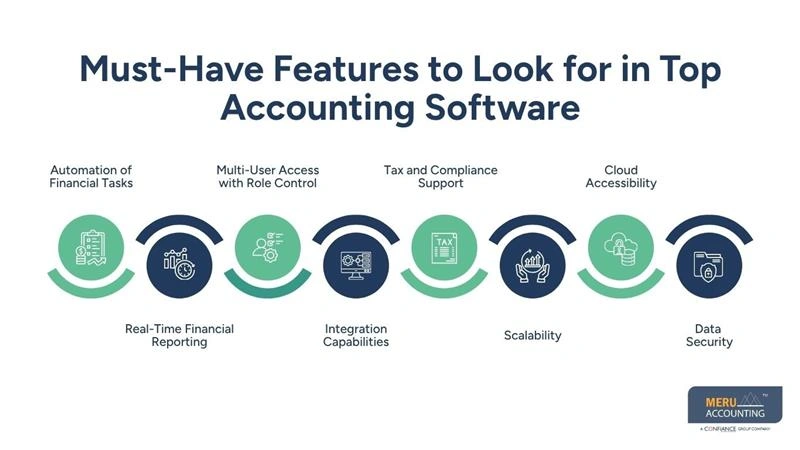
Scalability
The system must support growth without slowing down or breaking work flow during use. As transaction count grows, software should still work smooth without delay or system load issues. This ensures long term use as business size and work load increase over time.
Cloud Accessibility
Cloud based systems allow access from anywhere, which improves work flexibility and control for teams. This is useful for firms with many locations or remote working teams. It also keeps data stored safe and updated in real time without manual backup needs.
Data Security
Strong encryption and backup systems protect sensitive financial data from loss or misuse. This reduces risk of data theft, system failure, or wrong access by users. Strong safety steps also build trust and meet basic financial data control needs.
These features distinguish top accounting software from basic tools and make them essential for growing businesses.
Our Expert Perspective
From our experience working with growing businesses, most financial issues do not start with errors in records but with limited visibility in day-to-day financial data. When firms continue using basic tools for too long, they often lose real-time control over cash flow, costs, and performance tracking. This is why moving toward top accounting software becomes important for maintaining accuracy, transparency, and structured financial management as the business expands.
At Meru Accounting, we have observed that businesses make more stable and informed decisions when they shift to modern systems supported by professional accounting services. A well-structured setup helps connect financial data with real business actions such as budgeting, pricing, and cost control. With the right system and guidance, companies reduce financial risk and improve long-term decision-making quality in a compliant and reliable way.
Meru Accounting’s Business Accounting Services
At Meru Accounting, we support businesses that are transitioning from basic tools to structured financial systems powered by top accounting software. Our business accounting services are built to help companies handle growing financial complexity with clarity, control, and accuracy.
Instead of treating accounting as a back-office task, we position it as a core system that supports planning, monitoring, and business decision-making.
Our services include:
- End-to-end financial record management across business operations
- Preparation of structured financial statements for better visibility
- Support with tax compliance, filings, and regulatory requirements
- Ongoing tracking of income, expenses, and cash movement
- Financial planning support including budgeting and projections
- Guidance in adopting and optimizing top accounting software for business use
We work with businesses to reduce financial fragmentation, improve reporting accuracy, and create a more reliable decision-making foundation.
Our focus is on building financial systems that scale with business growth and remain stable even as operations become more complex.
Key Takeaways
- Basic tools work only in early-stage business operations
- Growth increases financial complexity, making advanced systems necessary
- Manual processes lead to errors, delays, and inefficiency
- Top accounting software provides automation, integration, and real-time insights
- Clear signs like errors, delays, and scaling challenges indicate the need for an upgrade
- Choosing the right system requires evaluating features like automation, security, and compliance
- Professional accounting services simplify transition and improve financial control
- Businesses benefit most when software and expert support work together
FAQs
Businesses switch when manual systems become inefficient, error-prone, and unable to handle growing transaction volumes and reporting needs.
It offers automation, real-time reporting, integration, and better accuracy compared to manual spreadsheets.
When financial errors increase, reporting becomes slow, or business operations expand beyond simple tracking capabilities.
Accounting services help in selecting the right system, migrating data, setting up workflows, and ensuring compliance during the transition.
Yes, many systems are scalable and suitable for small businesses planning future growth and financial expansion.