
Expanding transport companies face rising pressure from fuel costs, driver payments, route planning, and tax rules. At this stage of growth, many firms realize that basic bookkeeping is not enough. This is where structured trucking industry accounting becomes a key part of financial control and long-term stability.
As fleets grow, financial data becomes more complex. Income comes from multiple routes, clients, and contracts. Expenses are spread across fuel stations, maintenance vendors, toll charges, and payroll systems. Without a clear system, small errors can grow into serious financial gaps.
This blog explains why growing transport businesses need stronger financial systems, what challenges they face, and how structured accounting brings clarity in daily operations.
What You Will Learn From This Blog
- Why growing transport firms need structured financial tracking
- Common financial problems faced by expanding fleets
- Role of accounting systems in transport operations
- Importance of compliance in trucking finances
- How scalable systems support long-term growth
- Role of professional financial experts in this sector
Understanding the Role of Trucking Industry Accounting in Business Growth
Financial Tracking Across Fleet Operations
Transport companies manage income from multiple vehicles and routes, which is why trucking industry accounting plays a key role in tracking performance accurately.
Proper financial tracking, often managed by a trucking accountant, ensures each trip is recorded with accurate revenue and cost details.
Cost Control In Daily Transport Activities
Fuel, tolls, repairs, and driver wages form major expenses that are better managed through structured financial accounting practices designed for transport operations.
A well-structured accounting system records each cost in real time, which helps reduce unnecessary spending patterns.
Profit Visibility Per Route
Without clear accounting, companies cannot identify which routes generate strong returns. Detailed reporting helps management adjust pricing and route planning decisions.
Cash Flow Management In Transport Business
Cash flow gaps are common due to delayed client payments. Strong trucking industry accounting systems help track receivables and allow a trucking accountant to plan payments in a controlled manner.
Data-Driven Financial Records
Transport firms generate large volumes of data daily. Organized records help management review financial performance without manual confusion.
Key Financial Challenges Faced By Expanding Trucking Companies
Rising Fuel Cost Pressure
Fuel costs fluctuate frequently and form a significant portion of total operating expenses. Without proper tracking, it becomes difficult to understand their real impact on profitability.
Driver Payment Complexity
As fleets grow, driver salaries, incentives, and trip-based payments become more complex. Multiple pay structures increase the risk of errors and inconsistencies.
Multi-Location Operations
Transport businesses often operate across different cities or states, each with varying cost structures and operational rules. This makes unified financial tracking more difficult.
Maintenance and Repair Variability
Vehicle repair and maintenance costs differ based on usage, route conditions, and vehicle age. Without proper tracking, expenses can become unpredictable.
Delayed Client Payments
Transport companies often deal with credit-based billing cycles. Payment delays create cash flow gaps that affect day-to-day operations.
Why Expanding Transportation Companies Need Better Trucking Industry Accounting Systems
Growth Creates Financial Complexity
As operations expand, financial records multiply quickly across vehicles, clients, and routes, making the role of a trucking accountant increasingly important. Manual systems cannot manage this volume without errors or delays in reporting.
Need For Accurate Profit Measurement
Companies must understand profit per trip, per vehicle, and per client in a detailed manner, which is a key function of effective trucking industry accounting systems. Structured accounting provides accurate breakdowns for decision-making and pricing control.
Reduction Of Financial Errors
Improved systems reduce duplication of entries and missing cost records across departments. This improves financial clarity and reduces confusion in monthly reporting cycles.
Better Decision Making For Expansion
Management can only plan new routes or fleet expansion when financial data is reliable and updated regularly through structured trucking industry accounting systems. Clear reports make long-term planning more practical.
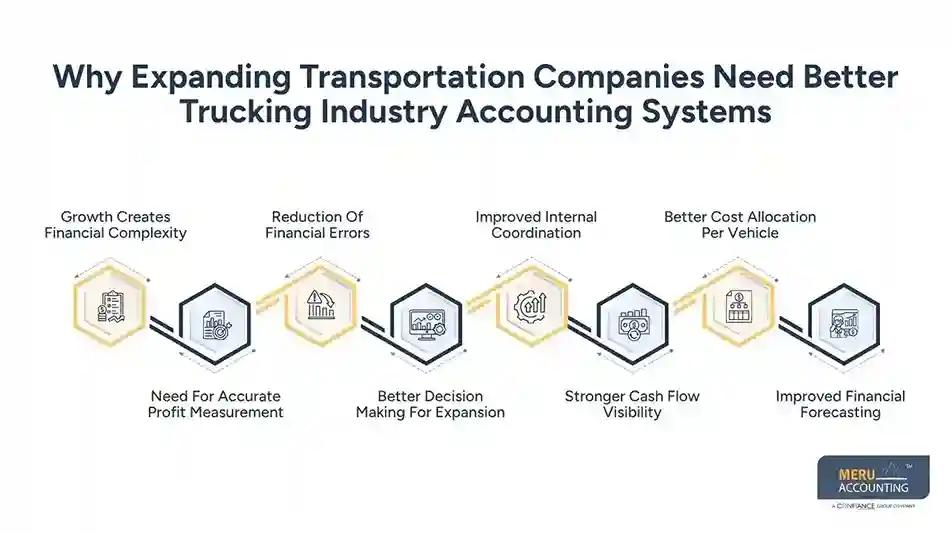
Improved Internal Coordination
Departments such as dispatch, billing, and payroll work better when all financial data is centralized in one system. This reduces miscommunication and record mismatches.
Stronger Cash Flow Visibility
Growing transport firms need clear insight into incoming and outgoing cash at all times. Better accounting systems make payment cycles easier to track and manage.
Better Cost Allocation Per Vehicle
Each truck generates different income and expense patterns based on usage and route. Structured systems help assign costs accurately to each vehicle.
Improved Financial Forecasting
With proper accounting systems guided by a trucking accountant, companies can predict future costs and income trends. This helps in planning fuel budgets, hiring, and fleet expansion more effectively.
The Role of a Trucking Accountant In Managing Complex Logistics Finances
Managing Fleet-Level Financial Records
A trucking accountant maintains records for each vehicle, ensuring income and expenses are correctly assigned to the right trip and route. Clear tracking helps create a detailed view of how each vehicle performs over time.
Handling Payroll And Driver Settlements
Driver payments require accuracy due to variable incentives and trip-based earnings, where structured trucking industry accounting helps ensure consistency and fairness.
Proper systems reduce confusion in settlements and payment disputes. Timely and correct payouts maintain driver trust and operational stability.
Monitoring Fuel And Operational Costs
Fuel is a major expense in transport operations. Regular tracking helps identify unusual spending and control cost leakage effectively. Better monitoring supports planning for future fuel budgets and cost control strategies.
Preparing Financial Reports For Management
Clear reports help business owners understand monthly performance and long-term financial trends in a simple format. Regular reporting also supports comparison between routes, clients, and fleet units.
Supporting Tax And Filing Requirements
Transport businesses must follow tax rules based on region and operations, and trucking industry accounting ensures accurate records for smooth compliance.
Accurate records reduce filing errors and penalties during audits. Proper documentation makes year-end reporting smoother and more reliable.
Regulatory Compliance and Risk Management In Transportation Finance
Tax Filing Requirements
Transport companies must follow tax rules related to income, fuel usage, and interstate operations, which rely heavily on structured trucking industry accounting systems.
Errors can lead to penalties from tax authorities. Accurate reporting reduces the risk of notices and compliance delays.
Vehicle And Driver Compliance Costs
Insurance, permits, and licenses form a key part of financial planning. These must be recorded properly in financial systems. Regular tracking ensures renewals are not missed and costs stay controlled.
Audit Readiness
Strong accounting systems, often supported by a trucking accountant, make audits easier by maintaining clear financial trails and documentation. Well-organized records reduce time spent during audit checks and reviews.
Fraud Risk Reduction
Structured systems reduce the risk of internal financial misuse or incorrect reporting within operations. Clear approval processes strengthen financial control across departments.
Industry-Specific Financial Rules
Transport finance follows specific rules based on region and operation type, requiring accurate record-keeping supported by trucking industry accounting frameworks. Compliance updates must be reflected quickly to avoid reporting errors.
Why Scalable Accounting Systems Matter For Growing Fleet Operations
Handling Increasing Transaction Volume
As fleets grow, financial transactions increase rapidly across vehicles, clients, and routes. Scalable trucking industry accounting systems ensure smooth processing without delays.
Multi-Vehicle Financial Structuring
Each vehicle generates separate income and expense streams. Scalable systems maintain clear segmentation for accurate reporting.
Integration With Transport Technology
Modern accounting systems integrate with dispatch and billing software, reducing manual entry and improving accuracy. Data flows seamlessly between operations, invoicing, and financial reporting systems.
Real-Time Financial Visibility
Live dashboards allow management to monitor cash flow, expenses, and performance in real time. Faster financial awareness supports quicker operational and pricing decisions.
Long-Term Cost Efficiency
Scalable systems reduce reliance on manual bookkeeping and improve operational efficiency as the business grows. Administrative workload stays controlled even as transaction volume continues to expand.
Meru Accounting Financial Services for Transportation and Logistics Operations
We at Meru Accounting provide structured financial services for transport and logistics businesses that manage growing fleets and complex operations. Our approach focuses on clear financial organization so that companies can track income, expenses, and operational costs in a more controlled manner.
Each financial record is managed with attention to detail, ensuring that transport businesses can understand their financial position with clarity and consistency. Our financial systems are designed to match transport operations, including fleet-wise reporting and cost tracking.
As businesses expand, we adjust these systems to handle higher transaction volumes and multi-location operations without loss of accuracy, ensuring scalable trucking industry accounting support.
We prepare detailed financial reports to support management decisions and performance review, allowing owners to evaluate routes, vehicles, and overall business performance in a more structured way.
We follow a compliance-oriented approach within the trucking industry accounting to maintain records in line with tax and regulatory requirements, reducing the risk of reporting errors.
Our experience across multiple sectors allows us to apply practical financial methods to transport businesses, ensuring structured reporting and better financial control in day-to-day operations.
Our Expert Perspective
Working with transport businesses shows a common pattern across different stages of growth in the trucking industry accounting and financial management practices. Many companies focus on operations first and place financial systems later in priority, often without involving a trucking accountant early in the process.
At early stages, simple records may appear sufficient for daily tracking. As fleets expand, financial confusion begins to build quietly in the background, especially across fuel, payroll, and maintenance costs.
Clear accounting practices in the transport sector are not only about maintaining records in an organized format but also about understanding operational profitability at a deeper level.
Our experience in the trucking industry accounting shows it is about understanding how each vehicle performs, where money is spent, and how future growth can be planned without financial pressure. Businesses that adopt structured systems early often face fewer disruptions during expansion and decision-making.
Over time, financial clarity becomes a core part of stable transport operations rather than an optional function in business management.
Key Takeaways
- Transport growth increases financial complexity and data volume
- Fuel, payroll, and maintenance are major cost areas
- Structured trucking industry accounting reduces errors and improves clarity across all financial operations.
- Scalable systems support long-term business expansion
- Professional financial support improves reporting accuracy
- Compliance plays a key role in transport operations
FAQs
Transport companies handle many expenses and income sources across routes, vehicles, and clients. Structured accounting keeps all records clear and organized for better control and financial accuracy.
In trucking industry accounting, fuel is usually recorded as the highest cost in trucking operations, followed by driver wages and vehicle maintenance expenses. Rising fuel prices directly affect overall profit margins.
Accounting, often reviewed by a trucking accountant, shows real profit data per vehicle and route, helping owners make informed expansion decisions. Clear financial records support better planning for new fleet investments.
Payments from clients may be delayed, creating gaps between income and expenses. Proper tracking ensures the business can manage daily operational costs smoothly without shortages.
Yes, even small fleets gain clarity in expenses and avoid financial mistakes with proper accounting systems. Better records also support gradual and stable business growth.