In large organizations operating across multiple branches or legal entities, cost control becomes challenging due to differences in operations, processes, and reporting methods. Uniform costing helps address this by applying the same costing principles, methods, and standards across all units.
This ensures that every branch records costs in a consistent manner, making performance comparison clearer and reducing inconsistencies in financial data.
In multi-branch and group structures, this approach strengthens planning, budgeting, and internal control by providing standardized and reliable cost information. It also supports the importance of financial reporting, as consistent data improves accuracy and decision-making at the management level.
Without a uniform system, financial reports can vary significantly across units, making it harder to evaluate true performance and maintain overall financial discipline.
What You Will Learn From This Blog
- How uniform costing works in multi-branch businesses and how it helps maintain consistent cost records across all units.
- Why do companies use this approach in group structures to ensure all branches follow the same cost methods and reporting rules?
- The link between cost standardization and the significance of financial reporting, and how it improves clarity, accuracy, and comparability of financial data.
- The main benefits and challenges include improved financial control, better performance comparison, and implementation difficulties across different locations.
- Best practices to improve cost control across entities using structured systems, clear guidelines, and consistent monitoring methods.
- Common mistakes businesses make in cost systems include inconsistent application, poor data handling, and a lack of training across branches.
- Practical use cases in real business environments where standardized costing supports decision-making, budgeting, and performance evaluation across multiple entities.
What Is Uniform Costing And Why Does It Matter in Multi-Branch Operations
Overview Of Uniform Costing
Uniform costing refers to a system where all branches or entities of a business follow the same method to record, calculate, and report costs. It ensures that expenses like material, labor, and overhead are measured in a consistent way.
In multi-branch setups, this approach helps remove confusion created by different local practices. This creates a single cost structure that supports clear comparison across units.
Why Multi-Branch Businesses Need It
Multi-branch businesses often operate in different regions with different cost patterns. Without cost standardization, each branch may report costs in its own way, which creates gaps in analysis.
By applying a common costing system, companies bring all branches under one cost framework. This makes it easier to track performance and supports better coordination across the organization.
Role In Cost Control
One of the main roles of this system is improving cost control across branches. When all units follow the same cost method, management can quickly identify where expenses are higher than expected.
This helps reduce waste and improve efficiency. It also supports internal benchmarking, allowing companies to compare branch performance using the same standards.
Connection With Financial Reporting
There is a strong link between cost standardization and the importance of financial reporting. When cost data is consistent, financial reports become more accurate and reliable. This improves group-level reporting and helps decision-makers trust the numbers.
The significance of financial reporting increases further in multi-entity businesses because accurate reports support compliance, audits, and strategic planning.
Real World Example Of Usage
In a retail chain with multiple stores, a consistent costing system ensures that each store records costs like rent, salaries, and inventory in the same way. This allows the head office to compare store performance fairly.
Without cost standardization, one store might report higher costs simply due to different accounting methods, not actual performance differences. This also strengthens the importance of financial reporting, as decision-makers rely on accurate and comparable data.
Key Principles Of Uniform Costing In Multi-Entity Businesses
Standard Costing Methods
Uniform costing depends on using standard methods for cost calculation. This helps remove differences in local practices and ensures consistency across all entities.
Equal Cost Definitions
Each cost element is defined in the same way across the organization. This ensures that all branches treat expenses like rent, wages, and utilities consistently, improving clarity in reporting.
Common Accounting Rules
All units follow the same accounting rules when applying a standardized costing system. This improves internal control and directly supports the importance of financial reporting.
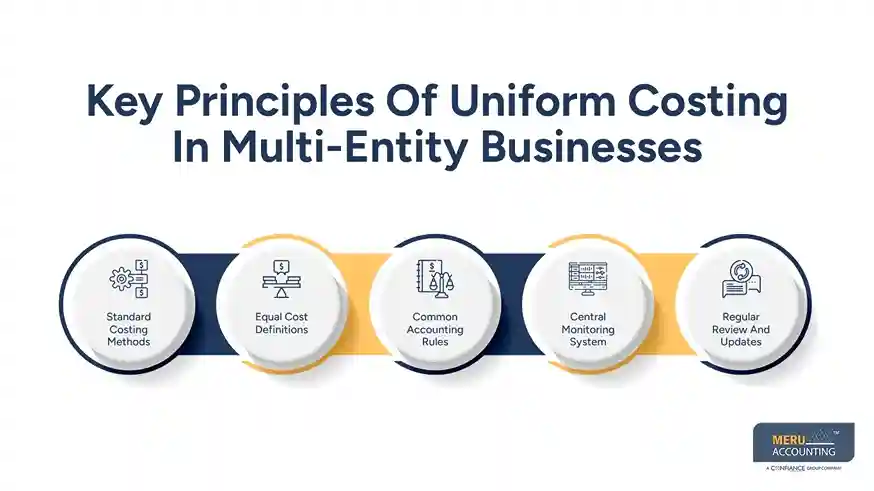
Central Monitoring System
A central team often monitors cost systems to ensure compliance across all branches. This helps avoid errors and maintains consistency across business units.
Regular Review And Updates
Cost systems are reviewed regularly to align with business changes. This ensures that cost data remains relevant, accurate, and useful for decision-making.
Benefits Of Implementing Uniform Costing Across Multiple Locations
Improved Cost Control
With cost standardization, businesses gain better control over expenses. It helps identify cost differences across branches and reduce unnecessary waste.
Better Decision Making
Managers rely on accurate and consistent data from standardized costing systems. This improves planning and supports the significance of financial reporting.
Easy Performance Comparison
Cost standardization allows easy comparison between branches. This helps identify strong and weak areas in the business more effectively.
Improved Financial Transparency
When a standardized costing approach is applied, financial data becomes more transparent and reliable. This supports internal audits and improves reporting accuracy.
Strong Group-Level Insights
Companies can generate group-level insights using uniform costing. This improves overall financial understanding and supports strategic planning.
Challenges In Maintaining Cost Uniformity In Large Organizations
Different Operational Structures
Each branch may have different processes, making the consistent application of cost standardization harder. This often leads to variations in cost recording even within the same organization.
Resistance To Standardization
Employees may resist changes required for a standardized costing system, especially when switching from older methods. This resistance can slow down implementation and affect overall consistency.
Data Collection Issues
Collecting accurate data across entities is a major challenge. Incomplete or delayed data can reduce the reliability of comparisons and impact reporting quality.
Technology Gaps
Not all branches may use the same tools, affecting the success of uniform costing. This creates gaps in reporting and limits system-wide integration.
Training Requirements
Staff need proper training to follow standardized costing rules correctly, which requires time and resources. Without proper training, errors in cost allocation are more likely to occur.
Role Of Uniform Costing In Standardizing Financial Data
Creating Comparable Data Sets
Uniform costing ensures financial data is comparable across all units. This improves internal analysis.
It also helps management identify real performance gaps between branches without confusion from different costing methods.
Supporting Audit Processes
Auditors rely on structured data from standardized costing systems to verify accuracy. This makes audit checks faster and reduces the chances of missing or unclear financial entries.
Reducing Reporting Errors
When a standardized costing approach is used, errors in financial reporting reduce significantly, strengthening the importance of financial reporting. It also improves consistency in financial statements across all business units.
Improving Budget Accuracy
Budgets become more accurate when based on consistent costing data across branches. This allows finance teams to set realistic targets based on reliable past cost patterns.
Enhancing Strategic Planning
Leaders use standardized costing reports to plan expansion and cost control strategies. It also supports long-term decisions by providing clear visibility of cost trends across entities.
Importance Of Financial Reporting In Multi-Branch And Multi-Entity Structures
- The importance of financial reporting increases in complex businesses where many units operate together.
- Accurate reports ensure compliance with financial rules and regulations.
- Financial reporting supported by uniform costing helps monitor branch-level performance.
- Reliable reporting improves trust among investors and stakeholders.
- Strong reporting systems help identify financial risks early.
- Better consolidation of financial statements across all branches and entities provides a single view of overall business performance.
- Improved decision-making becomes possible through clear and timely financial data shared across all units.
How Uniform Costing Improves Accuracy In Financial Reporting
Consistent Data Input
Cost standardization ensures all branches enter data in the same format, improving accuracy. This helps maintain uniform records across different locations without variation in reporting style.
Reduced Calculation Differences
By applying uniform costing, calculation errors across units are minimized. This further ensures that all branches follow the same costing logic while recording financial data.
Stronger Financial Analysis
Better data quality improves analysis and supports the significance of financial reporting. It also helps management compare performance trends across multiple entities more effectively.
Simplified Consolidation
Group consolidation becomes easier when a standardized costing system is followed. This reduces the time and effort required during the preparation of combined financial statements.
Improved Decision Support
Accurate reports help management make better financial decisions. It also provides clearer insights for planning budgets and controlling costs across all units.
Best Practices For Effective Cost Standardization Across Entities
Use Standard Cost Templates
Applying uniform costing templates helps maintain consistency across all units. This also reduces the chances of mismatched cost entries during reporting.
Regular Training Programs
Training ensures employees understand standardized costing methods clearly. It further helps staff apply the same costing rules without errors across branches.
Centralized Data System
A central system improves control and supports the importance of financial reporting. It also ensures that all financial data is stored and accessed from one reliable source.
Periodic Audits
Regular audits help maintain accuracy in standardized costing systems. This also helps identify and correct inconsistencies in cost recording at an early stage.
Strong Communication Channels
Clear communication ensures all branches follow standardized costing rules correctly. It also helps in quickly resolving doubts related to cost classification and reporting standards.
Common Mistakes Businesses Make In Uniform Costing Systems
- Ignoring local variations can reduce the effectiveness of uniform costing when businesses fail to adjust for regional or operational differences across branches.
- Weak data controls often lead to errors and inconsistencies, which can weaken the overall performance of standardized costing systems.
- Lack of staff training results in poor understanding of costing methods, increasing the chances of incorrect cost recording.
- Inconsistent implementation happens when standardized costing is applied only in some branches, which reduces its overall value and reliability.
- Poor reporting structure reduces the importance of financial reporting in decision-making, as it leads to unclear and unreliable financial insights.
How Meru Accounting Provides Uniform Costing Services For Multi-Entity Businesses
Meru Accounting provides structured cost standardization services designed for multi-branch and multi-entity organizations. With strong experience in global accounting systems, our team ensures that cost standards are properly designed, aligned, and consistently applied across all business units.
Our team builds reliable uniform costing systems that improve reporting quality and strengthen operational control. We also support businesses in improving the importance of financial reporting by creating clean data structures and clear cost classification methods that reduce confusion during reporting.
We work closely with multi-entity businesses to simplify cost tracking, improve reporting accuracy, and reduce errors in financial systems.
By using modern tools and practical accounting expertise, the firm ensures that standardized costing becomes a stable and dependable part of business operations, supporting better financial control and decision-making.
Key Takeaways
- Cost control across branches becomes stronger when all units follow a uniform costing system under the same rules.
- Better comparison between business units is possible when the same costing method is applied consistently across all locations.
- The importance of financial reporting increases in multi-entity setups where accurate and consistent data is needed for decisions.
- Standardization reduces errors and improves clarity in financial records across all branches and entities.
- Proper systems help in better planning and decision-making by providing reliable and comparable financial information.
Our Expert Perspective
From practical experience in multi-branch accounting systems, businesses often struggle with cost differences across units. When uniform costing is applied correctly, these variations are significantly reduced, and reporting becomes more stable. The importance of financial reporting becomes clearer when data is consistent and structured.
Our expert panel observes that many organizations achieve stronger financial control only after adopting standardized costing methods. This approach not only improves internal comparisons across branches and entities but also supports more reliable long-term financial planning within group structures.
FAQs
Uniform costing means using the same method to calculate costs across all branches or entities of a business.
It helps businesses compare performance and improve control. It also supports the importance of financial reporting.
Cost standardization can be used in small businesses, but it becomes more useful in multi-branch or group businesses where performance comparison is required.
Cost standardization makes financial data consistent, which improves accuracy and supports better reporting systems.
Challenges include training, data collection, and maintaining consistency across all units.