Businesses today manage money in a very different way compared to a few years ago. As companies grow, financial records become more detailed, and the need for accurate reporting becomes more important. This is where the discussion of Virtual Accounting vs In-House and What it Means for Growing Businesses becomes highly relevant.
Many companies now compare remote financial support models with traditional in-office accounting teams. The goal is simple: better accuracy, lower cost pressure, and stronger financial control.
In this blog, we will explore both approaches in detail and understand which one supports business growth in a more practical way. We will also look at how financial reporting changes, what challenges businesses face, and why many growing firms are shifting their accounting approach.
What You Will Learn From This Blog
- Clear difference between virtual accounting and in-house accounting
- How both accounting models function in real business environments
- Reasons companies are shifting and changing their accounting structure
- Key benefits and limitations of both approaches
- Ways growing businesses improve financial control and reporting
- Practical insights for choosing the right accounting model
- Real use cases of how businesses apply these accounting methods in operations
Understanding The Concept Of Virtual Accounting
Virtual accounting refers to a modern method of managing financial records through online systems instead of relying on a physical office setup.
In the debate of virtual accounting vs in-house, this approach allows accountants to work remotely and handle bookkeeping tasks using cloud-based accounting tools. This allows businesses to maintain financial records in a structured and organized manner without requiring in-house staff to be present on-site.
One of the key advantages of this system is cloud-based data access. This flexibility is a major reason why businesses compare virtual accounting vs in-house systems when choosing financial management solutions.
This is one of the key advantages that makes businesses prefer virtual accounting services over traditional in-house accounting setups.
Along with this, real-time reporting support ensures that updated financial reports are available much faster compared to traditional methods, helping businesses make quicker and more informed decisions.
Another important aspect is cost structure flexibility. Instead of hiring full-time accounting staff, companies only pay for the services they actually need, which helps reduce expenses related to salaries, training, and office infrastructure.
At the same time, technology integration plays a major role, as cloud accounting software automates tasks such as bank reconciliation, invoicing, and financial reporting, making the entire accounting process more efficient and accurate.
How Do Virtual Accounting Services Work Compared To In-House Teams?
Work Distribution System
In-house teams work from a fixed office setup, while virtual accountants work remotely. This structured workflow is a defining feature when comparing virtual accounting vs in-house models.
Communication Process
In discussions around virtual accounting vs in-house, in-house teams communicate face-to-face, while virtual teams use email, chat, and cloud dashboards for coordination.
This reduces dependency on meetings and helps maintain written records of all financial discussions.
Data Handling Method
In-house accountants often rely on internal systems, while virtual setups use secure cloud platforms for data storage. Cloud access also allows multiple stakeholders to review updated financial data at the same time.
Scalability Approach
Scaling in-house teams requires hiring more staff. Virtual systems can scale services quickly without physical expansion. This makes it easier for growing businesses to handle seasonal or sudden increases in workload.
Reporting Timelines
Virtual setups often provide faster reporting due to automation, while in-house teams may depend on manual processing. Faster reporting helps business owners take timely financial decisions without waiting for month-end delays.
Why Are Businesses Shifting Toward Virtual Accounting
Cost Reduction Pressure
Growing businesses look for ways to reduce fixed expenses, which is why many consider virtual accounting services as a cost-effective alternative to traditional systems.
When comparing virtual accounting vs in-house, virtual setups clearly help reduce salary and infrastructure costs.
Access To Skilled Professionals
This is one of the biggest advantages of virtual accounting services over traditional in-house hiring models.
Businesses can work with experienced accountants without being limited by local hiring constraints.
Faster Decision Making
Updated reports help business owners make quicker financial decisions. This reduces delays in planning and improves response time during financial challenges.
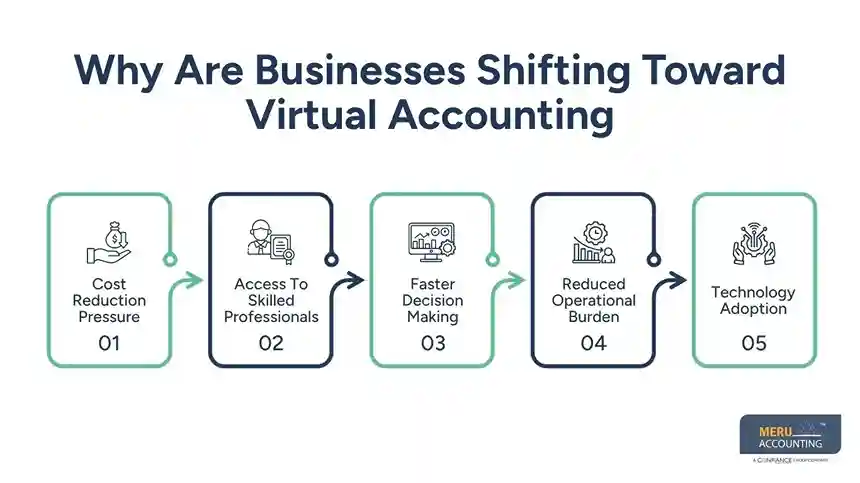
Reduced Operational Burden
Internal management becomes easier as accounting tasks are handled externally. This allows business owners and managers to focus more on strategy and operations.
Technology Adoption
Modern tools encourage companies to move away from manual accounting systems. It also improves accuracy by reducing dependency on paper-based or spreadsheet-heavy processes.
Virtual Accounting Vs In-House Accounting: Key Comparison
The following table highlights the key differences in the virtual accounting vs in-house model based on important operational factors.
Key Area | In-House Accounting | Virtual Accounting |
Cost Efficiency Difference | In-house accounting involves fixed salaries, office space costs, and ongoing employee benefits, which increase overall expenses. | Virtual accounting reduces fixed costs significantly by offering flexible pricing and eliminating office and infrastructure expenses. |
Control Over Operations | In the virtual accounting vs in-house model, in-house teams provide direct supervision and face-to-face control over accounting staff within the office. | Virtual accounting services rely on structured reporting, digital tools, and online communication for managing work and updates. |
Accuracy And Monitoring | In-house teams depend more on manual checks, which may increase the chances of human error. | Virtual accounting improves accuracy through automation tools and systematic monitoring processes. |
Flexibility Level | Scaling requires hiring, training, and onboarding new staff, which takes time and effort. | Virtual accounting services offer high flexibility, allowing businesses to scale services quickly without physical expansion. |
Security And Data Handling | In virtual accounting vs in-house comparisons, in-house data is managed within internal systems and office networks. | Virtual accounting uses secure cloud platforms with encryption and controlled access for safer data management. |
How Do Virtual Accounting Services Improve Financial Efficiency For Growing Businesses?
Automation Of Daily Tasks
Bank reconciliation, invoicing, and ledger updates are automated, reducing manual workload.
This helps finance teams save significant time on repetitive accounting activities.
Faster Financial Insights
Reports are generated quickly, helping businesses track performance without delays.
This allows owners to respond faster to changes in revenue or expenses.
Better Cash Flow Tracking
In virtual accounting vs in-house setups, real-time updates allow businesses to monitor income and expenses more effectively. This is a major improvement compared to traditional in-house accounting vs virtual accounting approaches.
Reduced Error Rates
Automated systems reduce human errors in data entry and reporting.
This improves the reliability of financial statements used for decision-making.
Improved Compliance Management
This structured approach is often highlighted in virtual accounting vs in-house evaluations.
It also ensures deadlines for tax filing and reporting are met more consistently.
What Challenges Do Businesses Face With In-House Accounting Teams?
Higher Fixed Costs
Salaries, office space, and training increase the financial burden. These ongoing expenses remain constant even during low business activity periods.
Limited Skill Range
One in-house team may not cover all financial specializations. This can lead to gaps in areas like taxation, reporting, or compliance handling.
Slower Scaling Process
Expanding teams takes time and increases operational complexity. Hiring, onboarding, and training new staff also delay immediate productivity.
Dependency On Individuals
This risk factor is often overlooked in the virtual accounting vs in-house evaluation. If a key employee leaves, financial reporting and accuracy may be disrupted.
Manual Workload Pressure
In-house teams often handle large volumes of manual entries. This increases the chance of fatigue-based errors during busy reporting cycles.
Why Are Virtual Accounting Services Considered More Scalable For Growing Companies?
Easy Resource Expansion
Companies can increase or reduce service usage without hiring delays. This flexibility helps businesses adjust quickly during growth or slow periods.
Multi-Industry Expertise
Virtual teams often handle clients from different industries, bringing broader experience. This exposure helps them apply better financial practices across various business types.
Cloud System Integration
Systems can be upgraded without changing internal infrastructure. It also ensures smooth data flow between accounting tools and business platforms.
Location Independence
Businesses are not limited to hiring accountants in a specific location. This opens access to a wider talent pool with better skill availability.
Consistent Service Quality
Standardized processes ensure stable output even as workload increases. This helps maintain accuracy and reporting consistency during business expansion.
How Meru Accounting Supports Growing Businesses
In the context of virtual accounting vs in-house, Meru Accounting helps companies simplify financial management through structured remote accounting support.
End-To-End Accounting Support
From bookkeeping to financial reporting, all core accounting tasks are handled in a structured way. This ensures businesses maintain complete financial clarity across all reporting periods.
Industry-Based Expertise
Different business sectors such as real estate, IT, and services receive customized accounting support. This helps align financial reporting with specific industry requirements and practices.
Cloud-Based Financial Systems
Modern tools are used to maintain transparency and real-time financial tracking. It also allows business owners to access updated financial data from any location.
Dedicated Financial Teams
Businesses get access to trained professionals without managing internal hiring. This reduces recruitment effort while maintaining consistent accounting quality.
Compliance-Focused Approach
Compliance efficiency is another strong factor in the virtual accounting vs in-house comparison. It helps businesses stay aligned with tax rules and avoid last-minute filing issues.
Our Expert Perspective
From practical experience comparing virtual accounting vs in-house models, the main issue is rarely low revenue but delayed or inconsistent financial records. When accounting is not updated on time, decision-making becomes unclear and reactive. A structured remote accounting approach helps improve consistency and financial visibility, but it still requires proper systems and regular reporting discipline to be effective.
Key Takeaways
- In the comparison of virtual accounting vs in-house, virtual accounting offers flexible and remote financial management
- In-house accounting provides direct control but higher fixed costs
- Growing businesses need faster and more accurate reporting
- Cloud systems improve financial visibility and reduce manual work
- Scalability is easier with remote accounting setups
- Choosing the right model depends on business size and complexity
- Structured financial processes support better decision-making
FAQs
It is a system where accountants work remotely using online tools to manage business finances and reports.
It depends on budget and workload, but many small businesses prefer flexible models to reduce fixed costs.
Yes, trained professionals can manage reporting, tax filing, and compliance using cloud systems.
Most systems use encrypted platforms and secure cloud storage to protect financial data.
Many companies are shifting due to high costs, limited scalability, and the need for faster reporting.