
Property investment today is no longer limited to buying and holding assets, especially when understanding what is real estate asset management becomes important for modern investors managing complex portfolios.
Investors now manage multiple income streams, tenant needs, repair costs, and financial records at the same time. In this setting, structured oversight of property assets has become essential for stable returns and long-term growth.
Modern investors face growing pressure from rising operational work, scattered data, and complex reporting needs, which is why understanding what is real estate asset management is becoming increasingly important.
As portfolios expand across cities or countries, manual tracking becomes difficult and error-prone. This is where organized property oversight and financial tracking systems play an important role in maintaining clarity and control.
What You Will Learn From This Blog
- How structured property oversight works in investment portfolios
- Why financial tracking is important for property income and cost control
- How accounting practices are connected to property performance
- Reasons investors outsource operational and financial work
- How outsourcing supports portfolio expansion
- What financial activities are part of property management systems
- How professional service providers add value to investors
Understanding Property Asset Management And Why It Matters For Investors
Meaning And Core Purpose
What is real estate asset management can be understood as the structured handling of real estate investments to maintain value and generate stable income. It includes monitoring income, expenses, tenant activity, and overall property condition.
Investors use this system to avoid financial gaps and maintain steady performance across assets.
Importance in Investment Stability
A well-managed property system helps investors reduce income loss and unexpected costs, which directly reflects the principles behind what is real estate asset management.
Regular tracking of rent, maintenance, and occupancy ensures better stability. Without this structure, financial decisions become reactive instead of planned.
Role In Portfolio Expansion
As investors acquire more properties, management complexity increases. A structured approach allows multiple assets to be monitored under one system.
This helps maintain consistency across locations, where real estate accounting also plays a key role in reducing operational confusion and improving financial clarity.
Risk Reduction And Control
Property investments come with risks such as vacancy, delayed payments, and repair costs. A proper management system helps identify these issues early. This reduces financial uncertainty and improves decision-making.
Income Optimization
Tracking rental performance and lease cycles helps identify underperforming assets. Investors can adjust pricing or upgrade properties to improve returns. This leads to better long-term income stability.
How Property Oversight Works In Modern Portfolios
Data Collection From Multiple Assets
Modern systems collect information from all properties, including rent, expenses, and occupancy status. This data is stored in centralized platforms for easy review. It allows investors to see overall portfolio health in one place.
Performance Tracking Systems
Each property is monitored for income flow, cost changes, and tenant activity, which helps explain what is real estate asset management at an operational level.
Performance reports highlight areas that need attention. This helps investors take timely action based on real data.
Lease And Tenant Monitoring
Lease agreements, renewal dates, and tenant payment behavior are closely tracked. This ensures that income cycles remain predictable. It also helps reduce delays and missed payments.
Financial Reporting Structure
Regular reports are created to show income, expenses, and net returns. These reports help investors understand financial performance clearly. They also support tax filing and compliance needs.
Decision Support Tools
Investors use performance insights generated through real estate accounting systems to decide whether to hold, sell, or improve assets. These decisions are based on financial records and market trends rather than assumptions.
Why Property Accounting Plays a Crucial Role in Asset Oversight
Accurate Financial Recording
Every transaction related to property income and expense must be recorded correctly under real estate accounting practices. This includes rent collection, repairs, and service charges. Accurate records ensure financial clarity and reduce errors.
Tax Preparation And Compliance
Property investments must follow tax rules based on location. Proper accounting ensures that income and expense reports are ready for tax filing. This reduces compliance risk and avoids penalties.
Cost Categorization And Control
Expenses such as maintenance, insurance, and utilities are grouped into categories. This helps investors understand where money is being spent. It also supports better cost control over time.
Budget Planning And Forecasting
In real estate accounting, annual budgets are prepared based on past performance and expected changes. This allows investors to plan cash flow more effectively. Forecasting also helps in managing future investments.
Financial Transparency For Investors
Clear reports in real estate accounting build trust among stakeholders. Investors can review income, expenses, and profit distribution without confusion. This improves transparency in financial operations.
How Outsourcing Improves Operational Efficiency For Investors
Reduced Internal Work Pressure
Outsourcing removes the need for large internal teams to handle daily tasks, especially when investors understand what is real estate asset management and its operational load. External experts manage reporting and tracking. This reduces workload for investors and internal staff.
Access To Skilled Professionals
Outsourced teams bring experience in handling property portfolios and financial systems. Their expertise ensures accurate reporting and structured financial management.
Better Data Organization
Information from multiple properties is organized into clear formats. This reduces confusion and improves reporting accuracy. It also helps in faster decision-making.
Faster Reporting And Updates
Reports are prepared on a regular schedule without delays. Investors receive timely updates on performance and financial status. This supports quicker planning and adjustments.
Easy Portfolio Scaling
As more properties are added, operational complexity increases. Outsourced systems allow smooth scaling without major internal changes. This supports long-term portfolio growth.
Why Investors Prefer Outsourced Property Management Solutions
Lower Operational Costs
Maintaining an in-house team for real estate accounting and property operations can be expensive. Outsourcing reduces hiring, training, and infrastructure costs. This allows better allocation of resources.
Focus On Investment Strategy
Investors can focus more on buying, selling, and improving properties. Routine tasks are handled externally, saving time and effort.
Support For Global Investments
Investors with properties in multiple countries benefit from centralized reporting. This ensures consistency across different markets and systems.
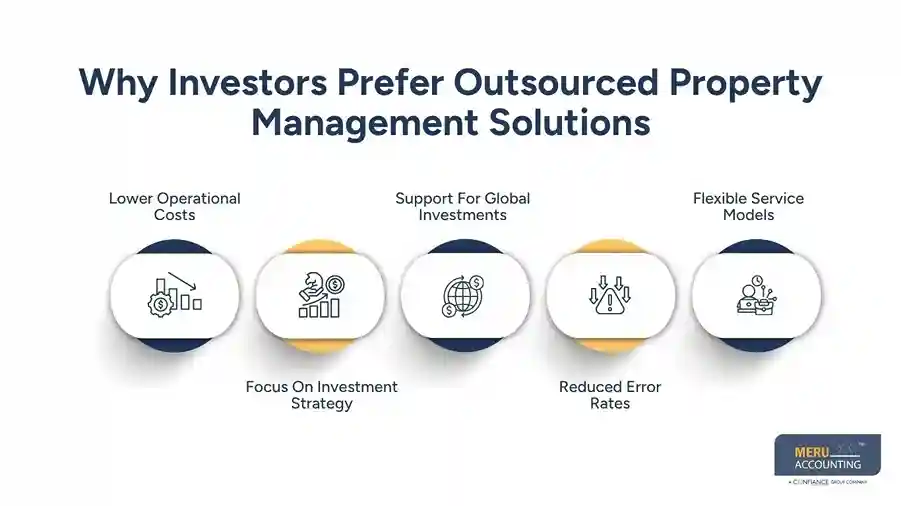
Reduced Error Rates
Professional handling reduces mistakes in financial records and reporting. This improves accuracy and reduces correction work later.
Flexible Service Models
Services can be adjusted based on portfolio size and needs. This flexibility helps investors manage both small and large portfolios effectively.
Financial Processes Included in Property Accounting for Asset Oversight
Income Tracking Systems
In real estate accounting, rental income from all properties is recorded and matched with lease details on a regular basis. This ensures clear visibility of cash flow and reduces the chance of missing or delayed entries.
Expense Management
All property-related costs such as repairs, taxes, and maintenance are recorded under proper categories. Clear grouping of expenses helps investors understand spending patterns and control costs better.
Cash Flow Monitoring
Cash inflows from rent and outflows from expenses are reviewed together to understand the liquidity position. Regular monitoring helps investors plan payments and avoid cash shortages across portfolios.
Budget Control Systems
Planned budgets are compared with actual spending to identify gaps in financial performance. These differences help improve cost planning and strengthen future financial decisions.
Financial Reporting And Analysis
Financial statements summarize income, expenses, and overall property performance in a structured format, supporting decision-making in what is real estate asset management.
These reports support tax preparation, investment planning, and portfolio evaluation.
Why Choose Meru Accounting?
Meru Accounting provides structured real estate accounting, financial, and operational support for property investors managing single or multiple assets. The firm works with global clients and focuses on clear reporting and organized financial systems.
Dedicated Property Accounting Teams
Specialized teams manage financial records, reporting, and tracking across different property portfolios.
Consistent processes are followed to ensure accurate reporting and reliable financial outputs for investors.
Multi-Platform Financial Handling
Financial data from multiple systems is collected and arranged into unified reports for easy review.
Investors gain a clear overall view of portfolio performance without dealing with scattered or incomplete information.
Global Client Experience
Meru Accounting serves investors across different countries with varied reporting and compliance needs.
Experience with international property structures helps in maintaining accuracy across different financial regulations.
Scalable Support Services
Services are designed to adjust based on portfolio size and investment growth over time.
Support remains consistent whether managing a few properties or large, multi-location portfolios.
Focus On Accuracy And Clarity
Reports are prepared with strong attention to detail and financial correctness at every stage.
Clear reporting helps investors make informed decisions with confidence and reduced financial uncertainty.
Key Takeaways
- Understanding what is real estate asset management highlights that property investment management requires structured tracking and reporting
- Financial recording is essential for stable income and cost control
- Organized systems reduce risk and improve decision-making
- Outsourcing reduces workload and supports portfolio growth
- Professional financial handling improves reporting accuracy
- Investors benefit from scalable and flexible service models
FAQs
Property asset management is the structured process of monitoring property income, expenses, tenant activity, and overall performance to maintain stable returns and long-term value.
Structured property management allows investors to track multiple assets in an organized way, reduce financial errors, and make informed decisions based on actual performance data.
Outsourcing assigns operational and reporting tasks to external professionals who handle financial records, performance tracking, and reporting on a regular basis for property portfolios.
Accounting tasks include rent tracking, expense recording, cash flow monitoring, budgeting, and preparation of financial statements for each property or portfolio.
Small investors also benefit because outsourcing reduces manual workload, improves reporting accuracy, and creates a clear financial structure for growth planning.