
Robotic accounting employs the Robotic Process Automation (RPA) technique with robotic accounting software to streamline and automate various accounting tasks, including data entry, reconciliation, report generation, and financial analysis. In this blog, we will explore the mechanics of RPA in accounting, its practical uses, advantages, and strategies for mitigating its limitations using intelligent automation tools. Let’s look deeper into the world of accounting automation to understand its inner workings, applications, benefits, and strategies for optimization.
Robotic accounting in real financial environments requires strict adherence to accounting standards and internal control frameworks. While automation improves speed and accuracy, financial outputs still require oversight by qualified accounting professionals to ensure compliance with applicable reporting standards, tax regulations, and audit requirements. This ensures that accounting automation systems remain aligned with professional financial governance and decision-making accountability.
What You Will Learn From This Blog
By reading this blog, you will learn:
- What robotic accounting is
- How accounting automation works in financial processes
- Risk, compliance, and security aspects of RPA-based processes
- How robotic accounting improves efficiency and decision-making
This guide is easy to follow but useful for both beginners and professionals working in accounting and finance.
Understanding Robotic Accounting
Robotic accounting utilizes the capabilities of Robotic Process Automation through specialized accounting automation software to revolutionize financial operations. RPA in accounting involves the deployment of software robots programmed to execute repetitive and rule-based tasks, including data entry, reconciliation, report generation, and financial analysis. These robots operate by emulating human actions, interacting with existing systems and applications to streamline processes seamlessly.
Robotic accounting works within structured financial environments where accuracy, consistency, and compliance are essential. It supports accounting teams by reducing manual workload while maintaining standardized processes across different financial functions. By integrating automation systems into existing systems, businesses can improve operational efficiency without disrupting established workflows.
How Robotic Accounting Works in Practice
Robotic accounting systems follow predefined workflows to execute tasks automatically across multiple financial platforms. These systems capture data, process transactions, and generate outputs based on configured rules.
- Extract financial data from invoices, bank statements, and other documents
- Process transactions according to predefined accounting rules
- Reconcile data across systems to ensure consistency
- Generate financial reports for review and decision-making
Role of Human Oversight in Robotic Accounting
While these systems automates routine processes, human involvement remains essential to ensure accuracy and compliance.
- Professionals review automated outputs for correctness and completeness
- Exceptions and complex transactions are handled manually
- Accounting experts validate reports before final use
- Oversight ensures alignment with accounting standards and business policies
Key Components of Robotic Accounting
Robotic accounting is built on a combination of automation technologies and structured financial processes that work together to deliver consistent outcomes.
Rule-Based Automation:
Executes repetitive accounting tasks using predefined logic. Accounting automation follows structured rules to ensure consistency in transaction processing and reporting.
System Integration:
Connects with accounting platforms, banking systems, and financial tools. Integration enables seamless data flow between systems without manual intervention.
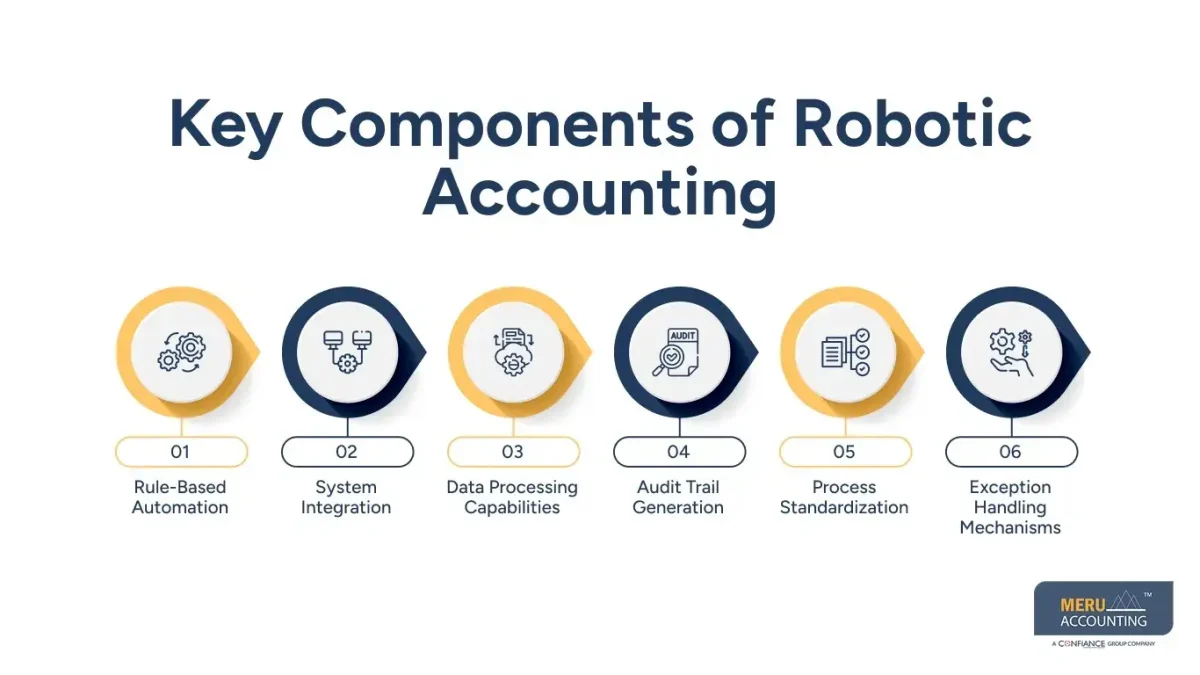
Data Processing Capabilities:
Handles large volumes of financial transactions efficiently. The accounting automation system processes data quickly while maintaining accuracy across multiple entries.
Audit Trail Generation:
Maintains records of automated actions for transparency and review. Audit trails support compliance, internal controls, and financial accountability.
Process Standardization:
Ensures that accounting workflows follow consistent formats and procedures. Standardization reduces variation and improves reliability in financial operations.
Exception Handling Mechanisms:
Identifies transactions that fall outside predefined rules. These exceptions are flagged for manual review to maintain accuracy and control.
Professional Oversight in RPA-based processes
RPA-based processes improve efficiency, but financial accuracy still depends on professional review and control. Automation should support, not replace, expert judgment in critical financial processes.
- Accounting automation systems operate based on predefined rules and workflows
- Financial outputs generated through RPA-based processes should be reviewed by qualified professionals
- Human validation helps ensure accuracy in financial statements and reporting
- Oversight is especially important in tax filings, audits, and compliance-related processes
Need for Automated Workflows
Automated workflows address this need by automating repetitive and rule-based tasks, such as data entry and reconciliation, thereby reducing the risk of errors and improving overall productivity. By using advanced technologies like AI, robotic accounting streamlines financial operations, freeing up valuable time for finance professionals to focus on strategic analysis and decision-making.
With the ability to handle large volumes of data quickly and accurately, automation systems are essential for organizations seeking to enhance their competitive edge and drive sustainable growth.
Challenges Addressed by Automation Systems
Traditional accounting processes often face operational limitations that these automation systems help resolve.
- High volume of repetitive manual data entry
- Increased risk of human error in financial records
- Time-consuming reconciliation and reporting cycles
- Difficulty in scaling accounting operations with business growth
Risk Considerations in Accounting Automation
Organizations can reduce risks in accounting automation by implementing structured controls and monitoring systems.
- Rule-Based Limitations: Accounting automation relies on predefined logic, which may not fully address complex or non-standard financial scenarios.
- Error Replication Risk: If automation rules are incorrectly configured, the same error can be repeated across multiple transactions.
- Reduced Manual Oversight: Over-dependence on accounting automation may lead to fewer manual checks, increasing the chance of unnoticed discrepancies.
- Continuous Monitoring Requirement: Regular review and updates are necessary to ensure the system remains accurate and aligned with business needs.
Data Security and Compliance in Robotic Accounting
- Sensitive Financial Data Handling: These systems process confidential financial information that must be handled with strict controls.
- Access Control Mechanisms: Role-based access ensures that only authorized personnel can manage or review automated processes.
- Data Protection Practices: Encryption and secure systems help safeguard financial data during processing and storage.
- Regulatory Compliance Alignment: RPA-based processes should follow applicable financial regulations and internal compliance policies.
Applications of Robotic Accounting
The adoption of robotic accounting software offers a multitude of practical applications across various financial functions. For instance, it can automate invoice processing by extracting data from invoices and entering it into accounting systems accurately and efficiently. Automation systems can facilitate bank reconciliations by matching transactions across multiple accounts with unparalleled precision. It can automate compliance tasks, ensuring consistent observation of regulatory standards and internal controls.
Benefits of accounting automation systems
- Enhanced Efficiency: Completes tasks faster and with greater accuracy than manual processes. Accounting automation systems reduce processing time by automating repetitive workflows, allowing financial teams to focus on higher-value activities.
- Reduced Error Risk: Minimizes the risk of errors, ensuring accurate financial data. By following predefined rules, accounting automation systems reduce manual entry mistakes and improves consistency across financial records.
- Improved Scalability: Handles increasing transaction volumes without needing additional staff. Accounting automation systems allow businesses to scale operations without proportionally increasing accounting resources.
- Enhanced Compliance: Ensures consistent agreement with regulatory requirements and internal policies. These systems maintain standardized processes, helping businesses meet compliance obligations more effectively.
Overcoming Limitations with Intelligent Automation Tools
For Maximizing the Benefits of Accounting Automation Software:
- Conduct Comprehensive Analysis:
- Identify processes suitable for automation based on volume, complexity, and frequency.
- Prioritize automation efforts for maximum impact and efficiency.
- Invest in Advanced Software:
- Choose RPA-based Software with cognitive automation and NLP capabilities.
- Enhance flexibility and adaptability in handling complex accounting tasks.
Implementing these strategies can help organizations fully leverage the advantages of automated workflows for streamlined and efficient financial management.
Meru Accounting’s Robotic Accounting Services
Managing financial processes manually can be time-consuming and complex. Robotic accounting helps simplify operations, but proper setup and monitoring are important. At Meru Accounting, we make accounting automation practical and reliable. Our team helps businesses automate processes while maintaining accuracy and compliance. We provide structured workflows and clear financial insights.
We offer:
Automation Setup:
We implement automation systems for tasks like data entry, reconciliation, and reporting. Our automation setup reduces manual effort and improves consistency. We ensure processes run smoothly with minimal errors.
Bookkeeping Automation:
We track transactions, expenses, and financial records using accounting automation tools. Our automated bookkeeping keeps records accurate and up to date. We help reduce delays and improve financial visibility.
Financial Reporting:
We generate real-time financial reports using automation systems. Our reports help businesses understand performance and make informed decisions. We also support planning and forecasting.
Compliance and Control:
We ensure RPA-based processes follow financial regulations and internal policies. Our compliance approach reduces risk and avoids penalties. We maintain proper controls for accuracy and accountability.
Process Optimization:
We analyze existing workflows and improve them using automation. Our optimization increases efficiency and reduces operational costs. We also help scale financial processes as the business grows.
With Meru Accounting, we help businesses adopt robotic accounting with confidence while we manage accuracy, compliance, and performance. This leads to better financial control and improved decision-making.
At Meru Accounting, we offer robotic accounting solutions by using innovative technology and automation software. Our expert team works closely with clients to identify opportunities for automation, customize solutions tailored to your specific needs, and optimize processes for maximum effectiveness. With Meru Accounting, businesses can unlock the full potential of robotic accounting, driving productivity, accuracy, and scalability while minimizing costs and mitigating risks.
Key Takeaways
- Robotic accounting automates repetitive financial tasks using structured workflows
- It improves efficiency, accuracy, and scalability in accounting operations
- Risk management and compliance are important when using automation
- Human oversight is necessary to ensure accurate financial reporting
- Accounting automation systems supports faster decision-making with reliable data
- Services like Meru Accounting make robotic accounting easier, safer, and more effective