Monthly books can tell you what came in, what went out, and what your business owns or owes. But clean books alone do not always tell you what those numbers mean for the next month, quarter, or year. That is where a CFO for small business can add value.
A CFO looks past the basic numbers to spot cash needs, cost changes, weak sales, rising debt, and other signs that may call for action. With the right review in place, monthly accounting becomes more than a record of past work. It becomes a tool for planning and making sound business choices.
What You Will Learn From This Blog
- What a CFO for small business does
- Why CFO review can add value to monthly accounting
- Which reports and numbers a CFO may review each month
- How CFO oversight can help with cash flow, A/R, and A/P
- How often small businesses may need CFO-level review
- What to look for in CFO consulting for small business
What Does a CFO for Small Business Do?
A CFO is not just a person who checks the books. The role is focused on the wider money side of the business. A CFO for small business may review past results, plan for future needs, and help owners make choices based on clear financial data.
The work may include:
- Reviewing monthly financial reports
- Building and tracking budgets
- Looking at cash flow
- Reviewing sales and cost trends
- Tracking key business metrics
- Planning for large purchases or growth
- Reviewing debt and funding needs
- Building cash flow forecasts
- Finding gaps in financial data or reports
An accountant or bookkeeper may focus on making sure the books are right and up to date. A CFO uses those books to ask what the numbers mean and what the owner should watch next.
For example, a rise in sales may seem like a good sign. But if A/R is also rising, cash may not be growing at the same rate. A CFO for small business can spot that gap and bring it to the owner’s attention before it puts strain on cash.
Why Monthly Accounting Needs CFO Oversight
Monthly accounting gives owners a set view of the business. The issue is that a report can be correct and still raise questions.
A CFO for small business can review the numbers in the right business context. Instead of only asking, “What did we earn?” the review can ask:
- Why did sales change?
- Why did a cost rise?
- Is cash keeping pace with sales?
- Are customers paying on time?
- Are we spending more than planned?
- Can the business fund its next big move?
- Are current results in line with the plan?
This type of review can help catch trends while there is still time to act. A cost that rises for one month may not need action. A cost that rises month after month may need a closer look.
The same is true for sales, payroll, debt, inventory, and customer balances. Monthly CFO oversight adds a second layer of thought to the accounting process.
It also gives small business owners a clear place to review results and discuss what comes next. That can be useful when the owner is busy with sales, staff, clients, and day-to-day work.
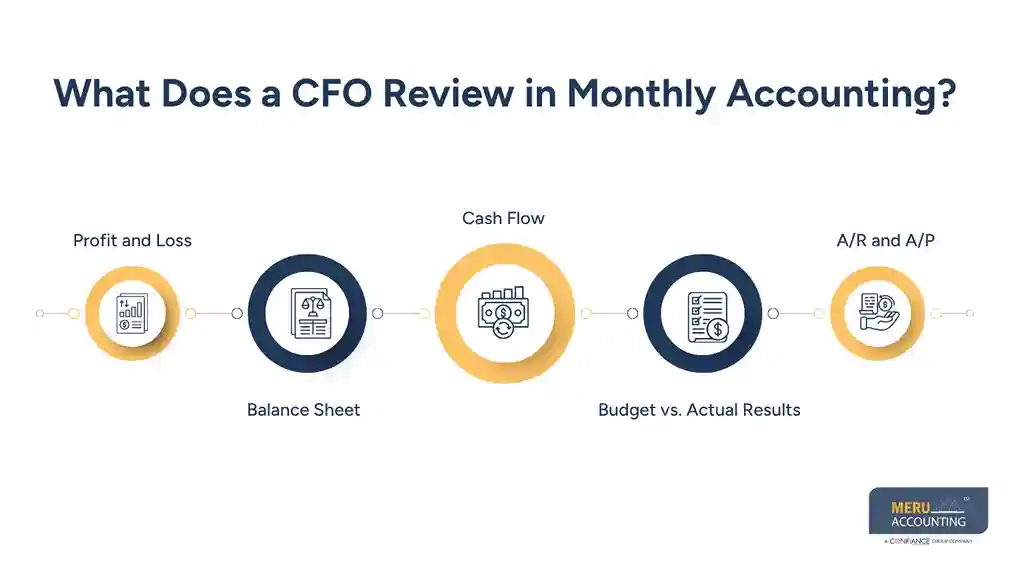
What Does a CFO Review in Monthly Accounting?
A CFO for small business will often review more than the profit and loss statement. The goal is to see how the main parts of the business work together.
Profit and Loss
The P&L shows sales, costs, and profit for a set time. A CFO may compare the current month with past months, the budget, or the same time last year.
The key is not just the final profit number. A CFO may look at which sales or cost lines drove the change.
Balance Sheet
The balance sheet shows what the business owns and owes. It can give clues about cash, debt, A/R, A/P, loans, and other assets and liabilities.
A CFO for small business may use this report to find changes that are easy to miss when only looking at the P&L.
Cash Flow
Profit does not always mean cash is on hand. A business can show a profit while cash is tied up in unpaid invoices, stock, or other assets.
A CFO may review cash flow to see what is coming in, what is going out, and what cash needs may arise soon.
Budget vs. Actual Results
A budget gives the business a plan. The monthly results show what took place.
A CFO can compare the two and review key gaps. If payroll, rent, ad spend, or another cost is well above plan, the reason should be clear.
A/R and A/P
Customer balances and bills due to vendors can affect cash. A CFO may review aging reports, large past-due balances, and payment trends as part of the monthly close.
optional anymore
on running the business
How CFO Oversight Improves Monthly Financial Reporting
Good monthly reports should do more than list numbers. They should help an owner see what needs attention.
This is one area where a CFO for small business can bring a clear process to the close. After the books are closed, the CFO can review key changes and flag items that need more work.
For example, a report may show that gross profit fell from one month to the next. The next step is to find out why. Was there a change in pricing? Did a key cost rise? Did the mix of work change?
The same process can be used for other key lines. A CFO may also add short notes to explain major changes, so the owner does not have to work through each report alone.
Over time, this can make monthly reports more useful. The owner can see trends, track goals, and use the same set of reports for regular business reviews.
CFO Oversight for Cash Flow, Receivables, and Payables
Cash flow is often one of the first areas that needs close review in a growing small business. More sales can mean more invoices, but it does not always mean more cash in the bank.
A CFO for small business may review the timing of customer payments, vendor bills, payroll, loan payments, and other cash needs.
For A/R, the review may focus on:
- Past-due invoices
- Large customer balances
- Days taken to collect
- Changes in payment habits
- Expected cash from open invoices
For A/P, the focus may include:
- Bills due soon
- Large vendor balances
- Payment timing
- Recurring costs
- Upcoming cash needs
This does not mean a CFO takes over the day-to-day work of sending invoices or paying bills. The CFO can use the data from those tasks to help plan cash and flag issues.
How Often Should a Small Business CFO Review Financials?
For many small businesses, a monthly review can give owners a steady view of results. It fits well with the monthly accounting close and gives enough time to spot trends without waiting for a quarter to end.
A CFO for small business may review the books each month and then take a deeper look each quarter. More frequent reviews may make sense when cash is tight, sales shift fast, the business is growing, or a major deal is in progress.
The right schedule depends on the size and needs of the business. What matters most is that the review is consistent and tied to clear business goals.
CFO Consulting for Small Business From Meru Accounting
Meru Accounting provides CFO consulting for small business owners who need more than routine bookkeeping but aren’t ready to build an in-house finance team. We work from your existing financial data and business goals to provide a clear view of where the business stands and what needs attention next.
Our CFO support can cover:
- Monthly financial close review
- Management-level financial reports
- Cash flow forecasting
- Budget preparation and tracking
- Financial planning for growth or expansion
- Review of margins, costs, and business KPIs
- Scenario planning for major business decisions
- Ongoing financial guidance based on your business needs
We can also work with the accounting software, reporting process, and systems your business already uses. This makes it easier to add CFO-level oversight without changing the way your day-to-day accounting is handled.
For owners who want a finance partner to help interpret the numbers, plan ahead, and stay on top of financial priorities, Meru provides CFO consulting for small business as an ongoing service rather than a one-time financial review.
Our Expert Insight
One thing we often see is a business closing its books each month without really reviewing what changed. A clean close does not always mean the numbers tell the full story. An unusual expense, a past-due customer balance, or a new asset can affect the month’s results and may need a closer look.
Before relying on monthly numbers, we recommend checking major variances and unusual transactions first. This simple step can catch issues that might otherwise carry into the next month and lead to poor planning.
Key Takeaways
- A CFO for small business looks beyond basic bookkeeping and reviews what the numbers mean for the business.
- Monthly CFO oversight can help owners spot trends, gaps, and cash needs sooner.
- A CFO may review the P&L, balance sheet, cash flow, budget, A/R, and A/P each month.
- CFO review can make monthly financial reports more useful for business decisions.
- CFO consulting for small business can give owners access to financial review and planning without building a full in-house CFO team.
- The right review schedule depends on the business, its cash needs, growth, and level of financial complexity.
FAQs
The cost depends on the scope of work, business size, and how often CFO support is needed. Many small businesses use part-time or outsourced CFO services instead of hiring a full-time executive.
A fractional CFO works with a business on a part-time or as-needed basis. A full-time CFO is an internal executive who works exclusively for one company. Fractional support can fit businesses that need CFO-level guidance without a full-time role.
Common triggers include rapid growth, plans to raise funding, cash flow pressure, expansion, complex finances, or major changes in the business. A CFO can also be useful when the owner needs more financial insight than routine bookkeeping provides.
Yes. A CFO can work alongside an internal or outsourced bookkeeper. The bookkeeper maintains the financial records, while the CFO can review those records and use them for planning, forecasting, and financial decisions.
It depends on the business’s needs and financial complexity. CFO consulting can be useful when an owner needs ongoing financial planning, forecasting, or decision support but does not need a full-time CFO.
optional anymore
on running the business