Running a small business means making sales, paying bills, sending invoices, and managing cash almost every day. But knowing what is in your bank account is not the same as knowing how your business is doing. Small business bookkeeping brings those daily transactions together so you can see what you earned, what you spent, what customers owe, and where your money is going.
The challenge is that bookkeeping needs can change a lot from one business to another. A contractor may need to track costs by job, while a retailer has inventory to manage and an ecommerce business may need to account for returns, shipping, and platform fees. The right setup and small business bookkeeping solutions can help keep these details organized as the business grows.
In this blog, we’ll cover how to set up your books, which records to keep, practical bookkeeping habits, and common mistakes that can vary by industry.
What You Will Learn From This Blog
- What small business bookkeeping includes
- How to set up a simple bookkeeping process
- Which records a small business should keep
- Best practices for clean and up-to-date books
- Bookkeeping mistakes that can vary by industry
- When outside bookkeeping support may make sense
What Is Small Business Bookkeeping?
Small business bookkeeping is the process of recording, sorting, and checking a company’s financial transactions. It includes sales, bills, costs, payments, bank activity, and other money moves.
Bookkeeping is not the same as full accounting. Bookkeeping focuses on keeping the records right and up to date. Accounting uses those records to create reports, review results, plan cash use, and support tax work.
A basic bookkeeping process often includes:
- Recording sales and other income
- Recording business costs
- Tracking bills and unpaid invoices
- Reconciling bank and card accounts
- Tracking assets and loans
- Reviewing key financial reports
The goal is not just to record each sale or bill. Good small business bookkeeping creates a set of books that an owner can use with confidence.
How to Set Up Bookkeeping for a Small Business
A clean setup makes the rest of the work much easier. Before recording large volumes of data, set up a clear system that matches the business.
Separate business and personal finances
Use separate bank and credit card accounts for business activity. Mixing personal and business spending can make it hard to tell which costs belong in the books.
Choose an accounting method
Most small businesses use either cash or accrual accounting, based on their needs and tax rules. The right method can depend on the business type, size, and reporting needs.
Build a useful chart of accounts
The chart of accounts gives each type of income, cost, asset, liability, and equity its own place. It should be detailed enough to give useful reports without creating needless work.
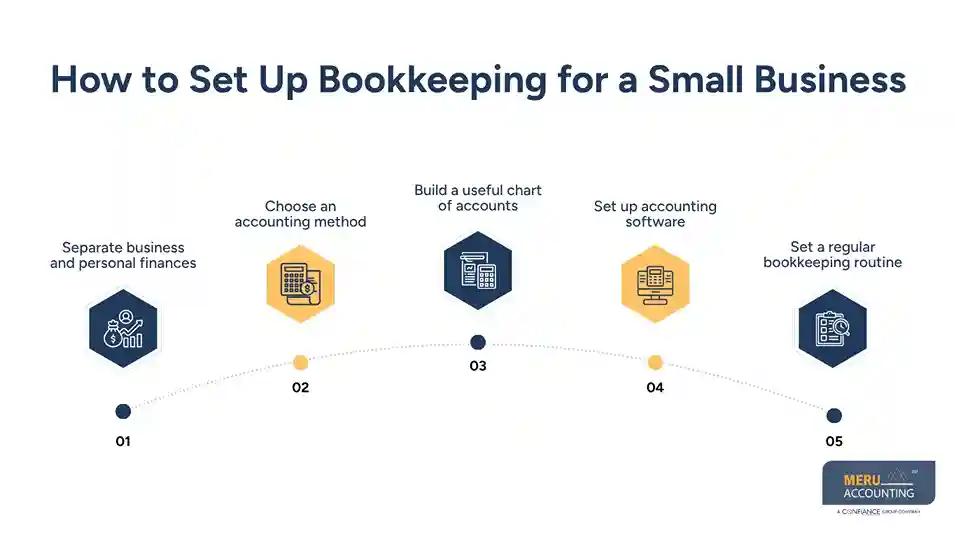
Set up accounting software
Choose software that fits the business size, type, and workflow. Set up bank feeds, user access, invoice tools, bills, and reports before the books get busy.
Set a regular bookkeeping routine
Do not wait until tax time. Set dates for recording transactions, matching payments, checking bills, and reconciling accounts. A set routine helps keep small business bookkeeping from falling behind.
What Records Should a Small Business Keep?
The records needed can vary by business, but most small businesses need a core set of financial records.
Income and sales records
Keep records of sales, customer payments, refunds, and other income. For businesses that send invoices, track both the invoice and the payment.
Expense records
Keep bills, receipts, card charges, and other proof of business costs. The record should show what was bought, when it was bought, and why it was a business cost.
Bank and credit card records
Bank and card statements help confirm that all activity is recorded. They also support the monthly reconciliation process.
Accounts payable and receivable
Accounts payable shows what the business owes. Accounts receivable shows what customers still owe. Both need regular review so old balances do not stay on the books without action.
Payroll and contractor records
Keep payroll reports, wages, payroll tax records, and contractor payment records in an organized place.
Asset records
Equipment, vehicles, computers, and other long-term assets should have clear records. Purchase dates, costs, and other key details may be needed for depreciation and tax work.
Small Business Bookkeeping Best Practices
A good process is less about doing more work and more about doing the right work at the right time.
Reconcile accounts on a set schedule
Bank and card reconciliation can catch missing entries, duplicate entries, wrong amounts, and other errors. For many businesses, monthly reconciliation is a basic part of small business bookkeeping.
Keep personal and business costs apart
A separate business account makes it easier to record costs and review business results. If a personal cost does enter a business account, mark it and handle it correctly instead of leaving it mixed in with normal business costs.
Review unpaid bills and invoices
Do not look only at the bank balance. Review bills that still need to be paid and invoices that have not been collected. This gives a better view of upcoming cash needs.
Check reports each month
A profit and loss statement, balance sheet, and cash flow view can show issues that are not clear from individual transactions. Look for large changes, unusual costs, old balances, and missing income.
Keep source records organized
Receipts, bills, invoices, bank records, and other support should be easy to find. A clear file system saves time when the books need review.
Fix errors when they are found
Small errors can become harder to fix when they sit in the books for months. Review odd entries as part of the normal monthly close instead of pushing them into year-end work.
optional anymore
on running the business
Industry-Specific Bookkeeping Mistakes to Watch For
Bookkeeping needs can change based on how a business earns and spends money. A process that works for one industry may miss key details in another.
Retail
Retail businesses need to watch inventory and cost of goods sold. A sale may look correct while the related inventory entry is wrong. Stock counts, purchases, returns, and damaged goods should tie back to the books.
Construction
Construction firms often need job-level cost tracking. Labor, materials, equipment, subcontractors, and other costs may need to be tied to the right job. Posting all costs to broad expense accounts can make it hard to see the true cost of each project.
Real Estate
Real estate businesses may have property-level income and costs, loan activity, repairs, assets, and depreciation records. Mixing activity from several properties can make reports less useful and can create issues during tax review.
Professional Services
Consultants, agencies, and other service firms often need to track client invoices, payments, retainers, and unbilled work. A common mistake is to focus on cash received while failing to review work that has been billed or is still due.
Ecommerce
Ecommerce businesses need to account for sales, refunds, shipping, platform fees, payment fees, and inventory. Recording only deposits from a sales platform can hide the detail needed to match gross sales, fees, returns, and net cash.
Restaurants
Restaurants have several moving parts, such as daily sales, food costs, payroll, tips, delivery fees, and waste. Recording sales without checking the related costs can give owners an unclear view of margins.
Healthcare
Healthcare businesses may need to track patient balances, insurance payments, adjustments, and collections. Posting payments without matching them to the right patient or payer account can leave balances that do not reflect what is actually due.
Small Business Bookkeeping Services From Meru Accounting
Small business books can get messy when routine tasks are handled separately or left until tax time. At Meru Accounting, we look at the books as a whole—from day-to-day transaction work and account reconciliation to financial reporting and year-end preparation. Our team works with QuickBooks, Xero, and Zoho Books and can fit the bookkeeping process around the software and workflow the business already uses.
What We Handle Each Month
Our services can include:
- Bookkeeping and reconciliation: Record transactions and reconcile bank and credit card accounts.
- A/P and A/R: Keep track of bills, invoices, customer balances, and payments.
- Payroll accounting: Record payroll activity and keep payroll-related accounts up to date.
- Monthly reporting: Prepare financial reports that show income, expenses, and overall business performance.
- Catch-up and cleanup: Bring overdue books up to date and correct issues found during the review.
- Tax-ready records: Keep financial records organized and ready for year-end tax preparation.
The level of support can change as the business grows. A newer business may need basic monthly bookkeeping, while a growing company may need more transaction review, A/P and A/R support, or ongoing cleanup and reporting. The goal is to keep the bookkeeping process practical and manageable as the business changes.
Our Expert Insight
In our experience, small businesses often run into bookkeeping issues because the same types of transactions aren’t handled consistently. A recurring expense may be coded to different accounts, owner purchases may be recorded each time differently, or deposits may be treated as income without checking what they actually represent.
These small inconsistencies can add up and make financial reports harder to rely on. Setting clear rules for recurring transactions and reviewing unusual entries each month helps keep the books consistent and makes the numbers easier to understand as the business grows.
Key Takeaways
- Set up separate business accounts and a clear chart of accounts.
- Record income and costs on a regular schedule.
- Reconcile bank and credit card accounts each month.
- Keep invoices, bills, receipts, and other source records organized.
- Review receivables, payables, cash flow, and financial reports.
- Adjust the bookkeeping process to the needs of the industry.
- Use small business bookkeeping solutions that fit the business, software, and workflow.
- Consider professional support when the books become hard to keep current.
FAQs
Start by separating business and personal finances, choosing an accounting method, setting up a chart of accounts, and selecting accounting software. Then create a routine for recording and reviewing transactions.
Software can handle much of the day-to-day work, but it still needs accurate setup, proper account categories, reconciliations, and regular review. The software records the data; it doesn’t decide whether an entry is correct.
Review your bank and credit card reconciliations, unpaid invoices and bills, unusual transactions, account balances, and key financial reports. This can help catch errors before they carry into later months.
Profit and cash are not the same. Your books may include unpaid invoices, unpaid bills, loan payments, equipment purchases, or other items that affect profit and cash differently.
Outsourcing may make sense when bookkeeping takes too much owner time, transactions are increasing, accounts are falling behind, or the business needs more regular reporting than the owner can manage alone.
optional anymore
on running the business