A manufacturing business can produce thousands of units each month and still struggle to protect its profit margins. Rising material prices, excess labor hours, production delays, and poor cost tracking can make some products far less profitable than they seem. A production accountant helps manufacturers understand where these costs come from and how they affect the bottom line.
By tracking production expenses, reviewing cost reports, and comparing actual costs with budgets, they give business owners a clearer picture of what it takes to make each product. This helps manufacturers make better decisions about pricing, purchasing, and production while keeping costs under control.
What You Will Learn From This Blog
- What a production accountant does and why manufacturers need one.
- How to track material, labor, and overhead costs.
- Ways to find waste and control production expenses.
- How cost data helps improve product pricing and profit margins.
- How production accounting software supports cost tracking and reporting.
- Which financial reports help manufacturers make better business choices.
What Is a Production Accountant and Why Does Manufacturing Need One?
A production accountant tracks and reviews the costs linked to making goods. Their work covers raw materials, direct labor, factory overhead, work-in-progress (WIP), and finished goods. They also help keep cost records in line with the firm’s financial books.
Unlike a general bookkeeper who records daily sales, bills, and payments, a production accountant looks more closely at the cost of making each product or batch. They help answer key questions:
- How much does it cost to make one unit?
- Are raw material costs higher than planned?
- Is labor time in line with the output?
- Which products bring in the best profit?
- Where can the firm cut costs without hurting quality?
Manufacturing costs can change due to shifts in raw material prices, labor rates, order size, and machine use. A production accountant helps track these changes and gives owners clear data to act on.
For small and mid-sized manufacturers, this support can be useful when in-house staff lack the time or skills to review complex cost data. It helps keep costs in check and gives leaders a better view of the firm’s financial health.
optional anymore
on running the business
Key Responsibilities of a Production Accountant in Manufacturing
A production accountant works with cost, stock, and financial data to help keep the books clear and up to date. Key tasks include:
1. Tracking Raw Material and Production Costs
Raw materials are often one of the largest costs in a factory. A production accountant tracks the cost of items used in each job, batch, or product line. They also check purchase records, stock use, and supplier bills to make sure costs are logged in the right place.
This helps spot price hikes, excess use, and stock loss that may raise the cost per unit.
2. Monitoring Direct Labor and Factory Overhead
Labor costs include wages and other pay linked to the staff who make the goods. Factory overhead may include rent, power, repairs, and machine upkeep.
A production accountant reviews these costs and checks how they affect the cost of each unit. This gives the firm a better view of its full production spend.
3. Managing Work-in-Progress (WIP) Inventory
WIP refers to goods that have begun the production process but are not yet ready for sale. These goods may have costs for raw materials, labor, and overhead.
A production accountant tracks WIP so that costs are not left out or booked too soon. This helps keep stock value and profit figures more accurate at month-end.
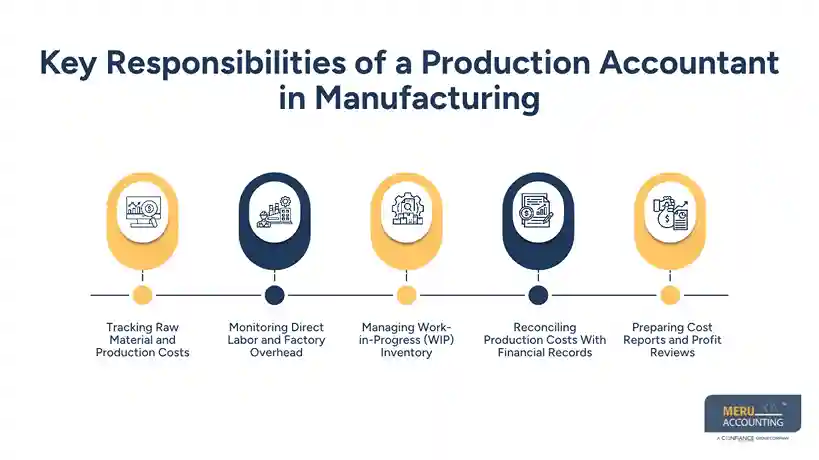
4. Reconciling Production Costs With Financial Records
Production data and accounting records must match. The accountant checks stock reports, purchase records, payroll costs, and the general ledger to find gaps.
They also review stock counts and adjust records for valid reasons, such as damaged goods, scrap, or stock loss.
5. Preparing Cost Reports and Profit Reviews
A production accountant prepares reports that show how much it costs to make goods and how those costs change over time. These reports help owners review product margins, spot cost issues, and plan future work.
How a Production Accountant Helps Control Manufacturing Costs
Cost control is not just about spending less. It is about knowing where money goes and finding ways to get more value from each dollar spent. A production accountant helps manufacturers do this through regular cost reviews.
1. Finding Material Waste and Production Losses
High material use can raise costs even when sales stay the same. A production accountant checks the amount of material used against the amount planned for each unit or batch.
For example, if a job needs 100 kg of raw material but uses 115 kg, the extra 15 kg needs review. It may be due to poor cuts, faulty goods, weak stock control, or an error in the bill of materials.
Finding the cause helps the firm cut waste and improve the use of stock.
2. Finding Labor Cost Issues
Labor costs can rise when jobs take longer than planned, staff work extra hours, or output falls. An accountant reviews labor hours, wage costs, and units made to see where costs are above plan.
For example, if a team takes 12 hours to make a batch that should take 9 hours, the extra time may point to machine delays, poor job planning, or a skills gap.
3. Keeping Factory Overhead in Check
Factory overhead can be hard to track because it does not always link to one product. Power, rent, repairs, and machine costs still form part of the cost of making goods.
A production accountant reviews these costs and checks how they are assigned to each product or job. This helps prevent under- or over-costing and gives owners a clearer view of the cost of each unit.
4. Comparing Actual Costs With the Budget
A budget sets the expected cost of making goods. Actual costs show what the firm spent. A production accountant compares the two to find cost gaps.
If the planned cost of a batch is $8,000 but the actual cost is $9,200, the $1,200 gap needs review. The cause may be higher material prices, more labor hours, or low machine output.
This review helps managers act before small cost gaps turn into larger losses.
5. Spotting Cost Variances Early
Cost variance is the gap between planned and actual costs. Regular checks help firms find these gaps before they hurt profit margins.
A production accountant can track trends across jobs, products, and months. This helps managers decide when to review supplier rates, change work plans, or fix process issues.
How Production Accounting Improves Manufacturing Profitability
Good cost control helps protect profit, but production accounting also gives firms the data they need to grow margins and make sound choices.
1. Giving a Clear View of Product Costs
When a firm knows the full cost of each product, it can see which items bring in a good return. This includes material, labor, and a fair share of factory overhead.
Without this data, a firm may sell high volumes of a product that brings in very little profit.
2. Supporting Better Pricing Decisions
Product prices should cover the cost of making goods and leave room for profit. A production accountant helps review unit costs so that sales teams can set prices based on sound data.
If material or labor costs rise, the firm can review prices before its margins fall too far.
3. Finding Profitable and Low-Profit Product Lines
Not all products bring in the same return. Some may need more labor, costly parts, or longer machine time.
A production accountant reviews product-level costs and margins to show which lines perform well. Managers can then review pricing, process changes, or product mix.
4. Reducing Inventory Costs
Too much stock ties up cash and can lead to storage costs, damage, or waste. Too little stock can delay orders and halt work.
By reviewing stock use, turnover, and WIP levels, an accountant helps firms keep stock at a sound level. This can free up cash and reduce avoidable costs.
5. Improving Cash Flow and Financial Planning
A clear view of production costs helps owners plan cash needs for raw materials, payroll, supplier bills, and other costs. It also helps them see how much cash may be tied up in WIP and finished goods.
This makes it easier to plan for new orders, buy stock at the right time, and avoid cash shortfalls.
How to Use Production Accounting Software for Better Cost Control
The right tools can make cost tracking faster and more accurate. Production accounting software helps firms record costs, track stock, and prepare reports with less manual work.
Here are some ways these tools can support better cost control:
- Track material and labor costs: Record the cost of raw materials, staff hours, and other inputs linked to each job or batch.
- Monitor WIP and stock: Keep track of goods at each stage of production and review stock levels.
- Prepare cost reports: Use current data to review unit costs, stock value, and cost gaps.
- Link production and finance data: Bring cost records and financial data into one view to help reduce gaps between reports.
- Review cost trends: Compare costs across jobs and time periods to find changes that need action.
When choosing production accounting software, firms should check if it supports their costing method, stock needs, and reporting needs. It should also work well with the tools they already use. Software can make data easier to review, but staff still need to check entries, stock counts, and cost rules.
Key Financial Reports Every Manufacturing Business Should Review
Financial reports help manufacturers see how much they spend, what stock they hold, and where costs are rising. A production accountant can prepare and review these reports on a set schedule.
Report | What It Shows | Why It Matters |
Cost of Goods Manufactured (COGM) | Total cost of goods completed in a set period | Shows the cost of finished production |
Cost of Goods Sold (COGS) | Cost of goods sold during the period | Helps review gross profit |
Work-in-Progress (WIP) Report | Costs tied to goods still in production | Helps keep stock value accurate |
Production Cost Variance Report | Gap between planned and actual costs | Helps find cost issues |
Inventory Valuation Report | Value of raw materials, WIP, and finished goods | Helps track stock value and cash tied up in stock |
These reports should be reviewed each month, with more frequent checks for firms that have high production volumes or fast-changing costs. The review should also include a check of stock counts and cost entries.
Improve Manufacturing Cost Control With Meru Accounting
Manufacturing profitability depends on more than production volume. Business owners also need reliable financial records to understand spending, review margins, manage supplier payments, and plan for upcoming costs. Without consistent accounting support, these decisions can become harder to make.
Meru Accounting helps manufacturing businesses stay on top of the financial side of their operations. Our outsourced accounting team supports:
- Production Expense Tracking: Record and organize expenses related to materials, labor, purchases, and daily operations.
- Accounts Payable and Receivable: Keep supplier payments and customer collections organized to support cash flow.
- Payroll Accounting: Maintain accurate payroll entries and related financial records.
- Reconciliation and Month-End Closing: Keep account balances in check and prepare reliable financial records for review.
- Financial Reporting: Provide clear reports that help business owners assess expenses, revenue, and overall financial performance.
With experience across multiple industries, we understand that manufacturing businesses have different cost structures, workflows, and reporting needs. We adapt our accounting support to your business requirements, giving you access to experienced accounting professionals at a fraction of the cost of a US in-house team.
Our Expert Insight
One area manufacturers should watch closely is work-in-progress (WIP) valuation at month-end. Not every product on the factory floor is ready to be counted as finished inventory. Its recorded value should reflect the costs incurred up to that stage, including materials, labor, and allocated overhead.
For example, if materials have been issued but production is still incomplete, recording the item as a finished good can distort inventory values and cost of goods sold (COGS). This can also lead to inaccurate gross profit figures.
Before closing the books, manufacturers should match production records with material issues, labor entries, and completion reports. This helps ensure that inventory and production costs are recorded in the correct accounting period.
Key Takeaways
- A production accountant tracks material, labor, overhead, WIP, and product costs.
- Regular cost reviews help manufacturers find waste, high labor costs, and budget gaps.
- Product-level cost data supports better pricing and profit reviews.
- Production accounting software can make cost tracking and reports easier to manage.
- Monthly reviews of COGM, COGS, WIP, and stock value help keep records clear.
- Outsourced accounting support can help manufacturers manage routine finance tasks and keep their books up to date.
FAQs
They should review material usage, labor records, purchase invoices, WIP schedules, and finished goods records to ensure production costs and inventory values are accurate.
Scrap increases material costs per finished unit by reducing usable output. Tracking normal and abnormal scrap separately helps manufacturers assess production losses.
It depends on the production process. Labor hours suit labor-intensive work, while machine hours are more useful for automated production.
Standard costing uses preset production costs, while actual costing uses the costs incurred. Comparing both helps identify cost variances.
When internal staff struggle to keep up with cost records, reconciliations, or month-end reporting, outsourcing can provide additional accounting support without hiring a full-time team
optional anymore
on running the business