Global payroll outsourcing allows a company to manage pay across countries without running a separate payroll team in each location. However, global payroll outsourcing works best when payroll data links with HR, accounting, time tracking, tax records, and bank systems. Without these links, teams may enter the same data twice, miss pay changes, or spend extra time fixing errors before payday.
For companies with staff in several countries, system links matter as much as payroll processing itself. The right setup keeps employee records in sync, records pay costs in the books, and gives finance teams a clear view of payroll across regions. Global payroll solutions for businesses should also account for local tax rules, data privacy laws, currency needs, and different pay cycles.
This blog explains the key integration features to review before choosing a provider, along with common risks, setup steps, and ways to check whether the system meets your needs.
What You Will Learn From This Blog
- Why system links matter when you choose global payroll outsourcing.
- Which HR, accounting, time, tax, and banking links to check.
- How payroll integrations can cut data errors and manual work.
- What common setup issues to plan for before launch.
- How to review global payroll solutions for businesses and choose a setup that fits your needs.
What is Global Payroll Outsourcing and Why Do Integrations Matter?
Global payroll outsourcing means hiring an outside provider to run payroll tasks for staff in more than one country. These tasks may include pay runs, tax calculations, payslips, statutory reports, and payment files, based on the agreed scope of work.
Integrations link the payroll platform with other business systems so data can move between them in a set way. For example, when HR records a salary change, an approved data link can send that change to payroll without a second manual entry. Global payroll outsourcing can then draw from the same approved record that HR and finance use.
These links matter because payroll errors can affect staff pay, tax filings, and company accounts. Global payroll solutions for businesses should set clear rules for data flow, review, and approval. A link alone does not ensure compliance; teams still need checks, local knowledge, and clear ownership of each task.
optional anymore
on running the business
Key Integration Capabilities to Look for in Global Payroll Outsourcing
HRIS and Employee Data Integration
An HR information system (HRIS) stores staff details such as names, work locations, job roles, pay rates, and start dates. A payroll link should transfer approved changes to the right country payroll without creating duplicate employee records.
Check whether the link can handle new hires, exits, transfers, salary changes, and changes in tax or bank details. Global payroll outsourcing should also flag missing fields and changes that need review before the next pay run.
Accounting Software and ERP Integration
Payroll costs need to flow into the general ledger so finance teams can track wages, employer taxes, benefits, and other staff costs. An integration with accounting software or an enterprise resource planning (ERP) system can post these costs to the right accounts and departments.
Ask whether the provider can map payroll items to your chart of accounts and cost centres. Global payroll outsourcing should also allow finance teams to review payroll journals and match them with payroll reports before posting.
Time, Attendance, and Leave Management Integration
Hourly pay often depends on approved work hours, overtime, shifts, and leave records. A link between time tools and payroll can send these figures to the pay system and reduce the need to copy data by hand.
Check how the system handles late timesheets, shift changes, paid leave, and overtime rules in each country. Global payroll outsourcing should flag unusual hours or missing approvals before they affect pay.
Benefits and Compensation System Integration
Pay may include bonuses, commissions, pension contributions, health benefits, allowances, and other items beyond base salary. A link to compensation and benefits systems can send approved amounts to payroll with the right pay codes and dates.
Ask how the provider handles one-time awards, recurring benefits, and changes made during a pay period. Global payroll solutions for businesses should also make it clear which amounts are taxable and which records need local review.
Tax and Statutory Reporting Integration
Payroll rules differ by country and may change over time. Tax and statutory links can transfer payroll data to local reporting tools or create files for required submissions, depending on the provider and the country.
Check which filings the provider prepares, which tasks remain with your company, and how it tracks rule changes. Global payroll outsourcing should include a clear review process for tax data, filing dates, and proof of submission. Do not assume that software alone guarantees compliance.
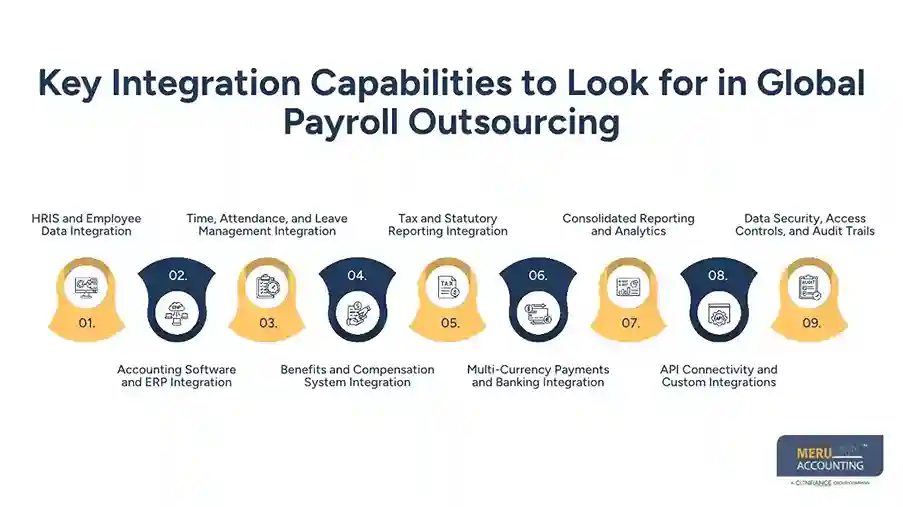
Multi-Currency Payments and Banking Integration
Companies that pay staff in different countries may need local bank files, cross-border transfers, or payments in more than one currency. Banking links can send approved payment details and return payment status or error messages.
Ask about currency conversion, exchange rate records, bank file formats, payment cut-off times, and rejected transfers. Global payroll outsourcing should also use clear approval steps to reduce the risk of sending funds to the wrong account.
Consolidated Reporting and Analytics
A company with staff in several regions needs a clear view of total payroll cost, headcount, tax costs, and changes in pay. Consolidated reporting can bring country-level figures into a common report while retaining local details for review.
Check whether reports use a consistent currency, show the exchange rates applied, and separate local payroll values from converted totals. Global payroll solutions for businesses should let finance teams compare periods and trace totals back to country-level records.
API Connectivity and Custom Integrations
An application programming interface (API) lets approved systems exchange data under set rules. APIs can connect payroll tools with an HR platform, accounting software, or an internal system when a ready-made link is not available.
Ask which data fields the API can share, how often it syncs, and what happens when a transfer fails. Global payroll outsourcing should include clear records of failed requests, access limits, and a process to fix errors without creating duplicate entries.
Data Security, Access Controls, and Audit Trails
Payroll records contain personal and financial details, so access must be limited to people who need the data for their work. Look for role-based permissions, secure data transfer, multi-factor login, and records of changes made to key fields.
Ask how long records are kept, how data is deleted, and how the provider handles security incidents. Global payroll outsourcing must also account for data transfer and privacy rules in the countries involved. Review the provider’s security terms and your own duties before sharing staff data.
How Global Payroll Integrations Improve Accuracy and Operational Efficiency
Connected systems can reduce repeated data entry and make it easier to trace payroll figures from the source to the final pay run. When approved HR changes flow into payroll, the team has fewer chances to use old salary or job details. Global payroll outsourcing can also cut the time spent matching payroll totals with accounting records.
For example, a company with teams in India, the UK, and the US may use one HR platform but run payroll under separate local rules. A linked setup can send employee changes to each local process, then bring approved payroll totals into one finance report. Each country still needs its own checks and legal review.
These links do not remove the need for human review. Teams should test totals, review exceptions, and compare payment files with approved payroll reports before funds leave the bank.
Common Integration Challenges in Global Payroll Outsourcing
Different Data Formats
HR, time, and accounting tools may use different names, codes, date formats, or employee IDs. Teams implementing global payroll solutions for businesses should agree on a shared data map before the first transfer.
Local Rules and Pay Cycles
Countries may use different tax periods, filing dates, and pay schedules. A single global calendar should show local deadlines and the person responsible for each task.
Poor Data Quality
Missing tax details, old bank records, or duplicate employee profiles can cause errors. Global payroll solutions for businesses require clean source records and rules to flag missing or unusual data.
Failed Data Transfers
A system link may fail because of a changed password, an API limit, or a network issue. Set alerts and a clear process to retry failed transfers and check the final totals.
Weak Ownership and Review
Problems can remain unresolved when HR, finance, and the provider each assume another team will act. Name an owner for each data set, approval, and error type.
Steps to Implement Global Payroll Integrations Successfully
Map Your Current Systems
List the HR, time, accounting, tax, benefits, and banking tools used in each country. Note which system owns each data field and where staff still enter information by hand.
Set Clear Data Rules
Agree on employee IDs, pay codes, cost centres, date formats, and currency rules. Set limits on who can add or change records and who must approve each change.
Check Provider Capabilities
When evaluating global payroll solutions for businesses, ask providers for a list of ready-made integrations, API options, supported file types, and country coverage. Confirm what the quoted service includes and which tasks need extra work or fees.
Test With Realistic Cases
Test new hires, exits, salary changes, overtime, bonuses, leave, tax items, and rejected payments. Compare the results with approved source records and resolve differences before going live.
Run a Controlled Launch
Start with a small group or one country when practical. Review the first pay runs closely, keep a record of issues, and retain a safe way to handle payroll if a link fails.
Review Performance After Launch
Track late data, failed transfers, manual corrections, payroll errors, and time spent on each pay run. Review these measures with the provider on a set schedule and update the process when business or local rules change.
How Meru Accounting Fits Into Your Global Payroll and Accounting Process
Global payroll outsourcing requires accurate payroll records, clear cost reports, and proper links between payroll and accounting systems. Meru Accounting provides payroll, bookkeeping, accounts payable and receivable, financial reporting, and virtual CFO services to businesses that need a clear view of their financial data.
- Payroll and Accounting Records: Meru Accounting provides payroll and accounting services that help businesses keep pay records and financial reports aligned.
- Software Compatibility: Our team works with QuickBooks, Xero, Zoho Books, NetSuite, and Odoo to meet the accounting and reporting needs of global payroll solutions for businesses.
- Payroll Cost Reporting: Businesses can review wages, employer taxes, benefits, and other staff costs through clear financial records.
- Accounts Payable and Receivable: Our services cover bill processing, payment records, customer invoices, and outstanding balances.
- Financial Reporting: Meru Accounting prepares financial reports that give business owners and finance teams a clearer view of costs and results.
- Virtual CFO Services: Our team provides financial reporting and planning services to businesses that need better insight into budgets, cash flow, and operating costs.
When reviewing global payroll outsourcing, businesses should first define their country coverage, software needs, and reporting goals. Meru Accounting can discuss these needs and help identify the accounting and payroll services that fit the existing process.
Our Expert Perspective
A payroll integration should do more than transfer data between systems; it must keep employee records, pay figures, and accounting entries accurate at each step. Before going live, test salary changes, overtime, bonuses, and staff exits to check whether each update reaches the right system. Compare payroll reports with payment files and accounting records, and set clear rules for approvals and error checks. Regular reviews after launch can catch data gaps early and keep payroll records accurate across countries.
Key Takeaways
- Choose global payroll outsourcing with links that fit your HR, accounting, time, tax, and banking systems.
- Check how the provider handles employee changes, approval steps, failed transfers, and audit records.
- Confirm which local filings, payments, and compliance tasks fall within the service scope.
- Use test cases to check pay totals and accounting entries before launch.
- Keep a named owner for each data set and review payroll exceptions before payment.
- Compare global payroll solutions for businesses on security, country coverage, reporting, and integration costs, not on feature count alone.
- Review integration results after launch and update the process when systems or local rules change.
FAQs
Global payroll outsourcing providers should offer HRIS, accounting, time tracking, tax reporting, banking, and data security integrations.
HRIS integration transfers approved employee details, salary changes, job updates, and leave records from HR software to payroll systems.
Yes, global payroll outsourcing can connect with accounting software and ERP systems to record wages, taxes, benefits, and payroll costs.
API integrations allow payroll systems to exchange data with other business tools, reduce manual entry, and flag failed data transfers.
Businesses should compare country coverage, software integrations, tax reporting, multi-currency payments, data security, and consolidated payroll reports.
optional anymore
on running the business