A real estate business can own a strong portfolio and still struggle to explain where its money goes. A vacant unit, an unexpected repair, a late rent payment, or a rise in property taxes can change the numbers more than an owner may expect. Knowing the value of your properties is one thing; knowing how well they perform is another. That’s where a property accountant specialist brings real value.
Unlike a general accountant, a property accounting expert understands the financial details behind rental income, operating costs, property-level budgets, and asset performance. They help turn day-to-day transactions into useful financial reports, giving owners a clearer picture of their investments. For firms that need this expertise without adding to their payroll, an outsourced property accountant can provide ongoing support as the portfolio evolves.
What You Will Learn From This Blog
- What a property accountant specialist does and how they support real estate firms.
- Why growing property businesses need expert accounting support.
- Common accounting issues that arise as a property portfolio grows.
- How to choose the right property accounting expert.
- When hiring an outsourced property accountant makes sense.
What Is a Property Accountant Specialist?
A property accountant specialist is an accounting expert who works with real estate firms, landlords, and property managers. They handle the books and financial data tied to real estate assets. Their work helps owners track how much each property earns, what it costs to run, and how well it performs.
Unlike a general accountant, a property accountant specialist deals with tasks that are unique to real estate. These may include rent tracking, lease-related costs, repair bills, vendor payments, property taxes, and reports for each asset.
Their key duties may include:
- Rental income tracking: Record rent payments, late fees, and other income for each property.
- Expense tracking: Log costs such as repairs, upkeep, insurance, and utility bills.
- Bank and account reviews: Match bank records with book entries to find errors or missing items.
- Accounts payable: Track vendor bills and ensure payments are made on time.
- Accounts receivable: Monitor unpaid rent and other dues.
- Financial reports: Prepare income statements, balance sheets, and cash flow reports.
- Budget tracking: Compare actual costs with planned budgets to spot gaps.
- Tax support: Keep records in order and help prepare data for tax filings.
These tasks give owners a clear view of their finances. They also help them spot risks before small issues turn into larger problems.
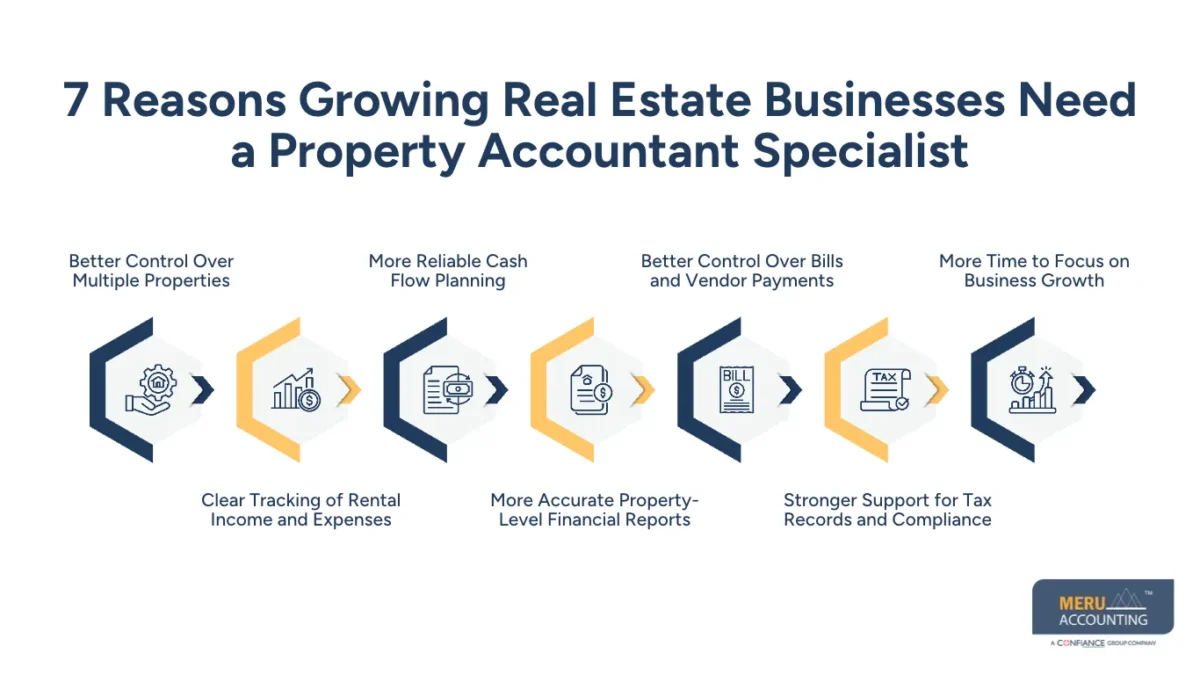
7 Reasons Growing Real Estate Businesses Need a Property Accountant Specialist
As a real estate portfolio grows, basic bookkeeping may no longer be enough. A property accountant specialist brings the skills and systems needed to keep financial data clear and useful.
1. Better Control Over Multiple Properties
Managing the books for one property is often simple. But when a firm owns or manages ten, twenty, or more properties, each one may have its own rent, bills, loans, and repair costs.
A property accountant specialist can keep records for each asset while also tracking the full portfolio. This helps owners see which properties earn well and which ones need more attention.
For example, a rental unit may bring in steady rent but also have high repair costs. If those costs are mixed with the rest of the business, the owner may miss the true cost of running that unit.
2. Clear Tracking of Rental Income and Expenses
Rent is a key source of income for most rental property firms. Yet, tracking it can be hard when there are many tenants, due dates, lease terms, and late fees.
A property accountant specialist helps record rent, track unpaid dues, and match payments with the right property and tenant. They also track costs such as repairs, cleaning, insurance, and property tax.
This gives owners a clear view of net rental income. It also helps them find unpaid rent and review costs that may be higher than planned.
3. More Reliable Cash Flow Planning
A real estate firm may own assets worth a lot, yet still face cash flow issues. Rent may come in late, large repair bills may arise, or loan payments may be due before enough cash is on hand.
A property accountant specialist helps track cash coming in and going out. They can prepare cash flow reports, review due dates, and flag gaps that may affect the business.
With this data, owners can plan for loan payments, repairs, taxes, and new deals. They can also set aside funds for costs that may not arise each month.
4. More Accurate Property-Level Financial Reports
When a firm owns many properties, it needs more than one set of total business figures. Owners need to know how each asset is doing.
A property accountant specialist can prepare reports that show income, costs, and net results for each property. These reports may also show budget gaps and changes in costs over time.
Such reports help owners compare assets and make better choices. They can use them to review rent rates, plan repairs, and decide if a property is worth keeping or selling.
5. Better Control Over Bills and Vendor Payments
Real estate firms often work with repair teams, plumbers, cleaners, builders, and other vendors. As the number of properties grows, so does the number of bills and due dates.
A property accountant specialist helps track vendor bills, check entries, and plan payments. They can also keep records of what was paid, when it was paid, and which property the cost belongs to.
This makes it easier to avoid late fees, duplicate payments, and missed bills. It also gives owners a better view of the costs tied to each asset.
6. Stronger Support for Tax Records and Compliance
Real estate tax records can be complex. Firms may need to track rental income, loan interest, repairs, asset costs, and other items for tax work.
A property accountant specialist helps keep these records in order throughout the year. They can group costs, match entries with source records, and prepare reports for the tax team or CPA.
This can reduce last-minute work during tax season. It also makes it easier to review past records if a tax query comes up. Tax rules vary by state and asset type, so firms should work with a qualified tax expert for tax advice and filings.
7. More Time to Focus on Business Growth
As a real estate firm grows, owners need to focus on deals, asset value, tenants, and new markets. But poor books and late reports can take up time that should go toward these tasks.
A property accountant specialist takes care of key accounting work and gives owners better data to use. With clear books and timely reports, they can spend less time fixing records and more time on growth plans.
This support can be useful when a firm buys new assets, adds rental units, or starts work in a new market.
Common Accounting Challenges Real Estate Businesses Face During Growth
Growth brings more work, but it can also expose gaps in the way a firm handles its books. Some common issues include:
- Mixed financial records: When income and costs from many properties are kept in one account, it becomes hard to see how each asset performs.
- Missed rent payments: A larger tenant base means more due dates and payments to track. Without regular checks, unpaid rent may go unnoticed.
- Poor expense records: Repair bills, vendor costs, and utility fees may be logged under the wrong property or account.
- Slow financial reports: If books are not updated on time, owners may make choices based on old or incomplete data.
- Hard-to-manage cash flow: Large repair costs, loan payments, and gaps in rent can put pressure on cash reserves.
- Lack of a clear review process: As more people handle payments and records, the risk of errors can rise. Firms need clear approval steps and regular account reviews.
Working with a property accountant specialist can help firms build better records, set review steps, and keep reports up to date.
How to Choose the Right Property Accountant Specialist
The right expert should know more than basic bookkeeping. They should understand how real estate firms earn income, pay costs, and track each asset.
Here are key points to review before you hire one:
1. Real Estate Accounting Experience
Look for an expert who has worked with rental properties, property managers, or real estate firms. Ask what types of portfolios they have handled and what tasks they have done.
2. Knowledge of Property-Level Reports
They should know how to track income and costs for each asset. Ask if they can prepare reports that help you review the results of each property.
3. Software Skills
Check if they can work with your current accounting tools and property systems. They should also know how to match bank feeds, rent data, bills, and other records.
4. Strong Review Process
Ask how they check entries, match bank records, and fix errors. A clear review process helps keep books clean and cuts the risk of wrong data.
5. Clear Communication
Your accountant should share reports on time and explain key changes in plain terms. You should know who to contact when you have a question or need a report.
6. Ability to Scale
Choose a team that can handle more work as your portfolio grows. This can help you avoid the need to change providers each time you add more assets.
optional anymore
on running the business
When Should You Hire an Outsourced Property Accountant?
Hiring an outsourced property accountant can make sense when your current team can no longer keep up with the work. It may also be a good choice if you need real estate accounting skills but do not want to hire a full-time employee.
Here are some signs that it may be time to outsource:
- You have added more properties, tenants, and vendor bills.
- Your books are often late or need frequent fixes.
- You cannot get clear reports for each property.
- Rent and other dues are hard to track.
- Your in-house team has too much work.
- You need more support but want to keep staff costs in check.
An outsourced property accountant can handle agreed tasks such as bookkeeping, bank reviews, bill tracking, and financial reports. The scope of work can be set based on your needs and the size of your portfolio.
Before you hire, set clear terms for the work, report dates, data access, and review steps. This helps both teams work well and keeps control of your books within your business.
Get an Outsourced Property Accountant with Meru Accounting
Adding properties to a portfolio also means keeping track of more financial details. Each property has its own rental income, maintenance costs, vendor bills, tax expenses, and cash flow needs. If these records are not tracked properly, owners may find it hard to compare property performance or plan their next investment.
At Meru Accounting, we provide outsourced property accounting services that help real estate businesses keep these numbers organized. Our team supports the accounting work behind your portfolio, from recording rent and property expenses to reconciling accounts and preparing financial reports.
Our property accounting services include:
- Property-Level Bookkeeping: Record rental income, security deposits, maintenance costs, insurance, utilities, and other property-related transactions under the right accounts.
- Rental Income and Accounts Receivable Management: Track rent collections, outstanding balances, tenant dues, and other receivables.
- Vendor and Accounts Payable Management: Process property-related bills, track payment due dates, and maintain vendor records.
- Bank and Account Reconciliation: Match bank activity with accounting records to identify missing entries, duplicate transactions, and discrepancies.
- Property Financial Reporting: Prepare income statements, expense reports, and cash flow reports to help owners review individual properties and overall portfolio performance.
- Catch-Up and Cleanup Bookkeeping: Organize past transactions, correct account records, and bring overdue books up to date.
- Payroll Accounting Support: Maintain payroll records and related entries for real estate businesses with in-house staff.
Whether you manage rental properties, oversee a growing portfolio, or operate a real estate management company, we can provide accounting support based on your workload. Need reliable accounting support for your property portfolio? Connect with Meru Accounting to discuss an outsourced accounting arrangement that fits your business.
Our Expert Insight
In our experience, real estate businesses should pay close attention to how they record security deposits, tenant incentives, and lease-related costs. These items are often handled incorrectly when property accounts are managed without real estate accounting knowledge. For example, a refundable security deposit should generally be recorded as a liability, not rental income, because the money may need to be returned to the tenant.
Small accounting errors like these can distort financial statements and create problems during audits or tax reviews. A property accountant specialist should understand these details and apply the right accounting treatment rather than simply recording transactions as they come in.
Key Takeaways
- Growing real estate firms need clear records for each property.
- A property accountant specialist helps track rent, costs, bills, and cash flow.
- Property-level reports help owners review asset results and plan growth.
- Regular bank checks and bill reviews can help reduce errors.
- An outsourced property accountant can add skilled support without the need to build a large in-house team.
- The right accounting partner should have real estate experience, sound review steps, and the ability to scale.
FAQs
A property accountant specialist handles real estate accounting, including rental income, operating expenses, bank reconciliations, vendor payments, and property-level financial reports.
Consider hiring one when you manage multiple properties, struggle to keep books current, need better financial reports, or have more accounting work than your current team can handle.
A property accountant understands real estate transactions, lease-related costs, rental income, property expenses, and portfolio reporting. A general accountant may not have the same level of industry-specific experience.
Yes. Outsourcing gives small real estate businesses access to accounting professionals without the expense of hiring and managing a full-time employee. It can also provide additional support as the portfolio grows.
Look for real estate accounting experience, knowledge of property-level reporting, software skills, clear communication, and a defined review process. Also, check whether the provider can handle your current workload as well as future growth.
optional anymore
on running the business