Understanding the tax rate for small business LLC owners is important for managing income, expenses, and yearly tax payments. An LLC does not have one fixed federal tax rate. The amount depends on its tax classification, business profit, owner’s filing status, and state tax rules.
The tax rate for small business LLC income can also change when owners select a different tax structure. Eligible business expenses reduce taxable profit, while LLC business tax deductions vary by industry and business activity. Knowing these rules allows owners to plan expenses and avoid missed tax claims.
This article covers federal tax brackets for 2026, self-employment tax, industry-specific expenses, tax calculations, and legal ways to reduce business taxes.
What You Will Learn From This Blog
- How LLC tax classifications affect the federal tax rate for small business LLC owners.
- Which 2026 federal income tax brackets apply to owners.
- How self-employment, payroll, and state taxes work.
- Which common and industry-based expenses qualify for deductions.
- How to calculate business profit and taxable income.
- How to plan legal tax savings based on the tax rate for small business LLC owners and maintain proper records.
Understanding the Tax Rate for Small Business LLC
The tax rate for small business LLC owners depends on the federal tax status of the business. The IRS treats an LLC as a sole proprietorship, partnership, S corporation, or C corporation, based on its ownership and elections. Each classification has different filing and payment rules.
How LLC Tax Classification Affects Your Federal Income Tax
Single-Member LLC Tax Rates and Filing Requirements
A single-member LLC is generally treated as a disregarded entity. The owner reports business income and expenses on Schedule C with Form 1040. The tax rate for small business LLC profit follows the owner’s individual income tax bracket.
Multi-Member LLC Tax Rates and Partnership Taxation
A multi-member LLC is generally taxed as a partnership. It files Form 1065 and gives each member Schedule K-1. Members report their share of business income, losses, and other tax items on personal returns.
LLC Taxed as an S Corporation: Tax Rates and Requirements
An eligible LLC can elect S corporation status by filing Form 2553. Working owners must receive reasonable wages, subject to payroll taxes. Remaining eligible profit may be distributed without self-employment tax.
LLC Taxed as a C Corporation: Corporate Tax Rates
An LLC electing C corporation status files Form 1120. The corporation generally pays 21% federal income tax. Dividends may also be taxed on the owner’s personal return.
Choosing the Right Tax Classification for Your LLC
Compare annual profit, owner wages, payroll costs, and filing duties before choosing a classification. The tax rate for small business LLC owners may differ under each option, so professional tax advice is useful.
Federal Income Tax Brackets for Small Business LLC Owners
Understanding Federal Income Tax Brackets
The tax rate for small business LLC owners is based on taxable income, not total business revenue. The US uses progressive brackets, so different portions of income are taxed at different rates.
How Individual Income Tax Brackets Apply to LLC Owners
Default LLC profits generally pass to the owner’s individual tax return. Other income, eligible deductions, and filing status also affect the final tax amount.
Marginal Tax Rates vs. Effective Tax Rates
A marginal rate applies to the last portion of taxable income. An effective rate is total income tax divided by taxable income. A person in the 22% bracket does not pay 22% on every dollar.
How Filing Status Affects Your LLC Tax Liability
Single, married filing jointly, married filing separately, and head-of-household taxpayers have different income limits. Two owners with equal profits may therefore owe different amounts.
2026 Federal Income Tax Brackets for LLC Owners
The 2026 federal income tax rates are 10%, 12%, 22%, 24%, 32%, 35%, and 37%.
Rate | Single Filers | Married Filing Jointly |
10% | Up to $12,400 | Up to $24,800 |
12% | 12,401–50,400 | 24,801–100,800 |
22% | 50,401–105,700 | 100,801–211,400 |
24% | 105,701–201,775 | 211,401–403,550 |
32% | 201,776–256,225 | 403,551–512,450 |
35% | 256,226–640,600 | 512,451–768,700 |
37% | Above $640,600 | Above $768,700 |
These are marginal brackets. The 2026 standard deduction is $16,100 for single filers and $32,200 for joint filers.
Self-Employment Tax and Other Taxes Applicable to LLCs
Understanding Self-Employment Tax for LLC Owners
Default LLC owners generally pay 15.3% self-employment tax on qualifying earnings. This is separate from income tax and affects the total tax rate for small business LLC owners.
Social Security and Medicare Tax Obligations
The 15.3% rate includes 12.4% Social Security and 2.9% Medicare tax. The 2026 Social Security wage base is $184,500.
Additional Medicare Tax for High-Income LLC Owners
An extra 0.9% Medicare tax may apply when income exceeds $200,000 for single filers or $250,000 for joint filers.
Federal Payroll Taxes for LLCs With Employees
Employers must manage income tax withholding, Social Security, Medicare, and applicable unemployment taxes. Payroll reports and timely payments are required.
State Income Tax, Franchise Tax and Sales Tax Obligations
State rules vary by location and business activity. An LLC may owe state income tax, franchise fees, sales tax, or annual registration charges.
optional anymore
on running the business
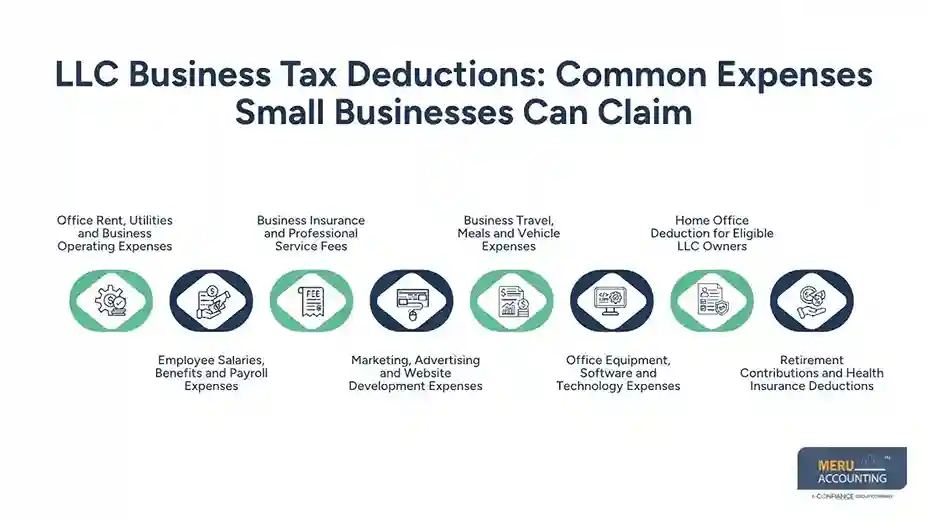
LLC Business Tax Deductions: Common Expenses Small Businesses Can Claim
LLC business tax deductions reduce taxable profit when costs are ordinary, necessary, and linked to business activity. Owners should keep invoices, receipts, and payment records.
Office Rent, Utilities and Business Operating Expenses
Office rent, electricity, internet, water, and maintenance may qualify as deductions affecting the tax rate for small business LLC owners when used for business. Personal household costs cannot be claimed as office expenses without meeting IRS rules.
Employee Salaries, Benefits and Payroll Expenses
Wages, employer payroll taxes, and eligible employee benefits are common deductible costs. Keep payroll reports and payment records to prove each amount.
Business Insurance and Professional Service Fees
Business insurance, legal fees, accounting charges, and professional service costs may qualify when linked to business operations. Personal insurance costs generally do not qualify.
Marketing, Advertising and Website Development Expenses
Online ads, promotional material, and eligible website costs may qualify. Large website development projects may need separate tax treatment.
Business Travel, Meals and Vehicle Expenses
Eligible business travel, hotel, and transport costs may qualify as deductions when calculating the tax rate for small business LLC owners. Business meals are generally subject to a 50% deduction limit. Personal trips are not deductible.
Office Equipment, Software and Technology Expenses
Computers, printers, software, and office tools may qualify as current expenses or depreciable assets, depending on their cost and use.
Home Office Deduction for Eligible LLC Owners
Owners may qualify when a home area is used regularly and exclusively for business. The simplified method allows $5 per square foot, up to 300 square feet.
Retirement Contributions and Health Insurance Deductions
Eligible owners may deduct qualifying retirement contributions and health insurance premiums. Income, plan type, and other eligibility rules affect the amount.
Industry-Specific LLC Business Tax Deductions
Industry-based LLC business tax deductions and the applicable tax rate for small business LLC owners depend on the work performed, assets used, and costs incurred. Owners must keep records that link each expense to business activity.
Tax Deductions for Construction and Contracting Businesses
Construction firms may claim tools, equipment rental, safety gear, job supplies, and eligible contractor costs. Large assets may require depreciation or a Section 179 election.
Tax Deductions for Retail and E-commerce LLCs
Retail firms may claim packaging, shipping, advertising, warehouse rent, and payment fees. Inventory costs are generally handled through cost of goods sold.
Tax Deductions for Restaurants and Food Service Businesses
Restaurants may claim eligible food supplies, kitchen tools, rent, cleaning, wages, and delivery costs. Stock and purchase records must be kept.
Tax Deductions for Real Estate and Property Management LLCs
Eligible costs include repairs, insurance, management software, advertising, and professional fees. Major property improvements may need to be capitalised and depreciated when calculating taxable income under the tax rate for small business LLC owners.
Tax Deductions for Consulting and Professional Service Businesses
Consultants may claim business software, office rent, professional fees, and client-related travel. Personal costs and general living expenses do not qualify.
Tax Deductions for Transportation and Logistics Companies
Transport firms may claim fuel, vehicle repairs, permits, insurance, and driver wages. Mileage and business-use records are important.
Tax Deductions for Manufacturing and Wholesale Businesses
Manufacturers may claim raw materials, factory rent, production wages, and repairs. Some production costs form part of inventory when calculating taxable income under the tax rate for small business LLC owners.
Tax Deductions for Technology and IT Service Companies
IT firms may claim cloud hosting, software, computers, cybersecurity services, and eligible employee training costs. Research expenses need separate review.
How to Calculate the Tax Rate for Small Business LLC
Calculating LLC Taxable Income From Gross Revenue
Start with total revenue and subtract returns, allowances, and applicable cost of goods sold. This gives the gross profit used to assess business expenses.
Subtracting Eligible Business Expenses and Deductions
Subtract qualifying rent, wages, insurance, and other costs. For example, $200,000 revenue minus $70,000 expenses gives $130,000 business profit.
Calculating Federal Income Tax Based on Tax Brackets
The owner’s taxable income includes applicable business profit and other income, less permitted adjustments and deductions. Apply each marginal bracket separately to calculate the tax rate for small business LLC owners.
Adding Self-Employment and Applicable State Taxes
Calculate applicable self-employment tax and state obligations separately. Do not treat income tax, payroll tax, and sales tax as one flat rate.
Practical LLC Tax Calculation Example for a Small Business
An owner earns $200,000 and has $70,000 in eligible expenses. Business profit is $130,000. If the owner is single and claims the $16,100 standard deduction, taxable income before other adjustments is $113,900. The final tax also depends on self-employment tax and other deductions.
Tax-Saving Strategies for Small Business LLC Owners
Selecting the Most Tax-Efficient LLC Classification
Compare default, S corporation, and C corporation treatment. Include owner wages, payroll costs, and filing expenses before choosing.
Maximizing Eligible Business Expense Deductions
Review every business payment and record qualifying LLC business tax deductions to reduce taxable income and manage the tax rate for small business LLC owners. Keep personal spending separate and avoid unsupported claims.
Planning Equipment Purchases and Depreciation
Plan purchases based on business needs. Section 179 and bonus depreciation may allow faster deductions for eligible assets, subject to current rules.
Using Retirement Contributions to Reduce Taxable Income
Eligible owners can consider SEP IRAs and Solo 401(k) plans. Check contribution limits, income rules, and plan deadlines.
Managing Quarterly Estimated Tax Payments
Owners who expect to owe at least $1,000 after withholding and credits may need estimated payments. Timely payments can prevent penalties.
Maintaining Accurate Financial Records to Avoid Missed Deductions
Keep receipts, invoices, bank statements, payroll reports, and mileage logs. Reconcile accounts each month to find missing costs.
Reviewing Tax Planning Opportunities Before Year-End
Review profit, expenses, equipment, and estimated payments before the year ends. Early planning gives owners more choices.
How Meru Accounting Manages Bookkeeping and Financial Reporting for Small Business LLCs
Small business LLC owners need accurate financial records to track business income, operating costs, payroll, and deductible expenses. Meru Accounting provides accounting, bookkeeping, payroll, accounts payable, accounts receivable, and financial reporting services for businesses across the United States.
Our accounting services cover key financial tasks, including:
- Income and Expense Recording: We record sales, operating costs, vendor payments, and other business transactions to maintain clear financial records.
- Accounts Payable and Receivable: We track outstanding vendor bills and customer payments to keep business transactions organised.
- Payroll Management: Our team maintains employee wage records, payroll expenses, and related financial transactions.
- Bank Reconciliation: We match bank and credit card transactions with accounting records to identify errors and missing entries.
- Financial Reporting: We prepare income statements, balance sheets, and other reports that show business income, expenses, assets, and liabilities for evaluating taxable profits and the tax rate for small business LLC owners.
These services give LLC owners a clear view of business profits and operating expenses throughout the year. Our organised financial records also allow business owners to review eligible LLC business tax deductions and share accurate financial data with their tax professionals when calculating the tax rate for small business LLC income.
Our Expert Perspective
The tax rate for small business LLC owners should not be judged by income tax alone. Self-employment tax, state charges, payroll costs, and eligible deductions also affect the final amount.
Regular bookkeeping and early tax reviews are better than waiting until filing season. Owners should check tax choices with a qualified US tax professional.
Key Takeaways
- An LLC has no single federal income tax rate.
- An LLC’s tax classification determines how the tax rate for small business LLC income applies to its owners.
- 2026 individual tax rates range from 10% to 37%.
- Self-employment tax is generally 15.3%.
- LLC business tax deductions reduce eligible taxable profit.
- Industry expenses must meet IRS rules.
- Accurate records prevent missed claims and filing errors.
FAQs
The federal tax rate for a small business LLC ranges from 10% to 37% for most pass-through LLC owners, while an LLC taxed as a C corporation generally pays 21%.
A small business LLC can claim eligible deductions for rent, salaries, insurance, advertising, travel, equipment, software, and other ordinary business expenses.
Construction, retail, restaurants, real estate, consulting, transportation, manufacturing, and IT LLCs can claim eligible industry-specific expenses that reduce taxable income under the applicable tax rate for small business LLCs.
Calculate business profit by subtracting eligible expenses from revenue, then apply the owner’s federal income tax brackets and applicable self-employment and state taxes.
An LLC can reduce its tax liability through eligible business deductions, suitable tax classification, equipment depreciation, retirement contributions, and accurate financial records.
optional anymore
on running the business