
In the aviation sector, financial control is not only about recording numbers but also about managing high operating costs, fuel changes, and strict compliance rules. Many airlines, cargo operators, and charter companies now rely on accounting for Aviation Industry to maintain clear financial records and stable operations.
At the same time, Aviation Accounting is becoming more complex due to global regulations and rising cost pressure. This growing complexity is the main reason many aviation businesses are outsourcing financial management.
In fact, structured aviation accounting is now considered a key support system for better cost control and reporting accuracy. With proper aviation-focused accounting systems, aviation businesses can manage revenue, expenses, and compliance in a structured way without internal overload.
What You Will Learn From This Blog
- How aviation financial systems work and why they are complex
- Why airlines are shifting to external financial support
- Key problems faced in internal accounting teams
- How outsourcing improves reporting clarity and cost tracking
- Role of compliance in accounting for Aviation Industry and its impact on regulatory and tax adherence
- Real profit example from airline operations
- How to choose the right finance partner for aviation needs
What Is Aviation Accounting and How Does It Work
Accounting for Aviation Industry focuses on managing and tracking financial activities in airlines, cargo operators, and aviation service providers. It includes revenue from ticket sales, cargo operations, aircraft leasing income, and major expenses such as fuel, maintenance, airport charges, and crew costs.
Aviation businesses handle high transaction volumes and complex cost structures. This requires detailed financial control. Accurate reporting and clear cost visibility across operations are essential.
A key part of this system is linking each flight with its direct costs and revenue, where fuel, landing fees, salaries, and repair expenses are mapped against route earnings to identify profit or loss per flight.
Modern systems also record financial data in real time, reduce manual errors, and improve reporting accuracy. Revenue is recorded only after service completion, while expenses are grouped into fixed and variable categories for clearer analysis.
Overall, these systems generate structured reports like profit and loss statements and route-wise performance summaries that help management take better financial decisions.
Key Challenges in Aviation Financial Management
High Fuel Cost Fluctuation Impact
In accounting for Aviation Industry, fuel price changes directly affect profit margins. Even small shifts in fuel rates can create large gaps in overall profitability if they are not tracked in real time. This makes cost planning difficult for airlines, especially on long-haul routes where fuel usage is high.
Complex Multi-Route Revenue Tracking
Aviation Accounting must track revenue from multiple routes, countries, and currencies. This makes financial reporting more complex and time-consuming.
Regulatory Pressure On Financial Records
Strict aviation rules require accurate and timely financial reporting. Any mismatch in records can lead to audit issues, penalties, or compliance risks. Airlines must maintain proper documentation to meet regulatory standards across regions.
Delayed Data Consolidation Issues
In many aviation companies, financial data from airports, vendors, and ground operations is often delayed. This creates gaps in monthly reporting and affects the accuracy of financial statements, making it harder to assess real performance on time.
Aircraft Maintenance Cost Uncertainty
In accounting for Aviation Industry, maintenance costs are unpredictable and can change suddenly due to repairs, inspections, or part replacements, impacting budget accuracy. These unexpected expenses can disturb planned budgets and impact overall financial stability if not managed carefully.
Why Aviation Businesses are Outsourcing Accounting Services
Focus On Core Flight Operations
Many airlines choose accounting for Aviation Industry outsourcing so internal teams can focus on operations, safety, and customer service instead of financial workload.
Operational teams gain more time to improve flight efficiency and passenger experience without finance-related distractions.
Cost Reduction In Finance Operations
Outsourcing Aviation Accounting reduces the need for large in-house accounting teams. This lowers salary and infrastructure expenses.
Access To Skilled Finance Experts
Specialized knowledge is essential due to complex cost structures and strict compliance rules in aviation operations. Outsourcing provides access to professionals who understand airline financial systems, route-based costing, and regulatory requirements.
Better Accuracy In Financial Reporting
With outsourced accounting, reporting errors are reduced due to structured systems and experienced review processes. Stronger validation steps ensure cleaner financial records and more reliable monthly reports.
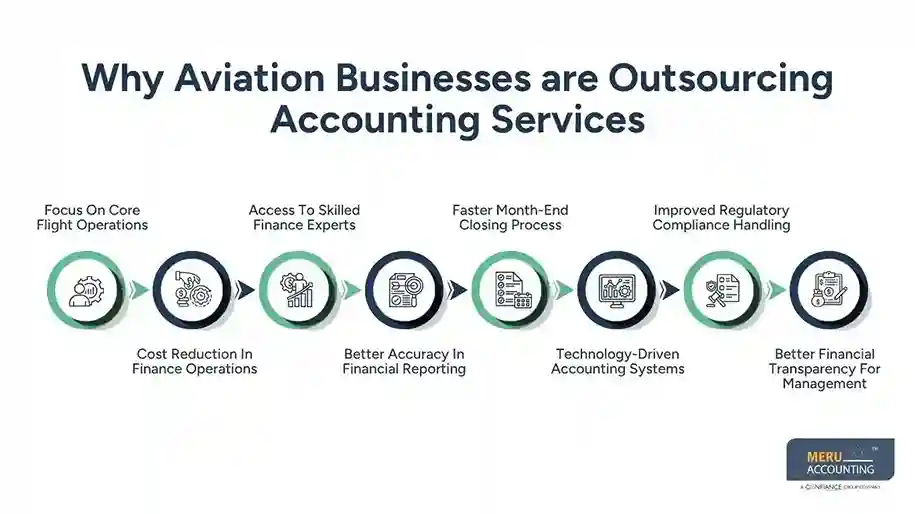
Faster Month-End Closing Process
Monthly closing speeds up because dedicated teams manage data entry, reconciliation, and reporting. Faster closing cycles allow management to review financial performance without long delays.
Technology-Driven Accounting Systems
Outsourced Aviation Accounting firms use advanced software tools for real-time tracking and automated reporting. Modern systems also improve data visibility across multiple routes and departments.
Improved Regulatory Compliance Handling
In accounting for Aviation Industry, businesses operate under strict financial and aviation authority rules that require consistent compliance management. Outsourced teams ensure records, audits, and filings stay aligned with required compliance standards, reducing the risk of penalties or reporting issues.
Better Financial Transparency For Management
Clear and structured reporting gives leadership better visibility of route-wise performance, cost behavior, and profit trends, helping in more informed financial planning and operational decisions.
Benefits of Outsourcing Accounting For Aviation Industry
- Outsourcing accounting for Aviation Industry provides clear visibility of fuel, maintenance, and operational costs across all routes, helping airlines understand where expenses are concentrated.
- Better budget planning becomes possible using historical data and route performance insights, allowing airlines to plan future operations with more stability and control.
- Manual entry mistakes are reduced significantly due to structured systems and controlled workflows, leading to more accurate and consistent financial records.
- Inflows from ticket sales and outflows for operational expenses can be tracked more effectively, improving liquidity control and financial balance.
- Financial systems can grow alongside airline operations without the need to build large in-house teams or increase fixed overhead costs.
- Accurate financial reports help management take quicker and more informed decisions related to pricing, route selection, and fleet expansion strategies.
Role of Aviation Accounting In Regulatory Compliance
Compliance With Aviation Authorities
Accounting for Aviation Industry must follow aviation authority rules for financial reporting and audit readiness. Regular updates in reporting practices help airlines stay aligned with changing regulatory requirements.
Tax Filing Accuracy
Aviation Accounting ensures correct tax filing for domestic and international operations, reducing penalty risks. Proper documentation of transactions supports smooth and error-free tax submissions across regions.
Audit Preparation Support
With structured financial systems, audit data is always ready and properly organized. Well-maintained records reduce last-minute stress during internal and external audits.
International Reporting Standards
Global standards like IFRS are followed to maintain consistency in reporting across countries. Standardized reporting makes financial comparison easier for multi-country airline operations.
Record Keeping For Legal Safety
In accounting for Aviation Industry, long-term financial records are maintained to support legal and regulatory checks and ensure documentation readiness when required. Accurate record storage helps resolve disputes and meeting documentation needs when required.
How To Choose The Right Aviation Accounting Partner
Industry Experience Check
Choose a partner with strong experience in accounting for Aviation Industry and airline financial systems. Hands-on exposure to airline operations helps in handling complex cost and revenue structures more accurately.
Technology Capability Review
Ensure advanced tools are used for real-time tracking and reporting. Modern systems improve data accuracy and reduce delays in financial reporting cycles.
Compliance Knowledge
Strong understanding of global aviation rules is essential for financial accuracy. Proper compliance handling reduces risk of penalties and supports smooth audit processes.
Transparent Reporting System
In accounting for Aviation Industry, clear and simple financial reports are important for better decision-making and operational clarity. Easy-to-read dashboards help management understand performance without confusion.
Scalability and Support
A good aviation accounting partner should support business growth without system issues. Flexible systems allow smooth expansion as operations and flight volume increase.
Real-Life Example
A mid-size airline operates 100 flights per month. Using accounting for Aviation Industry, the total monthly revenue is calculated from ticket sales and cargo services.
Fuel cost forms nearly 35% of total expenses, while maintenance and staff costs form another 30%. With structured Aviation Accounting, the airline identifies that two routes are generating low profit due to high landing charges.
After detailed financial analysis, management adjusts ticket pricing and reduces underperforming routes. This leads to a 12% increase in monthly net profit. Without proper structured accounting, these insights would remain hidden.
Meru Accounting supports aviation businesses with structured financial reporting and cost tracking systems designed to improve clarity and control over complex airline operations.
How Meru Accounting Supports Aviation Businesses
Meru Accounting provides specialized services in accounting for Aviation Industry with a focus on accuracy, compliance, and cost control. Our team understands complex aviation cost structures and supports airlines, cargo operators, and charter services.
We deliver complete Aviation Accounting solutions, including route-wise reporting, fuel cost tracking, and regulatory compliance support. Our systems are designed to reduce manual work and improve financial clarity for aviation businesses.
With strong experience in the aviation sector, Meru Accounting helps businesses manage growth with structured reporting and reliable financial systems. Our accounting services are built for accuracy, speed, and compliance needs of the aviation industry.
Key Takeaways
- Aviation finance systems are highly complex and need structured tracking
- Outsourcing reduces cost pressure and improves reporting accuracy
- Compliance plays a major role in aviation financial systems
- In accounting for Aviation Industry, proper financial tracking improves profit visibility per route and helps identify underperforming segments
- Skilled partners bring better control over aviation cost management
- Real-time data helps improve pricing and operational decisions
FAQs
Helps track fuel, maintenance, and ticket revenue in a clear way. Accurate tracking ensures correct profit calculation for each flight.
Outsourcing gives access to aviation-focused experts and structured systems that track route-wise profit, fuel cost changes, and monthly financial performance with better accuracy.
Airlines outsource to reduce costs, improve accuracy, and focus more on flight operations instead of financial management tasks.
Structured systems and expert review processes reduce manual mistakes in financial records and improve data reliability.
Yes, small operators also benefit by reducing workload and improving financial control without hiring large internal teams.