
A product sells for $40. The supplier charged $18. At first glance, that leaves $22 before other costs. But what if $3 went to freight, $2 to duty, and another $1 to direct import charges? The real product cost is not $18 anymore. This is where accounting for ecommerce business becomes closely tied to inventory control. If the full cost of bringing goods into stock is not tracked, a product can look more profitable on paper than it really is.
For an online seller with hundreds or thousands of units, even a small cost gap can add up quickly. Accounting for ecommerce businesses needs to capture these costs in a clear way so inventory value, cost of goods sold, and product margins are based on useful figures.
What You Will Learn From This Blog
- Why accounting for ecommerce businesses needs more than sales and payment records.
- Which costs can form part of landed inventory cost.
- How to calculate landed cost with a simple shipment example.
- How accounting for ecommerce business can keep stock costs tied to the right products.
- How landed cost affects inventory value and gross profit.
- How ecommerce accounting can show the real cost behind product sales.
- How ecommerce landed cost accounting can make shipment costs easier to track.
Understanding Accounting For Ecommerce Businesses
The supplier price is only the starting point for many ecommerce products. Imagine buying 1,000 units at $8 each. The supplier invoice shows $8,000, but the goods still need to reach the warehouse before they can be sold. If freight, duty, insurance, and other eligible direct costs add $2,000, the total cost becomes $10,000, or $10 per unit. Recording only the $8 purchase price would leave part of the inventory cost out of the accounts. Accounting for ecommerce business needs to capture the costs that are properly linked to bringing inventory into saleable stock, giving the business a better basis for inventory valuation and gross profit reporting.
Ecommerce stock can pass through several stages before a customer receives it. A product may leave the supplier, remain in transit, pass through customs, arrive at a warehouse, move to a fulfilment center, and then be sold. Accounting for ecommerce business should connect purchase records, SKU data, shipment costs, warehouse records, and sales so the business can track both the quantity and cost of inventory. This also matters when one shipment contains several SKUs and a single freight bill covers the full load.
A clear allocation method based on factors such as units, weight, volume, or value can keep shared costs consistent. Without a set method, the same shipment could produce different inventory values depending on who records it.
Inventory cost also has a direct link to reported profit because the cost of unsold goods stays in inventory until those goods are sold. Once a product is sold, its applicable cost moves to cost of goods sold and affects gross profit.
Ecommerce accounting brings purchases, inventory, sales, refunds, and other costs into the financial records so the business can see the result behind its sales. For example, a shipment of 500 units at $12 each has a product cost of $6,000.
Adding $900 in freight and $600 in eligible import costs brings the shipment to $7,500, or $15 per unit. That $15 gives accounting for ecommerce business a more complete basis for inventory valuation, cost of goods sold, and product margin reporting than the $12 supplier price alone.
What Costs Are Included In Ecommerce Landed Cost Accounting?
Product Purchase Cost
The supplier price is usually where the calculation starts. But discounts, rebates, credits, and purchase terms should be checked before the final inventory cost is set. The amount paid should reflect the actual purchase terms rather than simply copying the first invoice figure.
Freight and Shipping
A container may cost thousands of dollars to move, even when the goods inside are worth much more. Freight that is directly tied to bringing inventory to the required location may form part of the inventory cost. Ecommerce landed cost accounting should connect the freight bill to the shipment it belongs to.
Customs Duty and Import Charges
Imported stock can carry customs duty and other charges before it reaches the warehouse. These amounts should be reviewed based on their nature and the accounting rules that apply. Not every government charge should automatically be added to inventory.
Insurance and Handling Costs
Insurance for goods while they are in transit and certain direct handling costs may be included in inventory cost. Keeping the related documents with the shipment record gives accounting for ecommerce business a clearer trail when the cost is reviewed later.
Port and Broker Charges
A shipment can incur several smaller charges before it reaches the warehouse. Port fees and customs broker charges may seem minor on their own, but repeated shipments can make them material. Each charge should be assessed based on what it relates to.
Costs That Should Stay Separate
The fact that a cost is linked to selling a product does not mean it belongs in inventory. Marketing, general administration, selling costs, and some later storage costs may need separate treatment. Accurate ecommerce accounting depends on knowing where each cost belongs.
How To Calculate Landed Cost For Ecommerce Inventory
Start With the Total Product Cost
Begin with the quantity and purchase price. If 500 units cost $12 each, the starting amount is $6,000. Accounting for ecommerce business can then build the landed cost by adding eligible direct costs linked to that shipment.
Add Direct Freight Costs
Now assume the freight bill is $900. The shipment cost becomes $6,900. The key is not just adding the amount, but keeping a clear link between the freight bill and the products it relates to.
Add Eligible Import Costs
Add $600 in eligible duty and direct import costs, bringing the shipment total to $7,500. Ecommerce landed cost accounting should retain the bills and records that explain how this amount was reached.
Divide Cost Across Units
Divide $7,500 by 500 units, and the result is $15 per unit. This gives the business a more complete unit cost, subject to its accounting policy and the rules that apply.
Use a Clear Allocation Method
The calculation becomes less simple when one cost covers different products. A freight bill might need to be split by weight, volume, units, or value. The best basis depends on the nature of the cost and the goods involved.
Check the Cost Before Posting
Before the cost reaches the books, compare the purchase invoice, freight bill, import records, quantity, and allocation. This check gives accounting for ecommerce business a better chance of catching missing or duplicated costs.
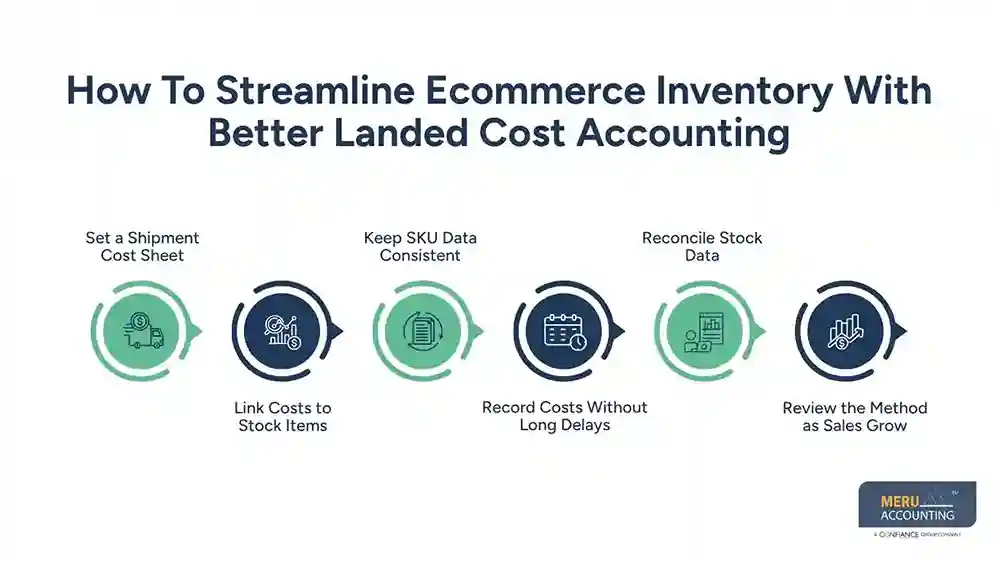
How To Streamline Ecommerce Inventory With Better Landed Cost Accounting
Set a Shipment Cost Sheet
Think of each shipment as its own cost file. List the purchase value, freight, duty, insurance, broker charges, and other eligible costs in one place. This gives accounting for ecommerce business a clear view of how the final unit cost was formed.
Link Costs to Stock Items
A freight bill sitting in an expense folder tells only part of the story. Link it to the shipment and related SKUs so the cost can be traced later. Ecommerce accounting becomes easier to review when the source and final inventory entry are connected.
Keep SKU Data Consistent
If the store calls an item “BLK-T001” while the warehouse calls it “Black Tee 1” and the accounting system uses “TEE-BLK,” matching can become messy. Consistent SKU data gives accounting for ecommerce business a cleaner path from purchase to sale.
Record Costs Without Long Delays
A month-old freight bill should not sit unnoticed while the related goods are being sold. Record key costs when the documents arrive, and the amount can be reliably assigned. This keeps current inventory and margin data more useful.
Reconcile Stock Data
The accounting system may show 2,000 units while the warehouse report shows 1,940. That difference deserves a check before the stock figure is used for reporting. Regular reconciliation gives accounting for ecommerce business a way to spot quantity and value gaps.
Review the Method as Sales Grow
A spreadsheet may work for a small seller with a few products. It can become hard to manage when thousands of SKUs and several warehouses enter the picture. Ecommerce accounting should be reviewed as the business adds products, suppliers, fulfilment centers, or sales channels.
optional anymore
on running the business
How Better Landed Cost Accounting Improves Inventory Valuation
Gives Stock a More Complete Cost
A product purchased for $10 may not have a true inventory cost of $10 if eligible direct costs add another $2. Accounting for ecommerce business can give the stock record a fuller cost when those amounts are properly assigned.
Reduces Large Cost Swings
Consider two months with similar sales. If a large freight bill is expensed all at once in one month, profit may fall sharply even though much of the stock has not sold. Recording eligible costs with inventory can place those costs closer to the sale of the related goods.
Keeps Cost of Goods Sold Clear
When a customer buys the product, its recorded inventory cost moves to cost of goods sold. This makes accurate unit cost a key part of accounting for ecommerce businesses and gross margin reporting.
Makes Slow Stock Easier to Review
A clear unit cost lets an owner compare stock value with current selling prices and expected recovery. If a product is sitting for a long time or its selling price has fallen, its recorded value may need further review under the applicable accounting rules.
Creates a Better Audit Trail
A reviewer should be able to ask, “Where did this $15 unit cost come from?” and find the answer. Supplier bills, freight records, customs documents, and allocation workings give accounting for ecommerce businesses a clear support trail.
Keeps Reports More Useful
Inventory reports are only as useful as the cost data behind them. Ecommerce landed cost accounting gives inventory, cost of sales, and margin reports a stronger base when the same method is used across shipments.
How Landed Cost Accounting Helps Ecommerce Businesses Track Profitability
Measure Product-Level Margin
A $40 sale does not mean $40 is available to cover other costs. If the landed product cost is $24, the product starts with a very different margin than one that costs $16. Accounting for ecommerce business makes this distinction visible.
Compare Products Fairly
Two products can both have a $10 supplier price while one costs $3 more to ship and import. Looking only at supplier price can hide that difference. Ecommerce accounting can bring the wider product cost into the margin review.
Check Channel Fees Separately
Amazon, Shopify, payment providers, and other channels may charge different fees. These costs affect the final result but should not automatically be mixed into inventory cost. Keeping them visible gives accounting for ecommerce business a clearer margin picture.
Find Margin Gaps
Suppose Product A sells for $30 and has a $12 landed cost, while Product B also sells for $30 but has a $19 landed cost. The sales value is the same, but the gross margin is not. Accurate cost data lets the business see that gap.
Plan New Purchases
Past shipment records can show how much freight and import costs added to a product. When the next purchase is planned, accounting for ecommerce business can provide useful historical cost data for the review.
Build Better Monthly Reports
A monthly report can show sales, landed product cost, returns, marketplace fees, and gross margin in one view. Ecommerce accounting becomes more useful when these figures can be traced back to reliable source data.
Why Choose Meru Accounting For Ecommerce Accounting?
Ecommerce businesses need more than basic transaction entry when inventory costs, freight, duties, sales, and platform fees affect reported profit. At Meru Accounting, we provide accounting for ecommerce businesses with a focus on accurate inventory costing and clear financial reporting.
Accurate Inventory Cost Tracking
We record product purchases and eligible costs such as freight, duty, insurance, and direct import charges. Our process gives each shipment a clear cost that can be traced back to its source records.
Better Landed Cost Management
Landed costs can change the actual cost of an ecommerce product by a large amount. We provide ecommerce landed cost accounting to assign eligible costs to inventory using a consistent and suitable method.
Clear Product Profitability
A sales figure alone does not show how much a product earns after its actual cost is recorded. Our accounting for ecommerce businesses brings product costs into financial reports so owners can review gross margins with better cost data.
Connected Ecommerce Records
Sales, refunds, purchases, fees, and inventory data may come from different systems. We organize these records through tools such as QuickBooks, Xero, Zoho Books, NetSuite, Odoo, and Power BI for clearer financial review.
Reliable Monthly Reporting
Our team provides accounting services covering inventory, sales, accounts payable, accounts receivable, payroll, tax, and financial reporting. This gives ecommerce businesses a structured process for keeping financial data current and ready for review.
Our Expert Perspective
A common issue we see in accounting for ecommerce businesses is a focus on sales while the cost side gets less attention. A store may report strong revenue, yet the margin can look very different once freight, duty, and other eligible direct costs are assigned to the goods.
In our view, ecommerce landed cost accounting should be part of the normal inventory process rather than a year-end exercise. A clear shipment record, consistent allocation method, and regular stock check can give ecommerce accounting a much stronger base for margin and inventory reporting.
Key Takeaways
- Accounting for ecommerce business should track the full cost of inventory, not just the supplier invoice.
- Landed cost may include the purchase price and eligible direct costs tied to bringing goods into saleable stock.
- Freight, duty, insurance, and some import charges need to be reviewed based on the rules that apply.
- A clear allocation method is needed when one cost covers several products.
- Shipment records should connect purchase invoices, freight bills, import records, and SKU data.
- Regular stock checks can reveal quantity and value differences before they affect reports.
- Accurate landed cost gives a clearer basis for product margin and cost of goods sold.
- Marketplace, payment, marketing, and other selling costs should be recorded according to their proper accounting treatment.
- Ecommerce accounting processes should be reviewed as product count and sales channels grow.
FAQs
Landed cost accounting records the full cost of bringing ecommerce inventory into saleable stock, including the purchase price and eligible costs such as freight, duty, and import charges.
Calculate landed cost by adding the product purchase cost and eligible direct costs, then dividing the total by the number of units to find the cost per unit.
Ecommerce landed cost accounting may include product cost, freight, customs duty, insurance, broker fees, and other eligible direct costs linked to bringing inventory into stock.
Landed cost affects inventory valuation because eligible costs are added to the cost of inventory, which can also affect cost of goods sold when the products are sold.
Landed cost affects ecommerce profit by changing the product cost used to calculate gross margin, giving accounting for ecommerce business a clearer view of actual product profitability.
optional anymore
on running the business