
Running an auto repair workshop is not only about fixing vehicles but also about managing costs, setting correct prices, and keeping labor expenses under control. Many workshop owners struggle because financial records are either incomplete or not structured properly. This is where accounting for mechanics becomes important.
When workshops follow proper accounting for mechanics, they can clearly understand job costs, labor usage, and profit per repair. Along with this, bookkeeping for mechanics ensures that every invoice, expense, and payment is recorded in a simple and accurate way.
Without these systems, pricing decisions often become guesswork, which can reduce profit over time. This blog explains how outsourced accounting creates better pricing strategies and helps manage labor costs in auto repair businesses.
What You Will Learn From This Blog
- How pricing becomes more accurate in auto repair shops
- Why is labor cost tracking important for workshops
- How financial records impact profit in repair businesses
- Role of accounting for mechanics in daily operations
- Importance of bookkeeping for mechanics in reducing errors
- How outsourcing reduces admin pressure
- How Meru Accounting supports mechanics with financial control
Introduction to Accounting For Mechanics and its Importance
Auto repair workshops deal with multiple cost layers in every job, including parts, labor, and overhead expenses. Without proper tracking, it becomes difficult for owners to understand the real profit from each service.
Accounting for mechanics helps break down these costs into a structured format, making it easier to evaluate job profitability and overall workshop performance. At the same time, bookkeeping for mechanics ensures that every transaction—such as invoices, supplier payments, and daily expenses—is recorded consistently and accurately.
This combination creates financial clarity by improving visibility into costs, pricing structure, and operational efficiency. Instead of relying on assumptions, workshop owners gain access to reliable financial data that supports better decision-making.
Over time, this structured approach helps identify profitable services, control unnecessary costs, and maintain stable business operations without relying on manual or incomplete records.
Financial Challenges In Auto Repair Businesses
Untracked Labor Hours
Mechanics often work on multiple jobs in a day, but hours are not always recorded correctly. This creates incorrect job costing. Accurate labor tracking becomes difficult when records are incomplete across shifts.
Irregular Expense Tracking
Parts and tools are purchased frequently, but without proper bookkeeping for mechanics, expenses remain unclear. Monthly cost review becomes complex when small purchases are not recorded properly.
Cash Flow Gaps
Delayed payments from customers create financial pressure on workshop operations. Salary payments and supplier dues often get delayed due to inconsistent incoming cash flow.
Incorrect Pricing Decisions
Without clear cost data, pricing is often based on assumptions instead of real numbers. Profit margins reduce when service rates do not reflect actual job costs.
High Administrative Workload
Workshop owners spend time on billing and records instead of business growth. Accounting for mechanics reduces this burden. Operational focus shifts back to repair quality and customer service.
Role of Accounting For Mechanics in Modern Workshops
Real-Time Financial Updates
With accounting for mechanics, workshops get updated reports that show income, expenses, and job profitability. Financial position across daily operations becomes easier to monitor without delays in reporting.
Structured Record Keeping
Bookkeeping for mechanics ensures that every transaction is properly recorded and easy to track. Records stay organized across invoices, supplier bills, and customer payments for quick reference.
Better Decision Making
Owners can identify which services generate higher profit and which need price adjustments. Pricing strategies become more aligned with actual workshop performance data.
Reduced Financial Errors
Manual mistakes in entries and billing are reduced through proper systems. Accuracy improves across job costing and financial summaries.
Growth Planning Support
Clear data helps workshop owners plan expansion and hiring decisions. Long-term planning becomes more stable with visible cost and revenue trends.
How Accounting For Mechanics Improves Pricing Strategy
Accurate Job Cost Breakdown
Every repair job includes labor, parts, and overhead costs. Accounting for mechanics separates each cost clearly for better control. An accurate breakdown helps avoid hidden losses in service pricing.
Better Pricing Decisions
When costs are known, pricing becomes more realistic and profitable. Accurate data supports stable pricing across different repair services. Pricing consistency increases trust and repeat customers.
Improved Market Position
Workshops can set prices based on actual cost instead of guesswork. Competitive pricing becomes easier with clear cost visibility. Better pricing structure strengthens position against local competitors.
Profit Margin Tracking
Bookkeeping for mechanics helps track profit from each job. Regular tracking highlights services with higher or lower margins. Profit trends guide better service adjustments over time.
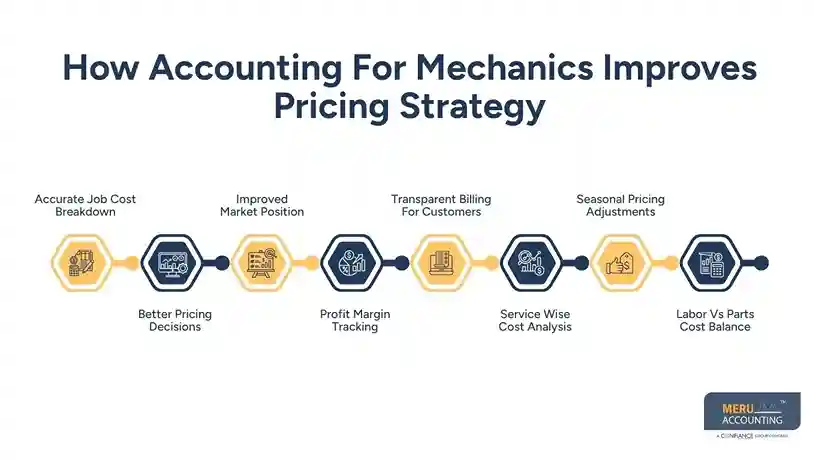
Transparent Billing For Customers
Clear invoices build trust and reduce disputes with customers. Customers gain confidence when charges are explained in detail. Transparency improves long-term customer relationships and loyalty.
Service Wise Cost Analysis
Each service type shows different cost patterns in workshop operations. Accounting for mechanics helps compare profitability across all services. Decision-making improves when service-level data is clearly available.
Seasonal Pricing Adjustments
Repair demand changes across seasons in auto workshops. Cost records support flexible pricing during peak and low demand periods. Revenue stability improves with timely pricing adjustments.
Labor Vs Parts Cost Balance
Labor and parts cost together define overall job profitability. Bookkeeping for mechanics separates both costs for clear analysis. Balanced cost control prevents profit loss in complex repairs.
Labor Cost Management Through Accounting For Mechanics
Tracking Mechanic Working Hours
Each technician’s time is recorded properly to calculate real labor cost. Accurate time logs help match work effort with job billing correctly.
Fair Wage Calculation
Accounting for mechanics helps set fair wages based on actual workload. Wage structure becomes more balanced when effort and output are measured properly.
Avoiding Overstaffing Costs
Financial reports show whether the workshop has too many staff members for the workload. Staffing decisions improve when workload trends are reviewed regularly.
Productivity Analysis
Owners can identify which mechanics complete more jobs efficiently. Performance comparison becomes easier across different technicians and shifts.
Cost Per Job Evaluation
Bookkeeping for mechanics helps calculate the exact labor cost per repair job. Job costing becomes more precise with structured labor tracking systems.
Overtime Cost Monitoring
Extra working hours directly impact workshop labor expenses each week. Monitoring overtime helps prevent unnecessary wage pressure on profit margins.
How Accounting For Mechanics Reduces Administrative Burden
Less Manual Paperwork
Invoices, receipts, and bills are recorded digitally instead of in manual registers. Paper-based errors are reduced when digital systems handle daily entries.
Faster Financial Reporting
Reports are generated quickly without manual calculations. Real-time summaries support quicker review of workshop performance.
Reduced Owner Workload
Owners can focus on repair quality instead of record-keeping. Time savings allow better attention to customer service and workshop growth.
Better Data Storage
Financial data is safely stored and easy to access anytime. Organized storage reduces the risk of missing or damaged records.
Easier Tax Preparation
Accounting for mechanics ensures all records are ready for tax filing. Clean records simplify audits and reduce filing stress during tax season.
How Meru Accounting Supports Mechanics With Financial Control
Meru Accounting provides structured financial solutions designed specifically for auto repair businesses. The goal is to simplify accounting for mechanics so workshop owners can focus on operations instead of financial confusion. Reliable systems reduce financial stress and improve day-to-day clarity in decision-making.
Industry Specific Setup
We design accounting systems based on workshop operations, ensuring accurate job costing and reporting. Each setup matches real workshop workflows for better financial accuracy.
Dedicated Bookkeeping Support
Our team manages bookkeeping for mechanics to ensure all transactions are recorded properly. Regular updates keep financial records clean and easy to review anytime.
Labor And Cost Tracking
We provide detailed reports on labor cost, parts usage, and job profitability. Cost breakdowns help identify profitable and low-margin services clearly.
Payroll Management
Mechanic salaries, overtime, and incentives are tracked in a structured way. Payroll accuracy improves employee satisfaction and reduces payment disputes.
Long-Term Financial Planning
We help workshops use financial data for growth and expansion planning. Strategic insights support better decisions for hiring, investment, and scaling operations.
Our Expert Perspective
In many workshops, pricing is decided based on experience rather than actual cost data. This often leads to profit leakage. When accounting mechanics are applied correctly, it brings clarity in job costing and pricing decisions.
We have observed that even small improvements in bookkeeping for mechanics, such as proper labor hour tracking, can increase profit margins over time. Financial control is not about complexity; it is about consistency.
Key Takeaways
- Proper financial tracking is essential for workshop profit
- Labor cost must be recorded per job, not estimated
- Pricing becomes accurate with structured cost data
- Accounting for mechanics reduces financial errors
- Bookkeeping for mechanics improves record accuracy
- Better financial data leads to stronger business decisions
- Outsourcing reduces administrative pressure
FAQs
Clear job cost details allow owners to set accurate and fair prices. Pricing decisions become more stable when based on real operational data.
Small workshops gain strong benefits from cost tracking and error reduction. Financial clarity improves even when operations are limited in size.
Manual work decreases significantly while focus shifts toward service quality. Time savings allow owners to manage operations and customer service more effectively.
Invoices, supplier bills, labor time sheets, and payment records are essential for smooth daily operations.
By maintaining structured records and reviewing transactions regularly instead of relying on memory or manual notes.