Mining work runs on high costs, strict rules, and fast changes in cash flow. Many firms now look for better ways to handle books and reports. This is where accounting for mining industry plays a key role. It helps track costs, manage risk, and support better choices on-site and off-site. It also gives leaders a clearer view of financial pressure before it becomes a problem.
In the past, most mining firms kept full finance teams in-house. But today, many are moving toward outside help. This shift is not just about cost. It is about skill, speed, and clear data.
Outsourcing accounting for mining industry tasks lets firms focus more on core work like digging, transport, and safety. It also helps reduce errors and late reports. In a field where small mistakes can lead to large losses, this change matters a lot. It also helps companies stay more flexible when market prices shift quickly.
This blog explains why mining firms are making this move and how it improves daily work and long-term plans.
What You Will Learn From This Blog
In this blog, you will learn:
- Why mining firms outsource finance work
- What does mining accounting mean in the real world
- Key tasks that firms send to outside teams
- Main benefits of outsourcing accounting systems
- How does it help with rules and risk control
- Best ways firms manage finance support today
- Real use cases across mining groups
- How outsourcing supports long-term financial stability
By the end, you will see how accounting for mining industry supports strong growth and steady control. You will also understand why more companies now treat it as a core part of operations instead of a support function.
What Is Mining Accounting and Why It Matters
Mining accounting is the system used to track all money flow in mining work. It covers costs for tools, staff, fuel, land use, and output value. It also tracks losses, gains, and tax needs. This type of work is more complex than normal finance tasks. Mining sites often run in remote zones. Costs change fast based on fuel, labor, and output levels.
That is why accounting for mining industry is not just basic bookkeeping. It needs strong data tracking and cost split by site, machine, and project. It also requires strong control over large asset bases that lose value over time.
Mining accounting matters because:
- It shows real profit per site
- It tracks the use of high-cost tools
- It helps control waste
- It supports tax and legal reports
- It improves long-term planning accuracy
Without it, firms risk poor planning and weak cost control. Over time, this can directly affect project survival and investor trust.
Core Accounting Functions Mining Companies Commonly Outsource
Many mining firms now send key finance tasks to outside teams. This helps them save time and improve data quality.
Common outsourced tasks include:
- Payroll for field workers and staff
- Cost tracking for fuel and tools
- Invoice handling and billing
- Monthly and yearly reports
- Tax filing and compliance checks
- Asset tracking for machines
These tasks are core to accounting for mining industry, but they do not always need to be handled on site.
By outsourcing, firms reduce pressure on in-house teams and get faster updates. This also helps when sites are spread across large areas. It also ensures that reporting stays consistent even when operations expand across regions.
In many cases, mining accounting teams use cloud tools to give real-time data. This helps managers make fast calls on spending and output. It also reduces the risk of outdated reports affecting decisions.
Key Benefits of Outsourcing Accounting for Mining Industry Functions
Outsourcing brings many clear gains for mining firms. It is not only about saving money. It is also about better control and fewer errors.
Main benefits include:
Lower Costs
Firms do not need large in house finance teams. This reduces pay, training, and office costs. It also helps turn fixed costs into flexible service costs.
Better Accuracy
Outside experts focus only on accounting for mining industry, which reduces mistakes. They also follow structured review systems that improve data quality.
Faster Reports
Data is updated in real time. This helps leaders act fast. It also supports better planning for fuel, labor, and equipment use.
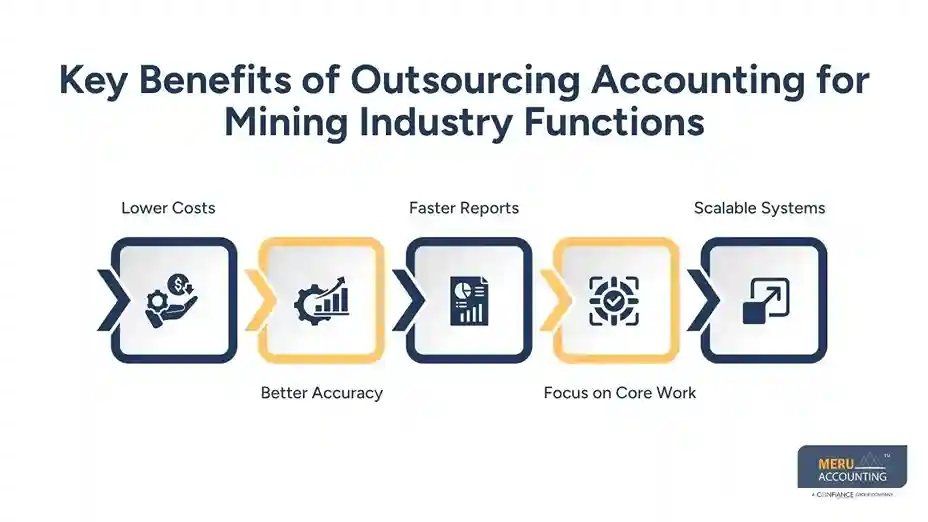
Focus on Core Work
Teams can focus on mining work instead of paperwork. This improves site efficiency and reduces management load.
Scalable Systems
As projects grow, outside teams can scale work fast. This is useful when new sites open or production increases suddenly.
These gains make mining accounting more stable and useful for daily decisions. Over time, they also improve investor confidence and financial clarity.
How Mining Accounting Improves Compliance and Risk Management
Mining firms must follow strict rules. These include tax laws, safety rules, and land use laws. Missing any rule can lead to fines or delays.
Good accounting for mining industry helps firms stay on track by:
- Keeping clear audit records
- Tracking tax payments on time
- Logging all site costs
- Supporting legal reports
- Reducing fraud risk
With strong mining accounting, firms can also spot risks early. For example, sudden cost jumps can show waste or theft. It also helps managers see patterns that may signal equipment failure or overspending.
It also helps with audits. When records are clear, audits move faster and more smoothly. This reduces downtime and avoids disruption in operations.
Best Practices for Effective Insurance Reimbursement Management
Mining work often includes insurance claims for damage, delays, or equipment loss. Good handling of these claims is key to stable cash flow.
Best practices include:
- Keep full records of all damage events
- File claims as soon as issues happen
- Match claims with clear cost data
- Track claim status in real time
- Work with finance teams for proof checks
Strong systems in this area support accounting for mining industry by keeping funds stable after losses. It also ensures that companies recover costs faster and avoid long payment gaps.
When firms combine mining accounting with insurance tracking, they reduce delays in fund recovery and improve cash flow control. This creates a stronger financial safety net during operational risks.
Meru Accounting's Bookkeeping Services for Dentists
At Meru Accounting, we support many industries with clean and simple bookkeeping systems. While mining is a complex field, we also provide structured support for other sectors, including healthcare.
Our bookkeeping services for dentists include:
- Daily income and cost tracking
- Insurance claim support
- Payroll handling
- Tax report prep
- Clean monthly statements
Even though this is outside mining, it shows our skill in handling strict financial systems. The same care and structure used in dental services is also used in accounting for mining industry projects. This experience helps us maintain accuracy even in high-pressure environments.
This cross-industry skill helps us bring clear systems to complex work like mining accounting. It also allows us to adapt methods based on industry needs.
Our Expert Insight
From our view at Meru Accounting, mining firms face one main issue: data delay. When reports come late, decisions also slow down.
This is why outsourcing is growing fast. It gives firms live access to numbers, cost flow, and output data.
We see that accounting for mining industry works best when:
- Data is updated daily
- Costs are split by site
- Reports are simple and clear
- Tools are cloud-based
In many cases, firms using mining accounting outsourcing see better cost control within months. They also gain stronger forecasting ability and fewer financial surprises.
The key is not just outsourcing, but choosing a team that understands mining flow and risk.
Key Takeaways
- Mining finance is complex and costly
- Accounting for mining industry helps track all key costs
- Outsourcing reduces cost and improves speed
- Mining accounting improves risk control and planning
- Insurance handling supports cash flow stability
- Clear data helps make better decisions
- Outsourcing is now a strong trend in mining
FAQs
It is the process of tracking all financial activity in mining work. It includes cost, income, tax, and asset control for mining sites.
They use them to reduce cost, improve accuracy, and get faster reports. It also helps with complex site-based tracking.
Tasks include payroll, cost tracking, tax work, billing, asset control, and financial reports. It also includes compliance tracking for mining operations.
Yes. It is safe when firms use trusted partners and secure cloud tools. It also improves data control and audit readiness.
It gives clear cost data, improves planning, and helps reduce waste. This supports long-term growth and profit control. It also helps companies invest more confidently in new sites.