
Fast-growing companies deal with rising transaction volume, expanding teams, and more complex financial records, which highlights the increasing advantages of accounting software in managing financial complexity at scale.
Manual records and basic spreadsheets often fall short when speed and accuracy matter at the same time. In such situations, a structured financial system becomes a key part of financial control.
As companies expand, financial data increases across sales, expenses, payroll, taxes, and vendor payments. Without a clear system, errors can grow quickly, and decision-making becomes slow. A digital accounting system organizes financial data into a structured flow and provides a clear, real-time understanding of a business’s financial position.
Modern businesses rely on real-time financial tracking, which is one of the key advantages of accounting software, to manage growth with fewer errors.
This blog explains how a digital accounting system helps streamline complex financial processes and why scaling companies rely on it for stronger financial control and improved decision-making.
What You Will Learn From This Blog
- Why do growing companies face financial tracking problems
- How accounting systems bring structure to financial data
- Key benefits that support business growth and control
- Ways financial systems improve cash flow clarity
- How different departments stay connected through one system
- Common financial problems solved by accounting tools
- How expert accounting support adds value in setup and use
The Role of the Accounting System in Modern Business
Centralized Financial Data System
With modern digital tools, financial data such as sales, expenses, invoices, and payroll is brought together in one system, creating a unified setup for easier management. Dispersed records are eliminated, resulting in a clearer and more complete view of overall finances.
Real-Time Record Updates
Transactions are reflected in the system immediately after they occur. Managers access updated financial status without depending on delayed manual reports.
Automated Entry Process
Repeated entries such as monthly bills and regular payments get recorded automatically. Manual workload is reduced, and accuracy improves across records.
Better Financial Control
One of the key advantages of accounting software is that income, expenses, and profit patterns stay visible in a structured format. Financial decisions become more controlled and based on clear data.
Simplified Reporting Structure
Advantages of accounting software appear clearly in reporting systems that generate profit and loss statements, balance sheets, and cash summaries quickly. Audit preparation and internal reviews take less time and effort.
Why Financial Management Becomes Challenging as Companies Grow
Higher Transaction Volume
As companies expand, daily transactions rise at a rapid pace. Manual systems often fail to manage this growing volume, which leads to delays and missing entries.
Multi-Department Complexity
Sales, HR, and operations teams generate separate sets of financial data. Lack of integration creates gaps when combining records into a single financial view.
Risk of Human Error
Manual data entry increases the chances of mistakes in invoices, payroll, and tax records, which highlights the advantages of accounting software in reducing human error. Even small errors can create confusion in overall financial reporting.
Delayed Reporting Issues
Financial reports take longer to prepare when systems are not structured. Slow reporting affects decision-making that depends on timely and accurate data.
Difficulty In Tracking Cash Flow
Growing companies often struggle to monitor incoming and outgoing cash flow clearly. Gaps in tracking reduce financial clarity and planning accuracy.
Key Advantages of Accounting Software for Fast-Growing Companies
Improved Accuracy In Financial Records
Modern financial system reduces manual entry work and applies consistent logic to financial data, which is one of the core advantages of accounting software for improving overall accuracy in financial records.
Faster Financial Decision Making
When data is available in real time, managers can make quicker decisions. This is important for companies expanding into new markets or services.
Better Cost Tracking
Businesses can track expenses across departments, projects, or clients. This makes it easier to identify high-cost areas and adjust spending plans.
Strong Compliance Management
Tax rules and financial regulations change often. Accounting systems help maintain proper records that match compliance needs and reduce reporting risks.
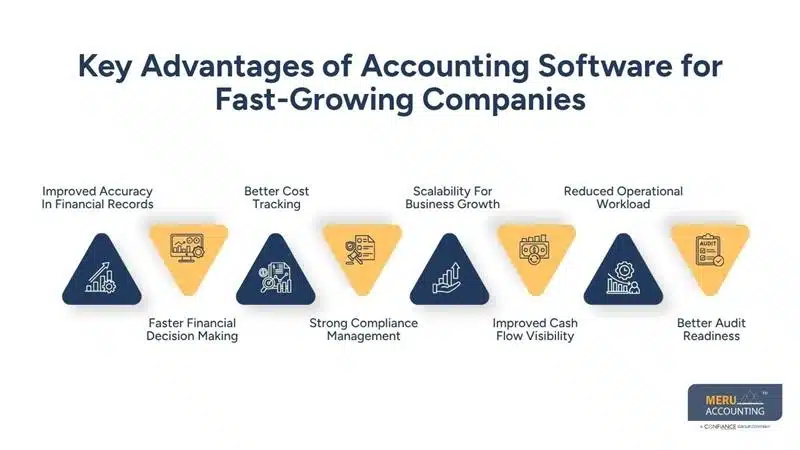
Scalability For Business Growth
As business volume increases, the system can handle more transactions without major changes, which are other core advantages of accounting software for scaling companies. This allows companies to grow without financial disruption.
Improved Cash Flow Visibility
Clear tracking of incoming and outgoing funds gives better control over cash position. Financial gaps become easier to identify before they create pressure.
Reduced Operational Workload
Automation of repetitive tasks such as invoicing and reconciliation reduces manual workload. Finance teams gain more time for analysis and planning.
Better Audit Readiness
Organized financial records simplify audit preparation. Clean data storage reduces stress during internal and external financial reviews.
How Digital Financial Systems Improve Cash Flow Tracking and Future Planning
Clear Cash Position Tracking
A major advantage of accounting software is that businesses gain a clear view of available cash at any point in time. Spending decisions become more controlled as cash limits stay visible.
Payment Cycle Monitoring
Payment schedules for customers and vendors are tracked within a single system, demonstrating the advantages of accounting software in improving financial discipline. Financial planning improves through better control of due dates and obligations.
Forecasting Based on Data Trends
Historical financial records help estimate future income and expenses. Planning becomes more stable during both high and low revenue periods.
Reduced Payment Delays
Automated reminders for pending invoices encourage faster customer payments. Cash flow stability improves through timely collections.
Expense Planning Control
Companies plan future expenses based on expected income levels. Financial pressure reduces during slow revenue cycles through better preparation.
How Integrated Financial Management Improves Coordination Across Multiple Departments
Unified Data Sharing
All departments work on a single financial system for recording transactions. Duplication and confusion reduce as data remains consistent across teams.
Project-Based Tracking
Income and expenses can be tracked for each project or department separately, another key advantages of accounting software for detailed financial visibility. Clear visibility helps identify profitable and high-cost areas.
Better Communication Between Teams
Finance teams can share reports quickly with other departments. Coordination improves as financial updates become accessible without delay.
Standardized Financial Process
Each department follows the same accounting structure for recording data. Consistency improves across all financial entries in the company.
Simplified Budget Allocation
Budgets can be assigned and monitored at the department level. Overspending risks are reduced as financial limits stay clearly defined.
Common Challenges Addressed by Modern Financial Management Tools in Scaling Businesses
Missing or Duplicate Entries
Automation reduces the risk of repeated or missing transactions in records. Clean data entry improves overall financial accuracy across all accounts.
Slow Financial Reporting
One of the major advantages of accounting software is that reports are generated quickly without manual calculations, saving time for finance teams and improving efficiency. Faster reporting supports timely business decisions and planning.
Inaccurate Expense Tracking
All expenses are recorded systematically, reducing confusion in cost management. Better tracking helps identify unnecessary or high-value spending patterns.
Difficulty in Tax Preparation
Organized records make tax filing easier and reduce last-minute workload. Accurate data reduces the chances of errors during compliance filing.
Lack of Financial Visibility
Business leaders can view financial data clearly and make informed decisions, which highlights the advantages of accounting software in improving financial visibility. Improved visibility supports better planning and long-term financial control.
Why Growing Companies Trust Meru Accounting for Financial Clarity
Structured Setup for Scaling Needs
Meru Accounting works with fast-growing companies to set up financial systems that match their size and growth stage by utilizing the advantages of accounting software for structured financial management.
The focus is on building clear record structures that can handle increasing transaction flow without confusion.
Smooth Migration From Existing Systems
Many companies move from tools like QuickBooks, Xero, or NetSuite when they scale, seeking the advantages of accounting software that better support higher complexity and volume.
Meru Accounting ensures that data transfer is handled with care so that no financial record is lost or misaligned during the shift.
Industry-Based Financial Design
Different industries follow different financial patterns. Meru Accounting designs accounting structures based on business type, which helps in better reporting and more accurate financial tracking across departments.
Error Reduction Through Clean Processes
Our team of certified experts focuses on reducing manual errors by setting up proper workflows. This improves accuracy in invoices, expense records, and financial reports, especially in high-volume businesses.
Better Visibility for Decision Making
Clear financial reports are created to help business owners understand cash flow, costs, and profit trends. This makes planning easier during expansion phases and reduces uncertainty in financial decisions.
Long-Term Support for Growth
Meru Accounting does not stop at setup, ensuring clients continue to benefit from the long-term advantages of accounting software as they scale.
Ongoing support is provided so companies can manage financial complexity as they grow, ensuring systems remain stable even with higher workload and expansion.
Our Expert Perspective
From our experience working with growing companies, we see that financial confusion often appears when transaction volume increases faster than the systems in place, highlighting why understanding the advantages of accounting software is critical during scaling.
Businesses that set up structured financial processes early tend to avoid reporting delays and cash flow issues later.
A well-planned financial system does more than record numbers—it brings clarity to planning, supports better decisions, and reduces uncertainty during expansion, helping companies manage growth in a more stable and controlled way.
Key Takeaways
- Growing companies face financial complexity due to rising transactions
- Manual systems are not suitable for scaling operations
- Accounting systems improve accuracy and reduce errors
- Cash flow becomes easier to track and forecast
- Multi-department financial integration increases control
- Financial reporting becomes faster and more reliable
- Structured systems reduce tax and compliance pressure
- Expert accounting support adds value during setup and scaling
FAQs
Fast growth increases financial data volume, and this is where the advantages of accounting software become especially important for structured financial management.
No, most systems allow easy data migration. With proper support, the transition becomes smooth and safe.
Real-time tracking, automated reporting, multi-user access, and clear dashboards are essential for handling increasing financial data with ease.
Structured entry formats, approval checks, and consistent data recording across all departments help reduce mistakes in financial reporting.
Modern systems track each branch separately while combining all data to provide a complete view of overall business performance.