
AI-based accounting tools are changing how small firms manage their books. An AI Bookkeeper is now used by many founders to reduce manual work, track money flow, and keep records clear. As more small firms adopt smart systems, AI bookkeeping for small businesses has become a key part of daily finance handling.
Today, business owners want faster records, fewer errors, and better control over cash. An AI-driven system is helping them reach this goal with less effort and more clarity.
This blog explains how AI bookkeeping for small business systems works, why they matter, and how small firms can use them for stable growth.
These tools also bring a shift in how financial decisions are made inside a business. Instead of waiting for monthly reports or manual summaries, owners can now view updated financial data in real time. This allows quicker reactions to cash gaps, expense spikes, or revenue changes, which is important for small businesses that operate with limited buffers.
What You Will Learn From This Blog
- How AI-based bookkeeping systems work in real business use
- Why small firms are shifting from manual records to AI bookkeeping for small business tools
- Ways AI reduces errors in daily accounting tasks
- How automation saves time in invoicing and reporting
- Security and compliance points every business must know
- Practical examples of AI use in small business finance
Understanding the Role of an AI Bookkeeper in Modern Businesses
Automated Transaction Sorting
AI systems read bank feeds and automatically classify transactions into the right accounts. Manual posting work is reduced significantly, and financial records stay more structured and consistent.
Real-Time Financial Tracking
Income and spending updates from an AI bookkeeper appear instantly in the system. Business owners gain continuous visibility into cash movement, which allows faster and more informed decisions.
Pattern Detection In Spending
Unusual or irregular spending behavior can be detected through data patterns. Business owners gain early alerts on possible waste or financial leakage, allowing corrective action at the right time.
Reduced Manual Workload
Data entry, reconciliation, and repetitive bookkeeping tasks shift to automation. Finance teams can then spend more time reviewing reports and analyzing performance instead of handling routine entry work.
Cloud-Based Access
Most systems operate on cloud platforms, allowing financial data access from anywhere. Remote teams and multi-location businesses benefit from this flexibility without delays or data loss.
How an AI Bookkeeper is Changing Bookkeeping For Small Business Growth
Faster Data Processing
An AI bookkeeper processes large volumes of transactions in seconds. Small firms close books faster every month with reduced backlog during peak activity periods. Faster processing also keeps financial records consistently updated without delays.
Better Cash Flow Control
Owners track money in and out on a daily basis. Better visibility over cash movement allows more accurate spending decisions and planning. Short-term cash gaps become easier to identify and manage in advance.
Clear Financial Visibility
Reports generated by an AI bookkeeper appear in real time. Business owners no longer wait for end-of-month updates. Continuous reporting also reveals early trends in revenue movement and cost changes.
Reduced Dependency On Manual Staff
Manual bookkeeping tasks reduce significantly, lowering operational pressure on internal teams. More time becomes available for financial review and performance analysis instead of repetitive data entry.
Easier Business Scaling
As transactions grow, systems adjust without requiring large finance teams. Business expansion becomes easier without matching growth in accounting workload or staffing needs.
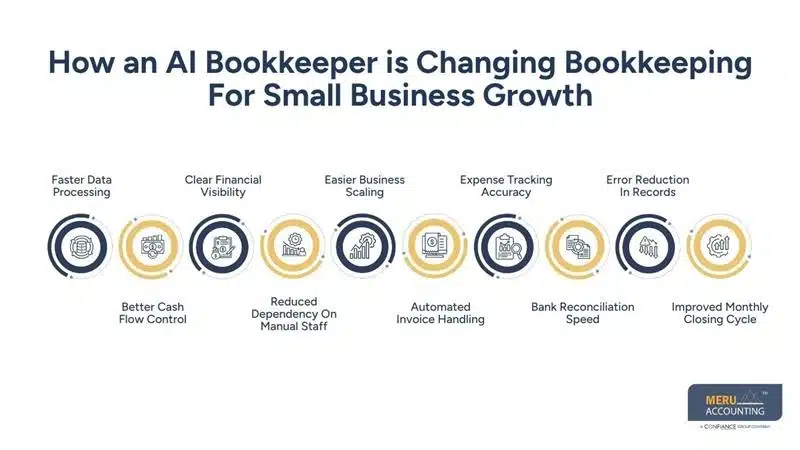
Automated Invoice Handling
Invoices are created and recorded automatically by an AI bookkeeper based system using sales data. Billing cycles become faster and customer records stay consistently updated without manual effort.
Expense Tracking Accuracy
Every expense gets captured and categorized in real time. Record accuracy increases while the risk of missing or duplicate entries reduces significantly.
Bank Reconciliation Speed
An AI bookkeeper matches bank transactions with internal records quickly. Month-end closing cycles shorten, and reconciliation workload becomes more manageable.
Error Reduction In Records
Automation reduces human entry mistakes in financial data, especially in AI bookkeeping for small business systems where transaction volume is high. Financial records remain cleaner, and fewer corrections are required during audits.
Improved Monthly Closing Cycle
Financial closing becomes faster and more consistent. Final reports become available without long waiting periods, improving overall financial control.
How Does AI Bookkeeping Improve Accuracy, Speed and Financial Decision Making
Error Reduction In Data Entry
AI reduces typing mistakes by using automated capture methods from bank feeds and invoices. Data validation checks run in the background to catch inconsistencies before they enter final records.
Faster Report Generation
Financial statements in AI bookkeeping for small business platforms can be created within minutes instead of days. Real-time data processing allows reports to reflect the latest financial position without manual compilation delays.
Smart Classification Of Expenses
An AI bookkeeper classifies transactions correctly based on past data patterns. Continuous learning from historical entries increases classification accuracy over time and reduces mislabeling of expenses.
Better Forecasting Ability
Systems use past data to predict future cash needs. Forecast models adjust based on seasonal trends and spending behavior to give more stable financial estimates.
Strong Decision Support
Owners using AI bookkeeping for small business tools get clearer reports that help them decide on hiring, pricing, and investment plans. Structured financial insights highlight cost trends and profit patterns that support more grounded business decisions.
What are the Real Benefits of Using an AI Bookkeeper for Daily Accounting Tasks
Time Saving In Daily Work
Tasks like entry posting and reconciliation are handled faster with an AI bookkeeper. Daily accounting workload reduces significantly, allowing teams to focus on review instead of repetitive processing.
Lower Operational Cost
Less need for large bookkeeping teams reduces cost pressure. Resource allocation becomes more efficient since fewer manual hours are required for routine accounting tasks.
Easy Tax Preparation
Organized records maintained by an AI bookkeeper make tax filing smoother and less stressful. Clean financial data reduces the time needed for document sorting during filing periods.
Improved Financial Discipline
Regular updates in AI bookkeeping for small business systems help owners stay alert about spending habits. Continuous monitoring encourages more controlled spending decisions throughout the month.
Scalable System For Growth
As the business grows, the system handles more data without slowing down. Expansion in transaction volume does not require proportional increases in accounting effort.
How Does AI Bookkeeping Automate Invoicing, Expense Tracking and Reporting
Automatic Invoice Creation
In AI bookkeeping for small business tools, invoices can be generated based on sales records without manual input. Billing data flows directly from sales entries into invoice formats with minimal delay.
Expense Tracking From Receipts
Receipts are scanned and data is extracted automatically. Optical recognition tools capture key details like amount, date, and vendor with high consistency.
Bank Reconciliation Automation
Bank transactions are matched with accounting records quickly. Matching rules reduce manual checking and speed up month-end closing work.
Real Time Reporting Dashboards
Dashboards powered by an AI bookkeeper system show profit, loss, and cash flow instantly. Updated figures reflect ongoing transactions without waiting for manual report preparation.
Recurring Payment Handling
Monthly bills and subscriptions are tracked without manual reminders. Payment cycles remain organized, reducing missed due dates and late fees.
Why is AI Bookkeeping Becoming Essential For Scaling Small Businesses in 2026
Rising Data Volume
Small firms now rely on an AI bookkeeper as they handle more transactions due to online sales growth. Manual systems struggle to manage increasing entry loads without delays or errors.
Need For Fast Decisions
Owners need quick financial data to respond to market changes. Faster access to numbers allows quicker reactions to pricing, hiring, and spending adjustments.
Remote Work Systems
Teams need cloud-based access to financial records. Distributed teams can review and update accounts without depending on a single office setup.
Cost Pressure On Businesses
An AI bookkeeper reduces the need for large accounting teams by automating repetitive tasks, helping businesses control fixed monthly expenses more effectively.
Demand for Real-Time Insights
Businesses want live financial updates instead of delayed reports. Continuous updates make it easier to monitor performance trends throughout the month.
How Meru Accounting Supports Businesses With AI-Based Bookkeeping
Meru Accounting provides structured bookkeeping and accounting services designed for small and mid-sized firms. Our team works with AI-based tools to manage records, improve accuracy, and maintain financial clarity.
We combine human review with smart systems to reduce errors and keep books audit-ready. Businesses that work with us gain:
- Clean and structured financial records
- Faster monthly closing cycles
- Clear cash flow reporting
- Support for multi-state and global operations
- Tax-ready financial statements
Our approach is built for startups, service firms, and growing companies that want stable financial systems without heavy internal workload.
Our Expert Perspective
At Meru Accounting, we have seen that an AI bookkeeper delivers the highest value when combined with strong accounting oversight and compliance-focused processes. For US and global businesses, aligning AI-generated financial data with standards like US GAAP and IRS reporting requirements is critical for accuracy and audit readiness.
Our experience shows that businesses adopting AI bookkeeping with expert supervision achieve faster closes, fewer compliance risks, and more reliable financial insights for decision-making.
Key Takeaways
- AI bookkeeping for small businesses reduces manual accounting work and improves overall financial efficiency
- Small businesses gain faster financial visibility
- Automation improves accuracy in daily records
- Real-time data helps in better decision-making
- Security and compliance are key parts of modern systems
- AI tools make scaling easier for growing firms
FAQs
AI bookkeeping is suitable for startups, freelancers, eCommerce stores, service firms, and small to mid-sized businesses. It works best where there are frequent transactions and the need for real-time tracking.
Most systems use encryption and secure access controls to protect financial data from unauthorized access and misuse.
No, an AI bookkeeper cannot fully replace accountants. It handles routine tasks like data entry, transaction sorting, and report generation, but human accountants are still needed for tax planning, compliance checks, and financial strategy.
Small startups benefit from faster processing and lower-cost accounting systems, making financial tracking easier from early stages.
Financial reports are generated quickly using live data, reducing waiting time and minimizing manual errors in reporting.