
Bookkeeping for wholesalers plays a direct role in how correctly a business measures stock value, profit, and real financial position. In wholesale trade, where goods move in large volumes and prices change often, even small recording mistakes can lead to wrong inventory value and profit errors. This is why bookkeeping for wholesalers is not only a record-keeping task but a control system for stock and cost accuracy.
When maintained in a structured way, wholesalers can easily track purchases, sales, returns, and stock adjustments without confusion. This also reduces gaps between physical stock and recorded stock, which is a common issue in wholesale supply chains.
What You Will Learn From This Blog
- How inventory valuation works in wholesale businesses
- Why bookkeeping accuracy affects profit and stock value
- Methods used to value inventory in wholesale trade
- Common errors that reduce financial clarity
- How expert support can improve stock control
What is Inventory Valuation in Wholesale Businesses?
Definition of Inventory Valuation
Inventory valuation is the process of assigning a monetary value to stock held by a business. For wholesalers, this includes bulk goods stored in warehouses or in transit. Bookkeeping for wholesalers ensures each unit is recorded at the correct cost.
Role Of Purchase Tracking
Every purchase invoice affects inventory value. When purchase data is recorded properly and on time, stock value remains updated and reflects real business activity.
Impact On Financial Reporting
Inventory value directly affects profit statements and balance sheets. Incorrect or incomplete data can distort net income and lead to misleading financial results.
Importance In Bulk Operations
Wholesale businesses deal with large batches of goods, so even small recording errors can multiply quickly and create significant valuation differences.
Connection With Stock Accuracy
Accurate valuation depends on matching physical stock with records. Without proper bookkeeping for wholesalers, discrepancies between the warehouse and books become common.
Understanding the Importance of Bookkeeping For Wholesalers in Modern Supply Chains
Real-Time Stock Visibility
Modern supply chains demand updated stock information. Bookkeeping for wholesalers ensures real-time visibility of stock movement across locations.
Reduction of Stock Errors
Errors in stock entry can create financial gaps and reporting issues. When records are maintained consistently, such mistakes are identified early and corrected before they affect valuation.
Better Supplier Coordination
Supplier payments and purchase tracking depend on clear financial records, which are often strengthened through accounting services for wholesale businesses. Strong record-keeping helps maintain trust, ensures timely settlements, and improves vendor relationships.
Demand Planning Accuracy
Wholesale demand planning depends heavily on past sales data. Proper records provide clear insights into buying patterns, helping businesses plan future inventory more effectively.
Warehouse Efficiency Improvement
Warehouse operations rely on accurate stock logs. When records are properly structured, storage, movement, and dispatch processes become more organized and efficient.
How Bookkeeping Impacts Cost Of Goods Sold (COGS)
Direct Cost Calculation
COGS is calculated using purchase and stock data. All cost inputs must be recorded correctly to ensure accurate cost measurement and financial reporting.
Purchase Price Tracking
Fluctuating supplier prices can affect profit margins. Maintaining accurate purchase records ensures exact values are captured for proper COGS calculation in bookkeeping for wholesalers, often managed through outsourced accounting services.
Handling Freight And Additional Costs
Shipping and handling costs also form part of inventory cost. These additional expenses must be included properly in the valuation to reflect the true cost of goods.
Adjusting For Returns And Damages
Returned or damaged goods must be recorded correctly. With bookkeeping for wholesalers, these adjustments are reflected in COGS.
Profit Margin Clarity
When COGS is accurate, profit margins become clearer. Strong and consistent financial recording reduces the chances of misreporting earnings and improves overall financial transparency.
Methods of Inventory Valuation Supported By Bookkeeping Systems
FIFO Method
First In First Out ensures older stock is valued first. In bookkeeping for wholesalers, this method relies on accurate purchase timelines and consistent record tracking to maintain correct valuation flow.
LIFO Method
Last In First Out is used in specific markets. Without proper financial records, applying this method becomes difficult and prone to inconsistency in valuation results.
Weighted Average Method
This method calculates the average cost per unit. Accurate bookkeeping for wholesalers is required for consistent cost tracking.
Specific Identification Method
Each inventory item is tracked and valued individually. Detailed records help avoid confusion between similar product units. It is commonly used for high-value or unique items.
Standard Cost Method
Pre-set costs are used for inventory valuation purposes. Differences between actual and standard costs are tracked separately. This helps maintain control over cost variations and reporting.
Best Practices For Accurate Bookkeeping In Wholesale Operations
Daily Transaction Recording
Recording daily sales and purchases reduces errors. No transaction should be missed during routine updates. Consistent entry habits improve overall financial accuracy and control.
Stock Reconciliation Routine
Regular matching of physical and book stock is essential. Bookkeeping for wholesalers supports accurate reconciliation.
Use Of Digital Systems
Software-based recording, especially when implemented through accounting services for wholesale businesses, reduces manual mistakes significantly. Automated tools improve speed and data consistency. Digital systems also help manage large transaction volumes easily.
Supplier Invoice Verification
Checking invoices before entry prevents costly recording errors. Every detail should match the purchase agreements and terms. This step improves accuracy in cost and payment records.
Regular Financial Review
Periodic review ensures data accuracy across all records. Errors are identified and corrected at early stages. This maintains consistency in financial reporting and analysis.
How Bookkeeping for Wholesalers Ensures Accurate Inventory Valuation and Better Financial Control
Clear Link Between Stock And Finance
Bookkeeping for wholesalers connects inventory movement directly with financial records, ensuring that every purchase and sale is reflected in valuation without delay.
This connection also reduces gaps between warehouse records and accounting books, improving overall financial clarity.
Reduction In Valuation Errors
When records are maintained properly, it reduces the overstatement or understatement of inventory value, which often affects profit reporting. It also helps avoid repeated correction entries that can slow down month-end closing.
Better Control Over Cost Flow
Strong record-keeping helps track how costs move from purchase to storage to sale, giving a clear view of total cost flow. This makes it easier to identify where costs increase and where efficiency can be improved.
Improved Profit Monitoring
With accurate records, profit is calculated based on real stock value instead of estimated figures. It also allows business owners to compare expected profit with actual performance more accurately.
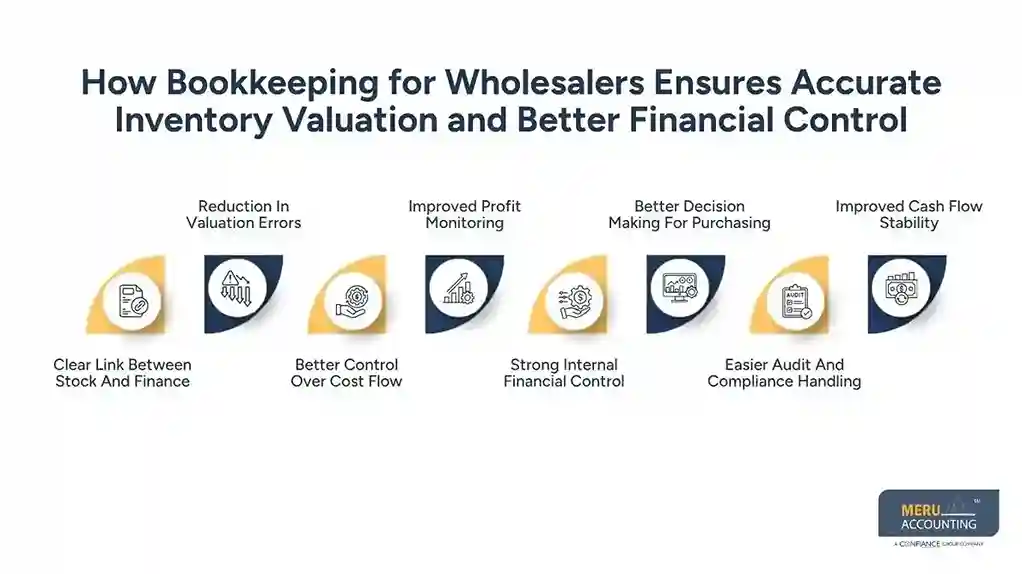
Strong Internal Financial Control
Proper systems create a structure where stock entries, invoice matching, and valuation checks remain consistent and reliable. It also reduces the chances of fraud, duplication, or missed entries in financial records.
Better Decision Making For Purchasing
Accurate records give clear data on which products move fast and which stay in stock longer. This helps wholesalers plan future purchases in a more balanced and cost-effective way, especially when supported by accounting services for wholesale businesses.
Easier Audit And Compliance Handling
With structured record-keeping, financial records stay organized and ready for audits at any time. This reduces stress during compliance checks and supports smoother reporting to tax authorities.
Improved Cash Flow Stability
Bookkeeping for wholesalers, often supported by accounting services for wholesale businesses, helps track how much money is tied up in inventory at any point in time. This makes it easier to manage working capital and avoid unnecessary cash shortages.
How Accounting Services For Wholesale Businesses Improve Inventory Control
Professional Record Management
Accounting services for wholesale businesses, along with bookkeeping for wholesalers, ensure structured and error-free financial records. These services bring discipline to inventory tracking.
Better Stock Accuracy Control
With structured accounting support, stock differences between the system and the warehouse are reduced, leading to more reliable inventory records. It also helps identify missing or excess stock at an early stage.
Cost Monitoring System
Accounting support tracks hidden costs like transport and storage, giving better clarity in valuation. This makes it easier to understand the true cost of each product.
Tax And Compliance Accuracy
Wholesale businesses must follow tax rules. Accounting services ensure compliance with financial regulations.
This also reduces the risk of penalties and filing errors.
Financial Reporting Quality
Reports prepared under professional accounting services give clearer insight into profit and loss trends. It also helps management make faster and more informed decisions.
Support For Inventory Valuation Methods
Different valuation methods require expert handling. Financial accounting solutions help apply FIFO, LIFO, or weighted methods correctly.
Case Insights: How Poor Bookkeeping Affects Wholesale Profitability
In many wholesale businesses, weak bookkeeping for wholesalers practices in stock purchases and sales leads to incorrect inventory valuation at month-end.
For example, when purchase invoices are not recorded on time or stock adjustments are missed, the recorded inventory value becomes higher or lower than the actual warehouse stock.
This creates confusion during financial closing and directly affects the cost of goods sold. As a result, profit figures become inaccurate, which can lead to wrong pricing decisions, poor margin control, and unclear understanding of real business performance.
How Meru Accounting Supports Wholesale Businesses With Better Financial Control
Meru Accounting provides structured financial solutions designed for wholesale operations that need accurate stock and cost tracking. Our team focuses on improving bookkeeping for wholesalers through clear systems that reduce errors in inventory valuation.
We also deliver expert accounting services for wholesale businesses that help businesses maintain clean financial records, improve reporting accuracy, and manage cost of goods sold with better clarity. By combining industry experience with structured processes, we help wholesalers reduce stock mismatches and improve financial control.
Our approach ensures that bookkeeping for wholesalers is aligned with real business operations, so every purchase, sale, and adjustment is recorded correctly. Along with this, our accounting services for wholesale businesses support compliance, audit preparation, and financial planning for long-term stability.
Key Takeaways
- Accurate inventory valuation depends on structured record-keeping
- Bookkeeping reduces errors in stock and cost tracking
- COGS accuracy improves profit clarity
- Wholesale businesses need consistent stock reconciliation
- Professional support improves financial control and reporting
FAQs
Bookkeeping records all purchases, sales, and stock movements in a structured way. This ensures inventory value is based on real data and not estimates.
Poor bookkeeping for wholesalers can lead to stock mismatches, wrong cost calculations, and incorrect profit reporting, which affect financial decisions and business stability.
Methods like FIFO, weighted average, and periodic tracking are commonly used. The best method depends on business size, product type, and sales pattern.
Records should ideally be updated daily or in real time to avoid gaps between physical stock and recorded inventory values.
Accounting services for wholesale businesses help maintain accurate stock records, reduce valuation errors, track costs properly, and ensure better financial reporting and compliance for wholesalers.