
Effective financial management is important for small business owners. While customer acquisition often takes precedence, precise bookkeeping practices are fundamental to sustained success. Whether a business is in its early stages or experiencing growth, implementing precise bookkeeping principles can significantly impact its trajectory. In this blog, we will understand the bookkeeping tips for small businesses that every business owner Should Know.
Strong bookkeeping for small businesses also supports accurate reporting, tax preparation, and better financial decisions. Adherence to these practices will enhance organizational efficiency, ensure compliance with financial regulations, and promote overall financial well-being.
For businesses aspiring to grow, applying practical bookkeeping tips for small businesses can help maintain accurate records and support better financial decisions.
What You Will Learn From This Blog
- Key Bookkeeping Tips for small businesses to establish an effective and organized bookkeeping system.
- Accurate recording of business income and expenses.
- Regular reconciliation of bank and credit card accounts.
- Proper management of invoices and outstanding payments.
- Better preparation for tax obligations and deadlines.
- Understanding financial statements and overall business performance.
- Identifying and avoiding common bookkeeping mistakes.
- Maintaining organized financial records and supporting documents.
- How to follow a simple monthly bookkeeping routine.
- When to consider professional bookkeeping support for your business.
What Is Small Business Bookkeeping?
Bookkeeping is the process of recording and organizing a business’s financial transactions. These transactions can include sales, purchases, expenses, payments, invoices, bank activity, and other financial movements.
Effective bookkeeping for small businesses provides a structured way to monitor these financial activities throughout the year. Simple bookkeeping tips for small businesses can further improve record accuracy and make financial reporting easier to manage.
How to Set Up Bookkeeping for a Small Business
Learning the bookkeeping basics for small business owners can help create a simple system that prevents many financial problems later. Start by establishing a process that makes every transaction easy to record, review, and verify.
1. Open Separate Business and Personal Accounts
One of the most useful bookkeeping tips for small businesses is to keep business and personal finances separate from the beginning. Mixing grocery purchases, personal transfers, or other private expenses with business transactions can make financial records difficult to understand.
Open a dedicated business bank account and consider using a separate business credit card. Pay business expenses from these accounts whenever possible.
Separate accounts can:
- Simplify reconciliation
- Improve expense tracking
- Make tax preparation easier
- Provide clearer financial reports
- Reduce bookkeeping errors
Separate financial accounts also make it easier to understand the actual financial performance of the business.
2. Choose Reliable Accounting Software
Manual bookkeeping can become difficult as transaction volume increases, making reliable accounting software one of the practical bookkeeping tips for small businesses worth considering. Accounting software can help organize income, expenses, invoices, payments, and financial reports in one place.
Popular options include QuickBooks, Xero, and Zoho Books. Choose software based on your transaction volume, reporting needs, integrations, and business requirements.
Useful features can include:
- Bank feeds
- Expense tracking
- Invoicing
- Payment tracking
- Bank reconciliation
- Financial reporting
- Recurring transactions
Software should reduce repetitive work while still allowing you to review transactions for accuracy. Choosing the right software is one of the practical Bookkeeping Tips for Small Business that can simplify daily financial tasks.
Key Bookkeeping Tips for Small Business Owners
Bookkeeping tips for small business owners are key to keeping everything running smoothly. Simple things like keeping your receipts organized, reconciling your accounts every month, and using the right software can make a big difference. These bookkeeping tips for small business owners will help you avoid costly mistakes and give you a clearer picture of your finances.
Separate your business and personal finances
One of the biggest mistakes business owners make is mixing personal amounts with business amounts. To avoid such mistakes, you should keep both accounts separate. You should also open a different and dedicated bank account for your business. Keeping accounts separate not only makes tax time easier but also builds credibility with banks and investors.
Keep financial records updated
Consistent record-keeping is an essential part of bookkeeping for small businesses, helping owners maintain accurate financial information throughout the year. Updating records daily or weekly prevents errors and end-of-period issues. Regular record-keeping simplifies income tracking, cash flow management, and accurate financial reporting, making it a powerful bookkeeping tip for small businesses.
Invest in reliable accounting software
Most of the business owner manage their books on their own, which sometimes causes errors that also affect business growth. To avoid such mistakes, business owners should use accounting software like Xero, Zoho Books, and QuickBooks.
Using reliable accounting software can simplify the entire financial process and is among the most useful bookkeeping tips for small business. These tools help in automating invoices, monitoring expenditures, generating financial reports, and reconciling bank statements effectively.
Track every expense
Lots of small business owners do not pay much attention to small costs because they think they don’t matter. But these small amounts can add up over time and can affect how much profit you make and what you can deduct on your taxes.
Keeping these records organized is an important part of bookkeeping for small businesses and can make expense reviews much easier.
Set aside money for taxes
Taxes can be a significant burden if you’re unprepared when the due date arrives.
Estimate your tax obligations based on your earnings and set aside a percentage each month.
This proactive approach avoids cash flow disruptions and late penalties during tax season.
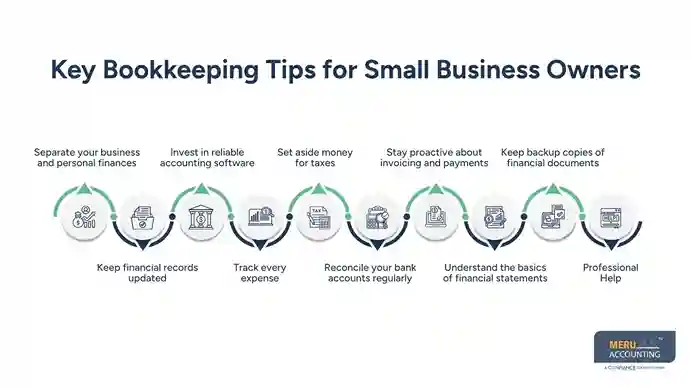
Reconcile your bank accounts regularly
Comparing bank statements to your records monthly is important and should be included among your essential bookkeeping tips for small businesses. It helps find errors and fraud early. This also makes sure your financial reports are correct.
Stay proactive about invoicing and payments
Bill customers promptly after providing services or goods to maintain consistent cash flow. Follow up politely on delayed payments. Efficient invoicing reduces unpaid balances and keeps your business running smoothly.
Understand the basics of financial statements
You should know about your finances even if you have an accountant. You should know the techniques to read and understand bank statements, balance sheets, and other cash flow statements. With this, you will come to know whether your business is on the right track for growth.
Keep backup copies of financial documents
Losing your money records can cause big problems with taxes or audits. Always keep copies of important papers like bills and bank statements, both on paper and on a computer. Using online storage or your accounting program can help keep these copies safe.
Professional Help
As your business grows and financial management becomes complex, engaging a professional bookkeeper or accountant is advisable. Their expertise ensures accuracy, frees up your time, and allows you to focus on core business operations. For sustained growth, this is a wise bookkeeping decision.
It’s one of the wisest bookkeeping tips for small business owners aiming for sustainable growth. Proper bookkeeping lays the foundation for financial success. That’s why every small business should prioritize it.
Why Bookkeeping Is Important for Small Businesses?
Understand Your Financial Story
- Following practical bookkeeping tips for small businesses can help you maintain accurate records and gain a clearer view of your financial health.
- Proper bookkeeping for small businesses helps track revenue, expenses, savings, and liabilities accurately.
Make Informed Business Decisions
- You should maintain all the records and statements in an organized form. This will let you know about your finances and also give you real-time insights to make good business decisions. This also helps in better planning, budgeting, and investment strategies.
Minimize Financial Risks
- Regular reviews are among the practical tips for small business bookkeeping that can help detect errors and reduce financial risks.
- It reduces the chances of missed payments, penalties, and cash flow issues.
Support Future Business Planning
- Applying effective bookkeeping tips for small businesses also helps create reliable financial records that support better planning and growth decisions.
- It empowers you to set achievable goals based on real performance metrics.
Ensure Smooth Audits and Compliance
- Consistent bookkeeping for small businesses keeps financial records organized, making audits and compliance reviews easier to manage.
- Good bookkeeping also helps you follow all the tax rules and other financial laws.
Improve Loan and Investment Opportunities
- If your money reports are easy to understand and correct, banks, investors, and lenders will trust you more. This can make it easier to get loans or find people to invest in your business.
Additional Bookkeeping Best Practices for Small Businesses
Once you understand the bookkeeping basics for small business owners, these additional practices can make your bookkeeping system even stronger.
Track Cash Transactions
Not every transaction may appear automatically through a bank feed, making accurate bookkeeping for small businesses important for tracking cash activity. Record cash sales, petty cash purchases, reimbursements, and other cash activity promptly.
Unrecorded cash transactions can create differences between your actual finances and accounting records.
Investigate Unusual Transactions
Do not categorize an unfamiliar transaction simply to finish your bookkeeping.
Check supporting documents when you notice:
- Unknown deposits
- Unexpected withdrawals
- Duplicate charges
- Unusual vendor payments
- Missing transactions
- Incorrect amounts
Investigating unusual activity early can prevent larger corrections later.
Maintain a Clear Audit Trail
Maintaining complete documentation is one of the essential bookkeeping tips for small business owners to include in their regular routine. Receipts, invoices, bills, contracts, and payment confirmations can help explain why a transaction was recorded.
A clear audit trail makes it easier to answer questions, prepare tax information, and review historical transactions.
Create a Small Business Budget
Reliable bookkeeping for small businesses provides the financial information needed to create a realistic budget. Estimate expected revenue and expenses, then compare actual results with your budget regularly.
Review areas such as:
- Sales
- Payroll
- Rent
- Software
- Inventory
- Marketing
- Utilities
- Loan payments
Regular budget reviews are among the practical tips for small business bookkeeping that can reveal overspending and potential cash shortages early.
Establish Simple Internal Controls
Basic financial controls should also be part of effective Bookkeeping Tips for Small Business owners to follow throughout the year. The goal is to reduce errors and limit opportunities for unauthorized transactions.
For example, avoid having one person responsible for recording transactions, approving payments, and reconciling accounts whenever possible.
Common Small Business Bookkeeping Mistakes to Avoid
Following practical bookkeeping tips for small business can help prevent these common errors and keep financial records accurate.
Mixing Personal and Business Expenses
Combining transactions makes financial reporting and tax preparation more difficult.
Waiting Until Tax Season
Trying to reconstruct months of transactions at once increases the chance of missing information.
Ignoring Unpaid Invoices
Revenue recorded on paper does not mean cash has been collected. Monitor overdue customer balances regularly.
Failing to Reconcile Accounts
Unreconciled accounts can contain missing, duplicate, or incorrectly recorded transactions, making regular reconciliation one of the most useful bookkeeping tips for small businesses.
Misclassifying Expenses
Accurate expense classification is a basic requirement of reliable bookkeeping for small businesses and supports clearer financial reporting.
Not Reviewing Financial Reports
Recording transactions without reviewing the results means missing valuable information about profitability and cash flow.
Failing to Back Up Records
Backing up financial records is another practical consideration when following bookkeeping tips for small businesses.
When Should a Small Business Hire a Professional Bookkeeper?
Handling bookkeeping internally can work when transaction volume is low, and the owner has enough time and knowledge. Professional support may become useful as the business becomes more complex, even when the owner already follows basic bookkeeping tips for small businesses.
Consider hiring a bookkeeper when:
- Transactions are increasing
- Books regularly fall behind
- Bank accounts are not reconciled
- Invoices remain unpaid
- Financial reports are difficult to understand
- Payroll becomes complicated
- Tax preparation takes too much time
- Business growth requires more owner attention
Outsourcing bookkeeping can allow owners to spend more time on customers, operations, sales, and business development while experienced professionals manage routine financial records.
Simple Monthly Bookkeeping Checklist
A consistent monthly routine makes bookkeeping for small businesses easier to manage and helps keep financial records current.
- Record all business transactions
- Categorize income and expenses
- Reconcile bank accounts
- Reconcile business credit cards
- Review outstanding invoices
- Review upcoming bills
- Save receipts and supporting documents
- Check for unusual transactions
- Review the Profit and Loss Statement
- Review the Balance Sheet
- Check cash flow
- Update the tax set-aside
Following these Bookkeeping Tips for Small Business consistently can prevent small bookkeeping issues from turning into larger problems.
At Meru Accounting, we provide professional bookkeeping support to help businesses maintain organized financial records and better manage their accounting processes. We offer expert bookkeeping help so businesses can stay organized and follow all the rules. When you follow these bookkeeping tips for small businesses, managing your finances becomes much easier and less stressful.
Our Expert Perspective
From our accounting perspective, effective bookkeeping is not only about recording transactions. Small businesses need a consistent process for reviewing financial information, reconciling accounts, monitoring outstanding payments, and keeping supporting documents organized. Regular bookkeeping gives owners reliable information for budgeting, tax planning, cash flow management, and business decisions. As transaction volume and financial responsibilities increase, professional bookkeeping support can also help maintain accuracy and allow owners to focus more on running and growing the business.
Key Takeaways
- Keep business and personal finances separate.
- Record transactions consistently and accurately.
- Use reliable accounting software for daily bookkeeping tasks.
- Track every business expense and retain supporting documents.
- Reconcile bank and credit card accounts regularly.
- Monitor unpaid invoices and outstanding customer balances.
- Set aside funds for expected tax obligations.
- Review financial statements to understand business performance.
- Maintain backups and a clear audit trail for financial records.
- Professional guidance can also help businesses apply bookkeeping tips for Small Business when financial tasks become more complex.