Selling a property for more than you paid for it sounds like a win—until the tax bill enters and does not tell you what you will owe. This is why how to avoid capital gains on real estate is important. A $200,000 profit does not always mean $200,000 is taxable, and the sale price alone is an important question to ask before a deal closes.
The answer depends on what you are selling, how you used it, how long you owned it, what you spent on major improvements, and what you plan to do with the sale proceeds. A homeowner may qualify for a home sale exclusion, while an investor may consider a 1031 exchange. Another seller may have capital losses that can offset gains.
The key is to plan before the sale is complete, not after the closing papers are signed.
What You Will Learn From This Blog
- How the main home exclusion can reduce taxable gain.
- When a 1031 exchange may defer gain on investment property.
- How improvements and selling costs affect your gain.
- How capital losses may offset certain gains.
- When an installment sale may spread gain across tax years.
- Why state tax rules deserve the same attention as federal rules.
How To Avoid Capital Gains On Real Estate Legally
Live In The Property And Meet The Primary Residence Exclusion Rules
If the property is your main home, start there. A qualifying seller may exclude up to $250,000 of gain, while some married couples filing jointly may exclude up to $500,000. This is often the first rule to review when considering how to avoid capital gains on real estate.
Use A 1031 Exchange For Qualifying Investment Properties
A rental property does not get the same treatment as a main home. However, a qualifying investment or business property may be exchanged for another qualifying property under Section 1031, which can defer the gain.
Consider Opportunity Zone Investments Where Applicable
Some gains may qualify for Opportunity Zone treatment when the required rules are met. It is not a simple way to avoid real estate capital gains tax, so the investment structure, dates, and current tax rules should be checked before funds are moved.
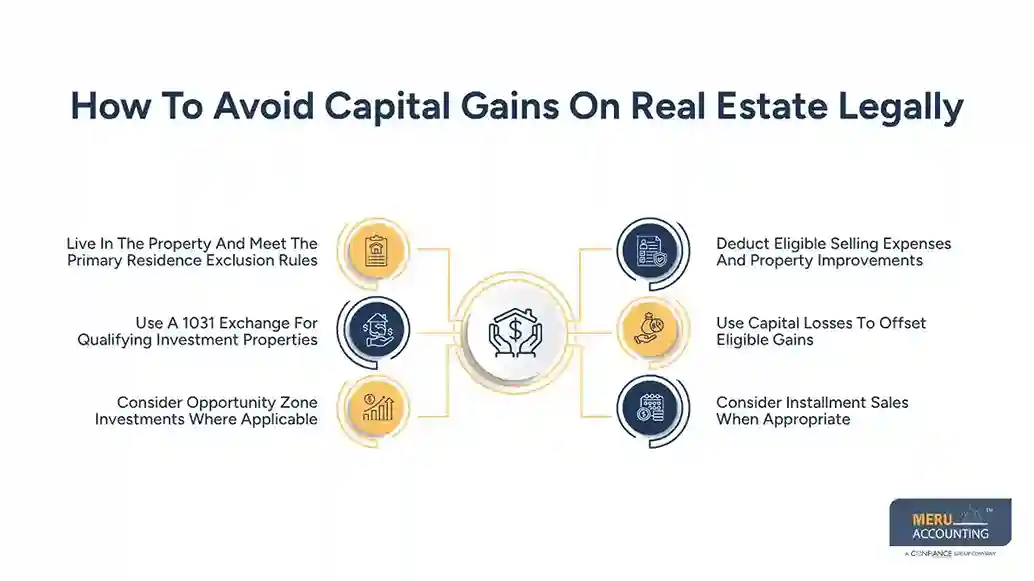
Deduct Eligible Selling Expenses And Property Improvements
The gain is not simply the sale price minus what you paid. Certain selling costs and major improvements can affect the calculation. A new roof or room addition, for example, may affect the basis in a way that routine repairs do not.
Use Capital Losses To Offset Eligible Gains
A property sale should be viewed with the rest of the year’s investments. Capital losses from other assets may offset eligible gains. If losses exceed gains, federal rules may also allow part of the remaining loss to reduce other income.
Consider Installment Sales When Appropriate
Receiving the full sale price in one year can create a large tax event. With a qualifying installment sale, part of the gain may be reported as payments are received in later years. The tax is delayed, not erased.
How The Primary Residence Exclusion Can Reduce Capital Gains
Ownership And Use Requirements
In most cases, the seller must have owned the home for at least two years and used it as a main home for at least two years during the five years before the sale. The two years do not have to be continuous.
$250,000 Exclusion For Single Taxpayers
A qualifying single taxpayer may exclude up to $250,000 of gain. For example, if the gain is $180,000 and the seller meets all requirements, the full gain may fall within the exclusion. This can be a major part of how to avoid capital gains on real estate on a main home.
$500,000 Exclusion For Married Couples Filing Jointly
Some married couples filing jointly may qualify for an exclusion of up to $500,000. Both spouses generally need to meet the use test, while ownership and prior exclusion rules also matter.
Situations That May Limit The Exclusion
The full exclusion is not automatic. A recent home-sale exclusion, certain periods of nonqualified use, or depreciation from rental or business use can affect the result. The property’s history should be checked before relying on the full amount.
Partial Exclusion May Be Available
What if you have not lived in the home for two full years? Certain job moves, health issues, and unforeseen events may allow a reduced exclusion. So, missing the full test does not always mean losing every tax benefit.
How A 1031 Exchange Can Help Avoid Real Estate Capital Gains Tax
What Qualifies For A 1031 Exchange
Section 1031 generally applies to real property held for investment or productive use in a trade or business. A rental building may qualify, while property held mainly for sale to customers generally does not.
Like-Kind Property Requirements
The replacement property does not have to look like the old property. Qualifying real estate can generally be exchanged for other qualifying real estate. The tax classification matters more than whether the buildings are similar.
45-Day Identification And 180-Day Completion Rules
Timing is critical. In a deferred exchange, the replacement property generally must be identified within 45 days after the old property is transferred and received within 180 days, subject to the applicable tax-return due-date rule.
Common 1031 Exchange Mistakes
A seller may focus on finding a replacement property and overlook the exchange process itself. Taking control of sale proceeds, missing the identification deadline, or choosing nonqualifying property can put the intended tax treatment at risk.
Tax Strategies For Investors Selling Rental And Investment Property
Review Adjusted Basis Before Listing
Before asking how to avoid capital gains on real estate, find out what the property’s adjusted basis is. Purchase cost, qualifying improvements, depreciation, and other adjustments can change the amount of gain.
Track Improvements With Proof
A folder of old invoices may seem unimportant until the property is sold. Receipts for a new roof, addition, HVAC system, or other major work can matter when basis is calculated. Keep those records with the property file.
Check Depreciation Recapture
Rental owners have another issue to review: depreciation. Depreciation claimed or allowed can affect the tax treatment when the property is sold. A seller should not estimate the tax from the sale price alone.
Time The Sale With Other Gains And Losses
A rental sale may be only one part of the year’s tax picture. Other capital gains and losses can change the final result. Reviewing them together is an important part of how to avoid capital gains on real estate legally.
Compare Sale, Exchange, And Hold Choices
Sometimes the best tax decision is not to sell right away. An owner can compare a direct sale with a 1031 exchange, installment sale, or continued ownership. Cash needs, debt, future plans, and tax cost should all be considered.
optional anymore
on running the business
How Federal And State Taxes Can Affect Your Real Estate Sale
Federal Capital Gain Rules
Federal tax depends on more than profit. Holding period, property use, adjusted basis, depreciation, taxable income, and available exclusions can all affect the final amount. Understanding how to avoid capital gains on real estate starts with identifying which federal tax rules, exclusions, and adjustments apply to the property.
State Income Tax
Federal planning does not end the analysis. A state may impose its own tax on the gain, and its rules may not match federal treatment. A strategy that can avoid real estate capital gains tax federally may still create state tax.
State Of Residence Matters
Your home state can matter even when the property is elsewhere. Someone living in one state and selling a rental in another may need to review rules in more than one jurisdiction.
Nonresident Property Sales
Some states impose filing or withholding rules when a nonresident sells property located there. The amount withheld at closing may not always be the final tax, but it can affect cash flow. This is another factor to consider when determining how to avoid capital gains on real estate, particularly when the property and seller are in different states.
Plan For The Full Tax Bill
A useful estimate should include federal tax, state tax, depreciation-related tax, selling costs, and other transaction items. Looking only at the federal gain can leave a seller with an incomplete picture.
Common Mistakes When Trying To Avoid Capital Gains On Real Estate
Waiting Until Closing To Plan
Some choices must be made before closing. A 1031 exchange is a clear example. Once the transaction is complete, certain planning options may no longer be available.
Confusing Tax Deferral With Tax Elimination
A 1031 exchange may defer gain rather than erase it. An installment sale may spread gain across several years. Knowing this difference is important when planning to avoid real estate capital gains tax.
Using The Home Exclusion For An Investment Property
The main home exclusion is not a general rental-property exemption. A property that was once a home and later became a rental needs a closer review of personal use, rental use, depreciation, and timing.
Ignoring Records And Basis
Missing records can lead to an incorrect gain. Purchase papers, improvement invoices, depreciation data, and closing statements should be kept together so the calculation can be backed by evidence.
Assuming Every State Follows Federal Rules
Federal and state tax rules can differ. Before choosing a strategy to avoid real estate capital gains tax, check the rules that apply to both the property and the seller.
How Meru Accounting Supports Real Estate Tax Planning
Tax-Ready Property Records
Meru Accounting provides accounting services that organize property income, costs, improvements, depreciation data, and transaction records for tax review.
Gain Review Before Sale
We provide accounting support for reviewing purchase data, adjusted basis, improvements, and eligible sale costs before the transaction closes.
Rental Property Tax Records
Meru Accounting provides accounting services for rental income, property costs, fixed assets, and depreciation records, giving tax professionals clear data for their review.
1031 Planning Records
Meru Accounting provides accounting support for the financial figures used in a 1031 review. The tax adviser and qualified intermediary handle the tax and exchange requirements.
Year-Round Tax Data
At Meru Accounting, we provide bookkeeping and accounting services that keep property records current. This means key figures are available when an owner starts planning a sale.
Our Expert Perspective
Selling real estate is not just about the price you receive at closing. The actual tax result can change based on the property’s adjusted basis, major improvements, depreciation, selling costs, past use, and whether the property was a main home or an investment.
For someone asking how to avoid capital gains on real estate, the right approach is to first understand the numbers and then match the property to the tax rule that may apply. In our view, tax planning should be part of the sale decision rather than an afterthought.
A homeowner may qualify for the primary residence exclusion, an investor may consider a 1031 exchange, and another seller may have capital losses or an installment sale to review. Clear property records and a review of federal and state rules can show which option fits the transaction before a choice is made.
Key Takeaways
- A qualifying homeowner may exclude up to $250,000 of gain, or up to $500,000 for some married couples.
- A 1031 exchange may defer gain on qualifying investment real estate.
- Improvements and eligible sale costs can affect taxable gain.
- Capital losses may offset eligible capital gains.
- An installment sale may spread qualifying gain over future years.
- State tax may differ from federal tax.
- Good records are essential when planning how to avoid capital gains on real estate.
- Tax planning should begin before the sale closes.
FAQs
You may exclude up to $250,000 of gain as a single taxpayer or up to $500,000 for certain married couples if you meet the IRS home-sale exclusion rules.
You generally must own and use the home as your main residence for at least two years during the five years before the sale to claim the full exclusion.
You may defer qualifying gain from a rental property through a properly structured 1031 exchange or reduce the gain by accounting for eligible basis adjustments and selling costs.
Reinvesting sale proceeds in another property does not automatically remove capital gains tax, but a qualifying 1031 exchange can defer gain on eligible investment real estate.
Eligible selling costs and qualifying capital improvements can increase adjusted basis or reduce the amount of gain subject to tax.
optional anymore
on running the business