
Buildium QuickBooks Integration is becoming an important setup for property managers who want clearer financial records and better control over daily accounting work.
Many property teams use Buildium for property operations and QuickBooks for accounting, but managing both without proper linking can create confusion in records.
Integration of Buildium and QuickBooks helps connect property data with accounting records so that income, expenses, and reports stay aligned. When done correctly, this integration reduces manual work and improves financial tracking for rental portfolios of all sizes.
In this guide, you will learn how Buildium QuickBooks Integration works, why it matters for property managers, common issues, and how expert support like outsource QuickBooks bookkeeping can improve results.
What You Will Learn From This Blog
- How Buildium and QuickBooks work together in property accounting
- Steps involved in Buildium QuickBooks Integration
- Benefits of using Buildium QuickBooks Integration for property managers
- Common errors and how to fix them
- How outsource QuickBooks bookkeeping supports better financial control
- Best practices for managing integrated accounting systems
- Real use cases and expert insights from property accounting work
Understanding Buildium And QuickBooks In Property Accounting Systems
Role Of Buildium In Property Management
Buildium is widely used for rent tracking, tenant management, and property operations. It helps managers record rent payments and handle maintenance costs. However, financial reporting is limited without accounting integration.
Role Of QuickBooks In Accounting Control
QuickBooks is a strong accounting system used for bookkeeping, financial reports, and tax records, and many businesses also rely on outsource quickbooks bookkeeping to manage it efficiently. It gives detailed financial statements but needs accurate input from property systems.
Why Integration Becomes Necessary
Buildium QuickBooks Integration ensures that property data flows into accounting records without manual entry. Without integration, managers may face duplicated entries and missing data. Outsourcing QuickBooks bookkeeping is often used to fix such issues.
Financial Data Flow Between Systems
With QuickBooks and Buildium Integration, rent payments, fees, and expenses move from Buildium to QuickBooks. This creates cleaner financial reports and reduces manual reconciliation work.
Importance For Property Managers
Property managers handling multiple units benefit from Buildium QuickBooks Integration because it reduces errors and improves reporting accuracy. It also supports faster month-end closing and better financial decision-making.
Strategic Overview Of Buildium QuickBooks Integration For Property Management Accounting
Setting Up Data Structure
A proper Buildium QuickBooks Integration starts with matching the chart of accounts between both systems.
Financial consistency improves when both platforms follow the same structure for income and expense tracking. Clear mapping of accounts also reduces confusion during reporting and reconciliation.
Syncing Income And Expense Records
Income from rent and service fees flows into QuickBooks through the integration of Buildium and QuickBooks, keeping records updated.
Regular syncing helps maintain accurate financial tracking. Outsource QuickBooks bookkeeping is often used alongside this process.
Automating Transaction Updates
Integration of Buildium and QuickBooks reduces manual posting by automatically syncing transactions from Buildium into accounting software.
Manual effort decreases significantly, allowing accounting teams to focus on review instead of data entry.
Improving Financial Reporting Accuracy
Reports generated after the integration of Buildium and QuickBooks give a clearer picture of profit, expenses, and cash flow.
Stronger reporting helps property managers understand financial performance with greater clarity.
Supporting Multi-Property Management
For managers handling several buildings, the integration of Buildium and QuickBooks provides structured financial data across all properties.
Separate tracking for each property becomes easier, even when portfolios grow in size.
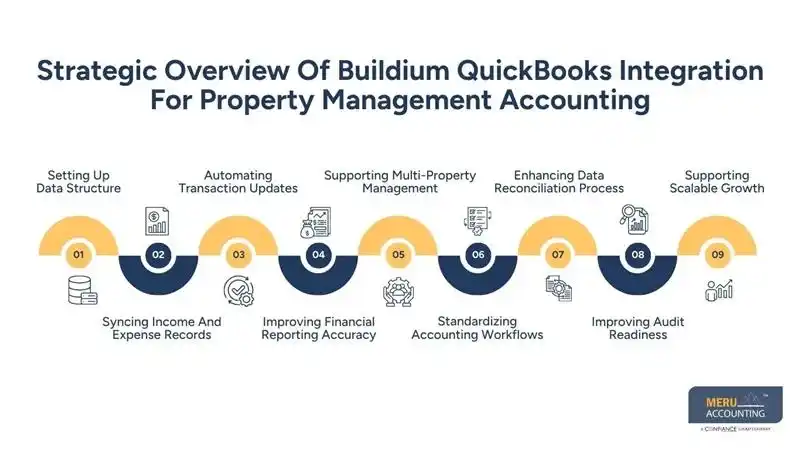
Standardizing Accounting Workflows
Integration of Buildium and QuickBooks helps create a consistent process for recording and reviewing financial data.
Standard processes reduce errors when multiple staff members manage accounting tasks.
Enhancing Data Reconciliation Process
Buildium QuickBooks Integration simplifies reconciliation between bank statements and accounting records.
Fewer mismatches appear when data flows regularly between both systems.
Improving Audit Readiness
Integration of Buildium and QuickBooks ensures financial records remain organized and traceable for audit requirements.
Well-structured data reduces stress during financial reviews or audits.
Supporting Scalable Growth
Integration of Buildium and QuickBooks allows financial systems to handle increasing transaction volumes as property portfolios expand.
Growth becomes easier to manage without losing control over accounting accuracy.
Business Advantages Of Buildium QuickBooks Integration
- Buildium QuickBooks Integration helps property managers track money flow with more clarity and fewer errors.
- Reduced manual entry when the integration of Buildium and QuickBooks is properly set up, saving time for accounting teams.
- Clear reports from the integration of Buildium and QuickBooks help managers plan budgets and investments better.
- With accurate records from the integration of Buildium and QuickBooks, tax filing becomes more organized and less stressful.
- As property portfolios grow, the integration of Buildium and QuickBooks supports higher transaction volumes without confusion.
Common Challenges In Buildium QuickBooks Integration And Solutions
- One common issue in integration of Buildium and QuickBooks is mismatched records between systems. Proper mapping solves this.
- Without a correct setup, the integration of Buildium and QuickBooks may create duplicate entries that need manual correction.
- Sometimes updates in Buildium take time to reflect in QuickBooks during the integration of Buildium and QuickBooks
- Wrong mapping in the Buildium QuickBooks Integration can lead to inaccurate financial reports.
- Many managers struggle with the initial setup. Outsource Quickbooks bookkeeping is often used for implementation support.
Understanding Data Flow in Buildium QuickBooks Integration
Rent Collection Data Flow
Rent collected in Buildium moves into QuickBooks as income entries. Each transaction includes tenant details, lease information, and payment method for accurate tracking.
Expense Tracking Flow
Maintenance and vendor expenses are transferred into accounting records. Proper categorization helps in monitoring property-wise costs and controlling unnecessary spending.
Owner Payment Records
Payments made to property owners are recorded properly in QuickBooks. Accurate records help in tracking distributions and maintaining clear financial statements for each owner.
Security Deposit Handling
Deposits are tracked separately to ensure proper reporting and compliance. Separate classification helps maintain correct liability balances and supports smooth refund processing.
Reporting And Closing Flow
Data from both systems helps in preparing monthly and yearly financial reports. Organized records support faster closing and reduce delays during financial review.
Fee And Charge Tracking Flow
Late fees, service charges, and other income are transferred into QuickBooks. Clear tracking ensures that all additional income sources are recorded without missing entries.
Role of Outsource QuickBooks Bookkeeping in Property Accounting
Support For Integration Setup
Outsource QuickBooks bookkeeping to help businesses correctly set up Buildium QuickBooks Integration without errors.
Proper setup reduces the chances of issues in financial syncing from the beginning.
Regular Record Management
With quickBooks bookkeeping outsourcing services, financial records stay updated after integration of Buildium and QuickBooks is completed.
Continuous updates help maintain accurate books across all property transactions.
Error Reduction In Accounting
Professional teams reduce mistakes in Buildium QuickBooks Integration by reviewing all transactions carefully.
Regular checks help identify and fix discrepancies before they impact reports.
Better Financial Reporting
QuickBooks bookkeeping outsourcing services ensure that reports generated after the integration of Buildium and QuickBooks are accurate and clear.
Reliable reporting supports better financial understanding for property managers.
Time Savings For Property Managers
Using outsource QuickBooks bookkeeping allows managers to focus on property operations instead of accounting tasks linked with Buildium QuickBooks Integration.
Reduced workload helps improve operational efficiency and decision-making speed.
Best Practices For Managing Integrated Accounting Systems
- A consistent structure ensures integration of Buildium and QuickBooks works without confusion.
- Monthly checks help maintain accuracy in Buildium QuickBooks Integration records.
- Manual changes can break Buildium QuickBooks Integration accuracy and should be minimized.
- Expert help improves the long-term results of the integration of Buildium and QuickBooks.
- Both Buildium and QuickBooks updates should be tracked to maintain a smooth the integration of Buildium and QuickBooks
Why Choose Meru Accounting?
Meru Accounting provides structured services for property managers who need reliable financial systems. Our team works closely on the integration between Buildium and QuickBooks to ensure clean data flow between property and accounting platforms.
We also provide outsource QuickBooks bookkeeping services that help clients maintain accurate records after the integration. Our experts handle setup, mapping, reconciliation, and reporting so property managers can focus on operations instead of accounting issues.
With experience in property accounting, Meru Accounting reduces errors in Buildium QuickBooks Integration and improves financial clarity for rental businesses.
Our Expert Perspective
From our experience working with property accounting systems, most challenges in Buildium QuickBooks Integration arise not from the tools themselves, but from inconsistent setup and weak financial mapping. When the integration is structured correctly from the beginning, it significantly reduces reconciliation issues and month-end delays. Consistent monitoring and professional oversight ensure that the system continues to deliver accurate and reliable financial insights over time.
Key Takeaways
- Buildium and QuickBooks work better when properly connected
- Buildium QuickBooks Integration reduces manual accounting work
- Property managers gain clearer financial reports
- Errors can happen without a correct setup or mapping
- Outsource QuickBooks bookkeeping improves accuracy and saves time
- Professional support helps maintain long-term accounting control
- Integration is useful for both small and large property portfolios
FAQs
It is the process of connecting Buildium with QuickBooks so financial data can move between property management and accounting systems.
It helps reduce manual work, improves accuracy, and gives better financial reports for property managers.
Yes, but it can be complex. Many managers prefer expert help or outsource QuickBooks bookkeeping services.
Common issues include duplicate entries, sync delays, and incorrect account mapping.
It ensures that Buildium QuickBooks Integration is set up correctly and keeps financial records accurate over time.