
Paying real estate taxes is a common cost for U.S. homeowners, landlords, and real estate investors. But can you write off Real Estate taxes on your federal tax return? In many cases, yes, but the rules depend on how you use the property, how the tax is paid, and whether the deduction falls under the state and local tax (SALT) limit.
A personal home, rental property, and business property do not always get the same tax treatment. Knowing the rules can help you claim a valid deduction while avoiding errors that may lead to tax issues.
What You Will Learn From This Blog
- When can you write off Real Estate taxes on a federal return?
- How the real estate tax deduction works for a primary home
- How the property tax write off works for rental property
- The current SALT deduction limit and how it affects property taxes
- Which real estate tax charges may not be deductible
- What records you should keep for your deduction
Can You Write Off Real Estate Taxes?
Yes, you can write off Real Estate taxes in many cases, but the answer depends on the type of property and how you use it.
For a personal home, real estate taxes can generally be claimed as an itemized deduction on Schedule A if the taxes meet IRS rules. You must also consider the SALT limit, which applies to the total of certain state and local taxes.
For rental property, property taxes are generally treated as an expense tied to the rental activity. This is different from the treatment of taxes on a personal home. The IRS provides separate rules for residential rental property, so landlords should not treat every property tax payment in the same way.
If you own property for a business, the tax treatment can also differ. Business use may allow the tax to be treated as a business expense rather than as a personal itemized deduction.
So, can you write off Real Estate taxes? The key is to first identify what property you own, how you use it, and what type of tax you paid.
How Does the Real Estate Tax Deduction Work?
A real estate tax deduction is not the same as getting a refund for the full amount of tax you paid. A deduction lowers the income that is subject to tax.
For a personal residence, the IRS generally allows a deduction for state and local real estate taxes that are imposed on you and paid to the taxing authority. If your mortgage lender collects money in an escrow account, you can deduct the taxes the lender actually paid to the taxing authority, not simply every dollar placed into escrow.
This is an important point when asking, can you write off Real Estate taxes paid through a mortgage? You may be able to, but you need to check the amount that was actually paid for property taxes during the tax year.
The tax must also qualify as a real property tax. Some charges shown on a tax bill are fees for services rather than taxes. For example, charges for water use, trash service, or a specific service may not qualify as deductible real estate taxes.
A special assessment can also have a different tax treatment. An assessment used to add value to a property, such as one for a new sidewalk or similar improvement, may need to be added to the property’s basis rather than deducted as a current expense.
optional anymore
on running the business
What Is the Property Tax Write-Off Limit?
The biggest limit for many homeowners is the SALT deduction limit.
For 2025, the overall federal limit for state and local income, sales, and property taxes is $40,000, or $20,000 for married taxpayers filing separately. The limit can be reduced for taxpayers with higher modified adjusted gross income.
For 2026, the limit is $40,400, or $20,200 for married taxpayers filing separately. The IRS states that the limit is reduced when modified adjusted gross income is above $505,000, or $252,500 for married taxpayers filing separately, but the limit will not fall below $10,000, or $5,000 for those filing separately.
This limit covers more than property tax alone. It can include state and local income taxes or sales taxes, as well as real estate and certain personal property taxes.
For example, suppose you have $25,000 in state income tax and $20,000 in real estate tax in 2026. Your total covered SALT amount would be $45,000 before applying the federal limit. You could not simply claim the full $20,000 property tax amount on Schedule A without considering the other taxes and the applicable limit.
This is why a property tax write off can be lower than the amount shown on your property tax bill.
Business and rental property rules can be different, so the SALT limit should not be applied in the same way to every property-related tax expense.
Can You Write Off Real Estate Taxes on Your Primary Home?
Yes, can you write off Real Estate taxes on your main home if you meet the rules for an itemized deduction.
The IRS says homeowners who itemize can generally deduct qualifying state and local real estate taxes paid during the year. The deduction is reported on Schedule A.
But itemizing matters. If you take the standard deduction instead, you generally do not claim your personal real estate taxes as a separate itemized deduction.
This means homeowners should compare their total eligible itemized deductions with the standard deduction before deciding which method gives them the better tax result.
The timing of payment also matters. If you bought a home during the year, the real estate taxes may be split between the buyer and seller at closing. Your share may qualify for a deduction, while certain amounts paid for the seller’s earlier tax period may instead affect the property’s basis.
So, can you write off Real Estate taxes when you buy a home? You may be able to deduct your share, but you should review the closing statement and tax records to see which amount belongs to your ownership period.
Also remember that homeowners association fees, service charges, and some local assessments are not treated as deductible real estate taxes.
Can You Write Off Real Estate Taxes on a Rental Property?
Yes, rental property owners can often deduct property taxes tied to their rental activity.
This is one of the main areas where a property tax write off works differently from a personal home deduction. Rental property expenses are generally tied to the cost of producing rental income, subject to the tax rules that apply to the activity.
The IRS’s rental property guidance covers property taxes along with other rental costs and reporting rules.
For example, imagine you own a rental home and pay $8,000 in property taxes during the year. If the property is fully used as a rental and the expense qualifies, that tax may generally be treated as a rental expense.
But mixed use can change the result. If you rent out a vacation home for part of the year and use it personally for part of the year, special allocation rules may apply.
This is why can you write off Real Estate taxes is not a simple yes-or-no question for every rental owner. The answer can depend on rental use, personal use, the type of property, and how the expense is reported.
Landlords should also keep records that connect the tax payment to the correct property. This is especially useful when an owner has several rentals, different tax bills, or properties held through different entities.
Meru Accounting's Real Estate Accounting Services
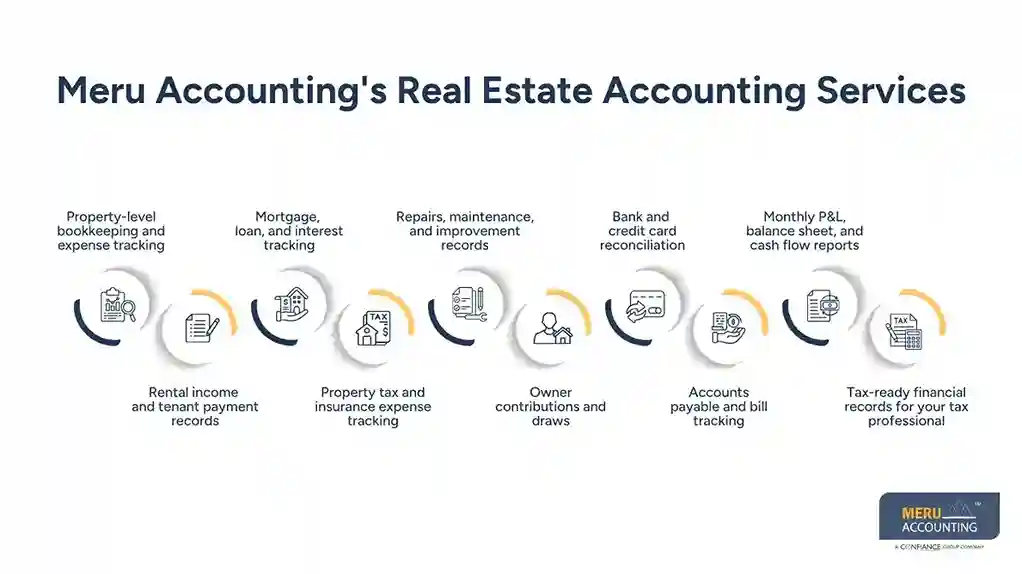
Real estate books can get hard to manage when an owner has more than one property, separate bank accounts, rental income, loan payments, repairs, and property-level costs. The goal is not just to record transactions. Each cost needs to be tied to the right property and account so the books give a clear view of how each property is doing.
At Meru Accounting, we help real estate owners keep their books organized around how their properties actually operate. Our team can track rental income, property taxes, mortgage payments, repairs, insurance, management fees, and other costs while keeping records separate for each property.
Our real estate accounting services can include:
- Property-level bookkeeping and expense tracking
- Rental income and tenant payment records
- Mortgage, loan, and interest tracking
- Property tax and insurance expense tracking
- Repairs, maintenance, and improvement records
- Owner contributions and draws
- Bank and credit card reconciliation
- Accounts payable and bill tracking
- Monthly P&L, balance sheet, and cash flow reports
- Tax-ready financial records for your tax professional
For investors with several properties, this structure can also make it easier to compare income, costs, and profit across properties. It gives owners and their tax professionals a cleaner set of books to review at year-end.
Our Expert Insight
One area we pay close attention to in real estate books is how transactions are classified. A mortgage payment, for example, should be split between principal and interest. Repairs should also be kept separate from property improvements, and owner transfers should not be recorded as income or expenses.
For investors with multiple properties, we recommend tracking income and expenses by property. This makes it easier to see the actual performance of each property and gives the tax professional cleaner records at year-end.
The goal is not just to keep the books balanced. It is to make sure each transaction is recorded in the right account and tied to the right property.
Key Takeaways
- Can you write off Real Estate taxes? In many cases, yes, but the rules depend on property use and tax type.
- Personal home real estate taxes are generally an itemized deduction subject to the SALT limit.
- Rental property taxes are generally handled as rental expenses when they qualify.
- Business property may have different deduction rules.
- The 2026 SALT limit is $40,400 for most taxpayers and $20,200 for married taxpayers filing separately, subject to income-based limits.
- Not every charge on a property tax bill is a deductible real estate tax.
- Keep tax bills, escrow records, closing statements, and property-level books to support your deduction.
FAQs
Yes. If you bought or sold a home during the year, the qualifying tax amount may be divided between the buyer and seller based on the closing records.
Keep your property tax bill, payment records, escrow statement, and closing documents. These records help support the amount reported on your tax return.
It depends on how you use and hold the property. A vacant rental, investment property, and personal property can have different tax treatment.
Some assessments for local improvements may be added to the property’s basis instead of deducted as a current expense.
- Can you deduct property taxes on multiple properties?
Potentially, yes, but the rules depend on how each property is used. Keep separate records so the taxes and other expenses can be tied to the correct property.
optional anymore
on running the business