
A $2 million property can look like a strong deal on paper. The rent is high. The seller shows a good cap rate. The area has seen rising prices. The projected cash flow looks enough to cover the loan. But what if insurance costs rise by $20,000 a year? What if the roof needs $100,000 in work? What if the loan takes more cash each month than the first model showed? And what happens to the tax result when the property is sold after years of depreciation? This is why a CPA for real estate investors looks at more than the price on the purchase offer.
The real question is not only whether the property can make money. It is whether the deal makes sense after income, costs, debt, capital needs, tax basis, and the planned exit are all put into the same view.
The same test applies at the end of the hold period. An investor may buy a property for $2 million and sell it for $2.7 million. That $700,000 gap may look like a clear gain, but it is not the full answer.
Selling costs, debt payoff, adjusted basis, depreciation, and other items can change the final result, which is why a real estate tax CPA may review the sale calculation before the investor focuses on the headline gain. The IRS states that gain or loss on a sale is generally based on the difference between the amount realized and the adjusted basis.
What You Will Learn From This Blog
- How a CPA for real estate investors reviews a property before purchase.
- Which income and cost figures matter when testing a rental deal.
- How debt changes the cash return from a property.
- Why adjusted basis matters when an investment property is sold.
- How a real estate tax CPA can review tax items tied to the property.
- Why the expected sale result should be considered before the property is bought.
Importance Of Financial Analysis Before And After The Real Estate Deal
A Deal Can Look Better Than It Really Is
Suppose a property earns $240,000 in gross rent each year. That number alone says very little.
The property may also have $85,000 in operating costs, $25,000 in vacancy and credit loss, and $90,000 in yearly debt service. Once those figures are placed in the same model, the cash result may look very different from the first sales pitch.
The Purchase Price Sets The Starting Point
Price affects the amount of cash the investor needs and the return that can be earned from the property.
A CPA for real estate investors can review the purchase price along with closing costs and other acquisition items. Some buying costs may become part of the property’s tax basis rather than being treated as a current expense.
The Hold Period Changes The Numbers
A five-year hold can bring changes that were not clear on day one. Rent may rise, but so may taxes, insurance, repairs, and management costs. A good model should be checked against actual results as the property is held.
The Exit Can Change The Whole Return
An investor can have strong yearly cash flow and still face a weaker total return if the sale price is below the expected level.
That is why disposition planning should not begin a few weeks before listing. The expected exit should be part of the investment plan from the start.
Tax Results Need Their Own Review
Rental property tax treatment can include income, expenses, depreciation, basis changes, and gain on sale. IRS guidance states that depreciation is used to recover the cost of income-producing property and that depreciation reduces basis for a later sale.
What Does A CPA For Real Estate Investors Do In Acquisition Analysis?
Reviewing The Property’s Financial History
The seller’s forecast is only one source of data. A CPA for real estate investors can review rent rolls, prior income statements, bank records, tax records, repair bills, utility costs, and other source records. This can show whether the forecast is close to the property’s past results.
Analyzing Purchase Price And Acquisition Costs
A $1.5 million purchase does not always mean a $1.5 million investment. Inspection fees, legal costs, title work, recording charges, transfer taxes, lender fees, and other costs may add to the cash needed at closing.
Some costs may also affect tax basis, based on their nature. A real estate tax CPA can classify these acquisition costs correctly and assess which amounts may affect the property’s tax basis.
Evaluating Projected Rental Income And Operating Expenses
Rent should be tested, not simply accepted. The review can compare current leases with market rent, vacancy, concessions, bad debt, management fees, insurance, repairs, taxes, utilities, and other property costs. A small change in these figures can have a large effect on NOI.
Reviewing Financing Terms And Debt Service
Two investors can buy the same property at the same price and get very different cash results.
The reason may be the loan. Rate, term, down payment, amortization, lender fees, and debt service all affect the cash left after financing. A CPA for real estate investors can place the debt schedule beside the operating forecast to show the actual cash burden.
Identifying Tax Considerations Before Closing
Tax review is not just about filing the return after the purchase. A real estate tax CPA can review how the property may be treated for tax purposes, how certain costs may affect basis, and how depreciation may enter the long-term model. The IRS notes that rental expenses and depreciation are subject to specific rules and record-keeping needs.
How A CPA For Real Estate Investors Evaluates A Property Acquisition
Gross Rental Income And Effective Income
A real estate tax CPA may first review gross rent as an indicator of the property’s earning potential. But an investor does not collect every dollar shown on a rent schedule. Vacancy, unpaid rent, concessions, and other income losses can lower the amount that actually reaches the property books.
Operating Expenses And Net Operating Income
NOI gives a clearer view of property performance before financing and income tax.
For example, if effective income is $250,000 and operating costs are $100,000, NOI is $150,000. If the purchase price is $2 million, the simple cap rate is 7.5%.
That figure can then be tested against debt, reserves, and the investor’s return target.
Cash Flow After Debt Service
NOI is not the same as cash flow. If the property produces $150,000 of NOI but annual debt service is $105,000, only $45,000 remains before other cash needs and tax effects. This is why a CPA for real estate investors should review the loan along with the property forecast.
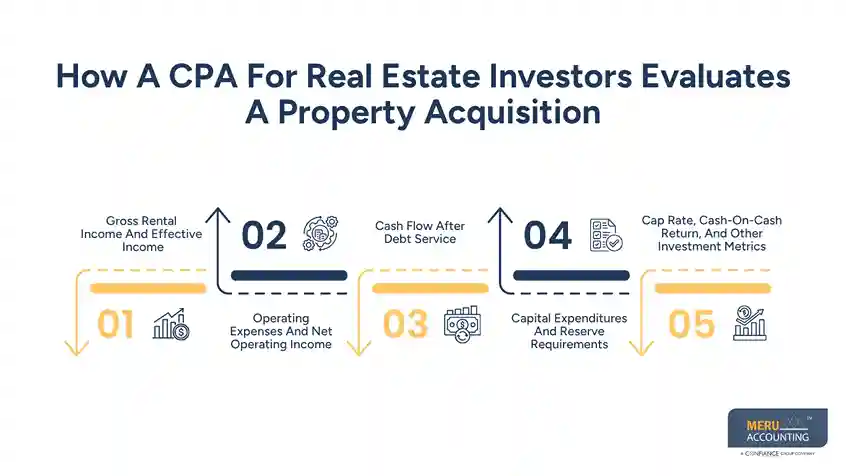
Capital Expenditures And Reserve Requirements
A real estate tax CPA may also consider major capital needs when reviewing the property’s cash flow.
Roof replacement, HVAC systems, elevators, plumbing, parking areas, and other long-life assets can create large cash needs. A useful acquisition model should set aside funds for such needs rather than treat all operating cash as available profit.
Cap Rate, Cash-On-Cash Return, And Other Investment Metrics
No single metric tells the full story. Cap rate can show the relationship between NOI and property value. Cash-on-cash return focuses on cash flow compared with the investor’s cash invested. Debt-service coverage can show how much room exists between property income and loan payments.
An experienced CPA for real estate investors can review these measures together rather than treating one ratio as the final answer.
optional anymore
on running the business
How A CPA For Real Estate Investors Supports Disposition Analysis
Determining The Property’s Financial Position Before Sale
Before a property goes to market, the investor should know more than its expected sale price.
The current loan balance, recent income, operating costs, repair needs, and expected selling costs all matter. A CPA for real estate investors can bring these figures together before the asking price is set.
Reviewing Adjusted Tax Basis
This is where a real estate tax CPA may review records from the purchase and hold period.
The IRS states that adjusted basis can increase through certain improvements and decrease through items such as depreciation and casualty losses. That adjusted basis is then used in determining gain or loss on sale.
Estimating Selling Costs And Net Proceeds
A $2.5 million sale does not mean the investor receives $2.5 million.
Broker fees, legal charges, transfer costs, repairs made before closing, loan payoff, and other sale items can reduce the amount that reaches the owner.
A CPA for real estate investors can review these projected selling costs and estimate the net proceeds before the transaction closes.
Calculating Potential Taxable Gain
Consider a simplified case. An investor buys a property for $1.5 million. After qualifying improvements and other adjustments, the basis changes over time. Depreciation also reduces basis. If the property later sells for $2.2 million, the tax analysis cannot simply use the original $1.5 million purchase price.
A real estate tax CPA can review the adjusted basis and amount realized to assess the potential gain. The IRS uses adjusted basis and amount realized as the core figures in calculating gain or loss.
Comparing Expected Sale Proceeds With Investment Objectives
A sale should answer a bigger question: did the investment meet its goal?
The investor may want a certain cash return, a target hold period, debt reduction, or funds for the next purchase. A CPA for real estate investors can compare the expected exit result with the original investment model and actual performance.
Acquisition Vs. Disposition: Key Financial Metrics A CPA Reviews
Financial Metric | Acquisition Review | Disposition Review |
Property Price | Tests the entry cost | Tests the expected exit value |
Rental Income | Measures earning potential | Shows current income strength |
Operating Costs | Builds NOI | Shows current cost burden |
Debt Service | Tests cash flow after financing | Determines loan payoff |
Capital Costs | Plans for future cash needs | Reviews work needed before sale |
Adjusted Basis | Starts the tax record | Helps calculate gain or loss |
Selling Costs | Usually estimated for the future | Used to estimate net proceeds |
Cash Return | Tests the expected investment return | Measures the actual exit result |
The key is to read these figures as a chain.
Purchase price affects the amount invested. Financing affects monthly cash flow. Improvements can affect basis. Depreciation can reduce basis. The final sale then brings the full record together.
This is why acquisition analysis and disposition analysis should not sit in two separate files with no link between them.
Why Investors Choose Meru Accounting
Clear Property-Level Records
Meru Accounting provides accounting and bookkeeping services for real estate investors. Property-level records can be organized so a CPA for real estate investors can review income, costs, assets, liabilities, and other transactions more easily.
Clean Income And Expense Data
Rental income and property costs need clear classification. Meru Accounting provides bookkeeping services that record these transactions in a structured manner for ongoing financial review.
Records For CPA Review
A CPA for real estate investors may need purchase records, improvement costs, loan data, depreciation records, and sale documents. Meru Accounting provides accounting records that can be used as a base for that review.
Acquisition And Disposition Records
The same property may stay on the books for years before it is sold. Keeping purchase costs, capital improvements, loan activity, and other records in order can make later analysis more useful.
Reporting For Real Estate Investors
Meru Accounting provides accounting and bookkeeping services for real estate investors and real estate businesses. Clear reports can give investors a better view of income, expenses, cash flow, assets, and liabilities during the hold period.
Our Expert Perspective
The best property analysis is not the one with the most figures. It is the one that makes the important figures easy to understand.
In our view, an investor should be able to trace the deal from purchase price to cash flow and then from cash flow to the final sale. If the records do not connect, the return shown on paper may not tell the full story.
A CPA for real estate investors can review the tax and financial side of the transaction, while sound bookkeeping gives that review a clean base. For investors with more than one property, keeping each asset’s income, costs, improvements, debt, and sale records distinct can make the full portfolio much easier to assess.
Key Takeaways
- A CPA for real estate investors can review a property before the investor commits capital.
- Acquisition analysis should test rent, vacancy, costs, debt, capital needs, and tax items.
- NOI shows property income after operating costs but before debt service.
- Cash flow after debt service gives a better view of the cash left from the property.
- Major repairs and capital costs should be included in the investment model.
- A real estate tax CPA can review depreciation, basis, and other tax items tied to the property.
- Adjusted basis matters when working out gain or loss at sale.
- Selling costs and loan payoff can reduce the cash received from a sale.
- Acquisition and disposition analysis should be linked from the start of the investment.
- Accurate accounting records make it easier to compare the original plan with the final result.
FAQs
A CPA for real estate investors reviews income, expenses, debt, purchase costs, cash flow, return metrics, and tax factors before the purchase.
A CPA for real estate investors compares rental income, operating costs, NOI, debt service, capital needs, and expected investment returns.
A CPA for real estate investors reviews the sale price, selling costs, loan payoff, adjusted basis, potential gain, and expected net proceeds.
A real estate tax CPA reviews adjusted basis, depreciation, selling costs, and potential taxable gain from the property sale.
Adjusted basis is important because it is generally used with the amount realized to determine gain or loss on a property sale.
optional anymore
on running the business